Feeds:
Posts
Comments

I love the city during this past Easter weekend.  A big part of the population was gone vacationing somewhere and what’s left was an adorable quiet city at a much slower pace everywhere.  Add on the light spring breeze and a hint of sunshine, I am falling in love with Hong Kong all over again.

On Friday I picked a normally bustling Starbucks in Central and found that the place was completely deserted, at 1pm in the afternoon.  I almost cried out for joy.  I picked up my usual venti cappuccino, grabbed all the male fashion magazines I could find, and picked the best sofa to lounge myself away.  Half hour later, an Indian fellow wearing a white shirt, a big gold pendant around his neck, and khaki pants (I believe) walked by where I was sitting with a big smile and saying “Congratulations my friend.”   Normally if I were on the streets, I would have headed off without a doubt.  But I was trapped.  There was nowhere for me to run and I kind of hesitated to get out of my heavenly seat.  Plus, I was in a public place with witnesses.  I took a mental note of where my belongings were and got myself prepared for the worst.

“Pardon me?” I asked.

“My friend, I just want to congratulate you today.  You are a lucky man.” “May I sit down?” He pointed to the seat next to me and invited himself to sit down.

“Errr….I guess.”  I reluctantly replied.  You get the drift of what happened next.  He then went on saying that he was from Singapore, showed me a picture of his “master” from his filofax, and told me 3 great things will be heading my way in May.  My work is going to be much better, my love life is going to be eventful with multiple people loving me (I can’t help giggling even when I’m writing this now), and I’m going to make a lot more money.  He gave me a small crumpled-up yellow paper knot, told me to hold on to it while asking me how many siblings I have in my family, and my favorite color.  After he wrote down what I said, he asked me to unroll the crumpled yellow paper to reveal exactly the same answers I provided to him.  To be honest, I wasn’t really that surprised at all, perhaps due to the all-too-predictable setup.

I wonder how he was going to wrap this up.  He opened his filofax, asked me to return the yellow piece of paper with his predicted answers in it, and said “If you could put in some money for your good luck.”  Alright, the secrets of the trick were finally revealed.   “$100 or $200 would be enough,” he said.  No to hell would I give him $100, but I was prepared to reward him with something for the time and entertainment he had provided.  “You have $30 more?”  He asked seeing the $20 note I was putting in.  I gave him my biggest and brightest smile with a no, and I thanked him for the 10 minute spectacle.

After this self-proclaimed psychic walked out, a tall caucasian man sitting opposite me approached.  I almost thought there was part 2.  “Hey I am just curious to find out what he said,” the man shared.  “I ran into someone similar somewhere before and he could name my dog’s name.  I felt that was spooky then.  And by the way you seem totally calm and in control of the whole thing.”  I replied saying that I just found the whole encounter entertaining.

It was surely unanticipated entertainment of an otherwise quiet Good Friday.  My friends are amazed with how generous I was with a scam artist, but I really had nowhere to run at the time.  Plus I know I am a rational minded person and I made a quick assessment of the worst case scenario right when he started to sit down.  I seriously paid little attention to his predictions at all, but as I told my friends, 3 great things coming my way are way better than him telling me I have only one month to live.

Guess I see a silver lining to everything, huh?

 

I went to a primary/secondary school that is heavily focused on musical extra-curricular activities.  Every year the school makes sure it is sending its finest team of orchestra players and choir teams to the annual inter-school music competition in Hong Kong.  I am quite sure that the music teachers are all measured in how many trophies they can get every year, very much like the sports trophies some other schools are focused upon.  Then it slowly branches out to other elements of the arts.  Our English teachers start to pull students to participate in prose reading competitions, as well as an intensively trained debating team.


With that widespread competitive spirit all over the school, my school days have never been left hollow.  I would be finishing my lunch box within 15 minutes and then ran to rehearse for the choir almost 3 days a week, all through the rest of the lunch hour.  Orchestra rehearsals were much longer and hence started right after school ends.  Even on long school break holidays during winter, chinese new year or summer, you would easily see a team of 50 to 60 students heading to school every other day to rehearse for the upcoming musical numbers that everyone was so anxious about.  The bus drivers used to recognize me hauling my violin case around town.

It may sound so geeky to you now, but that kind of classical music training at a young age proves to be invaluable, plus it’s all free!  For me at the time, though I didn’t get much of free time aside from rehearsals and studies, I got to hang out with my schoolmates a lot during the process.  We got to go to other schools and the city’s fancy cultural venues for competitions, and for a couple of years a few of us were selected to join the St. John’s Cathedral choir for its annual midnight Christmas mass.  The experience was literally heavenly.  Last but not least, one year the cathedral choir was invited to deliver a personal performance to the Governor of Hong Kong (Sir Edward Youde) in the previous Government House, where a grand British style party was held near Christmas.  I used to still have a few red match boxes with the golden letters “G.H.” (Government House) engraved that I snatched from the party, but they are no longer in sight now after all these years.

Our school choirs and orchestras did very well at our time, and we were always within the top 3 places in Hong Kong.  Then there was also the debating team, which was much harder since we only had 3 to 4 representing the school and it took us weeks and months to prepare with our English coach.  You need to possess a highly analytical mind, think fast, be poised, great at speaking publicly, carry confidence, character, charisma, and be able to savage any unforseen challenges, all live in front of a theatre of thousands.  Plus the inter-school competition debate topics were mostly focused on hot political issues of the hour.  We needed to make sure we could brush ourselves up on current events and viewpoints.  It could get even tougher if you were assigned a side that was the opposite of the city’s mainstream views.  I remember I was one of the 3-person team representing the school in the very final round, competing against an all girls school.  This alone was a disadvantage for us since boys are not as eloquent as girls at least at that age.  I found myself speaking in front of an audience of 3,000 students and journalists in the Queen Elizabeth Stadium, a live television camera, and blaring spot lights that I couldn’t see a soul down at the audience, defending why Hong Kong was not ready for universal suffrage in 1988.  It was a sure losing bet, and we did.  Though we lost gracefully, and our rebuttals were to the point and highly skillful.  I only wish that the lead adjudicator then, our respected Mr. Martin Lee, could proclaim in his speech that he focused on assessing the debating logic and techniques on stage rather than the topic addressed.  But no he didn’t.  Instead, he gave a speech in front of the TV crew re-iterating how Hong Kong would benefit from the power of the common vote. 

There was definitely no opposition to that from us whatsoever, even when it was 1988.  Though for a team of first runner-up debating juniors, all we thought at that moment was that the objective of the competition itself had been sidelined, and the image of a great public speaking idol of mine, slightly tainted.


We’ve all made it one point in our career life, and as a consultant that chance is far greater than ever.  We are dealing with multiple client projects at the same time, though likely at different project stages.  All of them are on a time clock.  We are by default low in resources, and there is practically no one else to cross check or even cover for us at times of near crisis.  Rookie mistakes, we’ve all had them. 

Some of these mistakes are silly and understandable, but by no means are they acceptable by your boss and the clients.  Forgetting to bcc your e-mail senders is a catastrophe.   Forwarding the wrong file to a client is borderline violation to the privacy ordinance.  We can check and double-check ourselves, but looking at the same document that you have been working on for the past 5 hours, at 3am in the office, is not going to make much of a difference. 

I love this article by Kristine Schoonmaker of MyConsultingLife.com.  Knowing how to handle a crisis created by ourselves, and how to move on, is one of the most important learning chapters of our career life.  Check it out, and you will benefit from it.

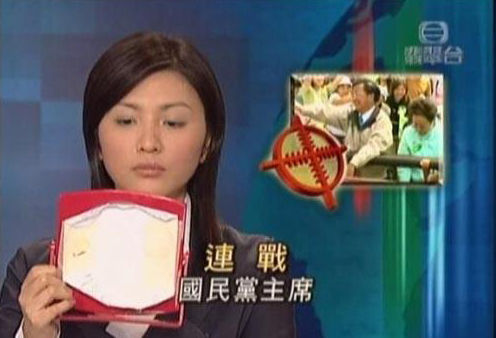
I think it was year 1990 or 1991 when I was in the United World College attending a media summit organized by the school faculty and students.   A few prominent speakers, including some movers and shakers of the media industry, were invited to address the students about the role of the media and its impact in the political world.  I don’t remember who the speaker (some American journalist) was now, but she was talking about her views on news productions around the world.  “You know what’s the worst news reporting production I have seen so far,” she shared in the middle of her speech.  “It was the Hong Kong TV news programs.”  There was laughter and gasps.  My schoolmates immediately turned to me giggling.  Being one of the only two Hong Kong students in the school, suddenly I felt that I was singled out.  Should I say something?  Should I defend something – anything?  The speaker didn’t need to be a genius to realize that a poor Hong Kong ambassador was in the hall, and she reiterated: “I’m serious.  The newscasters were babbling on and on at a piece that needs not much explaining.”

Maybe I didn’t quite get it at the time, since I hardly had much else to reference to, having only been away from my home town for less than a year.  But I get it now, big time.   Some 20 years later, I am still amazed and amused by where we are today with our news productions.

First a disclaimer.  I know nothing much about the industry, and my frame of reference since then has been largely related to that of the States.  But I think I am still entitled to share my views as a TV audience, and one attempting to seek up-to-date information from the local programs.  By the way, there aren’t that many choices to begin with.

I am a complete believer in news reporters’ and the station’s impartiality in any news stories, but do they all have to be so stone-faced and robotic?  Those of us who are also in the “people business” understand that we as the messengers play a huge part in getting our messages across.  How we say it and how we deliver it is an art by itself.  Yet throughout the few decades of TV news programs I have seen, it seems that there is a cardinal rule in their training programs that no news reporters or anchors should ever shed a single hint of emotion and intonation, whatsoever.  Hey, don’t get that mixed up with adding an opinion, as I know they aren’t talk show hosts and they are not supposed to.  I am talking about adding the right pause, phrasing, and emphasis to the key points, conclusions and transitions.  Sometimes subtle body language and hand gestures may be appropriate.  Though no, all I see is complete stiffness from beginning to end.  Maybe this is requested and demanded by the viewers?  I’m not sure, and I’m not one of them.

I like news anchors who have credibility and professionalism, and it takes them years on the field to gain that hard-earned reputation.  I don’t want them to turn into another extreme like some of the TV news programs in Taiwan, where the programs are much closer to entertainment than anything else, just so they could push up ratings in a relatively much more competitive media market than Hong Kong.  Despite the authoritative figure, I like to see some personalities being presented from time to time.  That brings an element of relatability, trust and connection with the audience.  I understand it can be hard to do here because the local presenters are not as high paid, their career prospect not as secure and promising, and hence it will be much tougher for them to build a distinct brand for themselves.

That’s what I would like to see changed, at least progressively.  It starts from the top at the leadership level, and goes down to where news stories are reported.  The news transcripts do not need to repeat everything we are already seeing on TV.  Come on, we are watching news with news feeds.  The news stories can stand to be a bit more original and non-repetitive.  Interviewing parents and school kids every year on September 1 when the new school year starts is not newsworthy material, similar to shooting at the flower market every Valentine’s Day, or dim sum restaurants on Mother’s Day.  Asking passing by citizens on the streets what they think of the recent public bus fare hike can only lead to one uniform answer.  Every time, I feel that 20 to 30 minutes of my life is robbed.  I don’t dislike the events themselves, I am just longing for a few more original questions or angles on them.

We need some pioneers and some daring moves to push everyone out of their comfort zones once in a while, even if they are of the TV viewers.  I want to envision myself jumping out of my auditorium chair some day, defending the next coming critique if I am fortunate enough to get stuck representing Hong Kong again. 

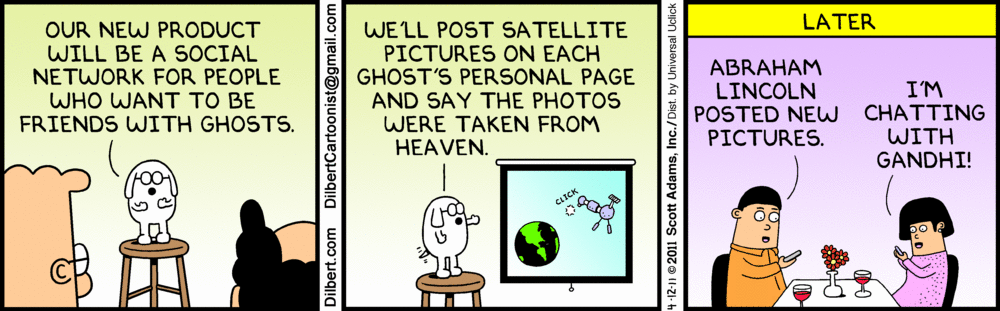
Have you had complete strangers requesting to “friend” you on Facebook out of nowhere?  [Read my earlier post on Facebook Depression] If you do, welcome to the 21st century.  It’s no big deal, according to my up and personal polls with my Gen-Y friends.   Apparently, in this day and age, you can stick to the old school traditional etiquette of meet-and-greet in the social arena, or you can cut to the fast-and-easy hit-or-miss fast food culture of what kids (and grown-ups) do nowadays.  Quite frankly, you do can tell a bit, even if not a whole lot, of what kind of person someone is, from his or her Facebook page.  In today’s well acceptable “etiquette” of background checks, it just seems that I better conform and get accustomed to making friends, or at least acquaintances, through the mighty powerful platforms of Facebook or LinkedIn.

Whenever you feel the need to ask such question, count your blessings.  At least you are interesting enough (or weird enough) for someone to come knocking.

My Part One covers two most popular scenarios in office politics, and they are generally centered around individuals who are plain lazy and who just want to get by every single day waiting for the pay cheque to come.  Who doesn’t want that really?  Yet we should have the decency not to cause harm and inconvenience to others in the process, and that is just plain and simple professional courtesy.

Though the other biggest war field of all times is:

  • Power and control

Maybe you are a star employee and you are a high performer at work.  Instead of focusing on your own business you can’t help but notice whispers and gossips from people around you.  No, you seldom hear it directly from the originators.  These rumors have been circling around the office floor for weeks or even months before you get to hear them, perhaps from a trusted colleague.  And you can be sure these whispers are everything but complimentary.  Some include contents that you are the boss’s boy (or girl), that you are just lucky to land the biggest client, that you are playing favorites, or even contains rumors that your team is going to be taken over by them altogether, only as a way for them to eliminate competition altogether. 

Remember what your parents as well as teachers used to tell you when you ran into bullies in primary school?  Don’t take the bait.  It’s tougher when you were young since it’s pretty hard to detach yourself from a physical fight, if that’s the case.  However no matter how tempting it could be, fist fights at the workplace are still frowned upon, so we are mostly restricted to verbal and written fights which are actually nothing less hurtful.  I take my childhood learning seriously.  Don’t take the bait.  Don’t stoop to their level.  Remember what they said, and try to find out more facts and background why they said it and what their grand plans are.  Don’t confront them without gathering all the facts.  Keep your ear to the ground.  Analyze what you have heard, and synergize with your allies if available.  Is there any truth to the rumors?  Personal defamation is utterly wrong, but rumors about your team being absorbed, outsourced or even eliminated may not be a vindictive rumor but truly a managerial decision.  What do they gain from all this?  What will you lose if at all?  Contemplate all the possibilities and be prepared.  It’s no time to be hazy and reckless especially when you are at the receiving end of hateful office politics.  Keep yourself poised and confident.  Losing your ground is the number one cause of future politics.

Evaluate your options.  If you believe you have nothing to fear considering the fire power of both sides, you can take the high road and ignore these rumors, but be on the lookout for the best timing to let people around know that you are well aware of the whispers around town.  Projecting the image that you are well-informed warns others not to underestimate you, and also a subtle way to let people know you are well-connected with people you can trust.  If the rumors turn out to be less than flattering, the number one rule is still to hold yourself together, and then consult with your trusted mentors, colleagues or superiors.  Be humble and discuss what options you can take.  Can you volunteer for some meetings or tasks to showcase what you are good at?  Can you initiate a brown bag lunch session to talk about your line of work so as to invite more open dialogues that are honest and professional?  Can you have your internal and external customers provide recommendations or testimonial for you in times of need?  Remember, what you are proposing does not only apply to yourself, but to your colleagues and most likely to those who fire the bullets in the first place.  They will need to be measured accordingly and they need to be put under the same test as well. 

I am fully aware that the above is not universal to all workplaces based upon variations in cultures, seniority, level of autonomy and experience.  But you get the drift.  Today’s workplace is way more complicated than worrying about cliques, sides, fights and insults.  Much more is at stake now including our own jobs and even the livelihood of people working under us.  Don’t underestimate office politics.  It’s actually part of the work itself, and it will get worse and even more sophisticated.  If the job is so straightforward that we just need to mind our own business from start to finish, chances are we won’t even have that job to begin with.  It can well be outsourced to others half our pay.  Our job is also about getting through hurdles, aligning people, managing friction, influencing tough minds, and coming up with innovative programs to reward everyone better according to individualized motivators. 

“It’s not my job,” many would say.  But honey, that’s why you are hired in the first place.

The term “office politics” sure has a negative tone.  Most people use sentences like “I hate that workplace because there is just too much office politics.”, or “I like working for myself so I don’t need to get involved with all that meaningless office politics.”  Yes we all have a million stories about how we end up being victims of cunning office preys and jealous co-workers.  It is certainly no fun to be involved in unproductive games and exchanges with people we don’t like, especially when we believe that is all they do at work. 

Yet when you think again, there really is no way to escape such dealings no matter where you work.  Even if you have your own business, your relationship with your employees as well as clients and partners constitute much of the same thing. 

My advice to almost every pet peeve is to embrace it with an open heart.  As long as you understand why people do what they do and what their intentions are, you will be able to rise above it and learn to tackle it with the right spirit.   Let me take a few common scenarios as examples.

  • Colleagues taking credit for your work

This is probably by far the biggest complaint anyone could have made, and sometimes it is your boss instead of a colleague who is in the wrong.  Instead of merely bitching about the nerves they have, put a mark on your work by making yourself more prominent but not in a cocky way.  If you still don’t know how to articulate that, you may deserve to be taken advantaged of.  No I’m not trying to be mean, but come on, bragging about something not yours is wrong, but letting people know of what you have come up with is your eternal right.  No one can take that away from you, so fight for your own recognition.  For bosses however, I learn to take a step back most of the time.  If my boss looks good, I look good too.  That’s why I get paid and I don’t mind contributing to the common good.  However, you better make sure you will be rewarded at the end of the day.  Knowing how to “tango” with your boss is an art that needs years of trust and mastering.  For that to happen, you have to be honest with each other.

  • Colleagues are lazy and they keep shredding their responsibilities

Yes most people don’t want to move their butts until they absolutely have to.  “It’s better be someone else’s problem than mine,” most would think.  I don’t care if they want to shred their responsibilities, because more often than not they would be caught sooner than you think.   I am eager to cross my arms and witness how it plays out.  However, why would I become the victim?  If you find yourself being blamed or positioned for something that you are indecently accused of, stand up for yourself.  No, not to your boss since it will look whiny and childish like getting abused in a school fight.  Stand up by following paper traits.  Put exchanges on paper.  Don’t resort to verbal fights as you will end of looking as bad as the other party.  Take a deep breath, write a calm and logical e-mail stating why it is in their own turf rather than yours, and state how sympathetic you are.  “Oh I just want to focus on the issue and have this resolved for the good of the department or the company, but would it work out even better if that comes from my dear colleagues instead?”  If you make it sound like you have risen well above the silly issue and manage to focus on the overall good, you can toast your victory.  Remember, let your boss know that you are a problem solver instead of whiner, even if it’s your arch-rival who has stirred all this up in the first place.  Being silent and passive is not likely to do yourself justice.

Chances are, someone is always going to review the facts if the issue turns bigger and uglier.  There is no way to ignore black and white texts on e-mails, so use that to your advantage, wisely.   Better yet, those who review it (including your boss) will realize that you are not to be underestimated.  Bravo.


CNNGo.com put up an article of “Life after dark:  10 things best done around midnight in Hong Kong“.   How appropriate.  One of the biggest reasons I still consider Hong Kong my most favorite place of abode is its ultimate accessibility.  Where else in the world could you find convenience stores, eateries, massage centers and karaoke boxes around the clock?  And you don’t even need to get on taxis if you don’t want to.  There are affordable enough buses and mini-vans to almost every corner of the territory, 24 hours a day.  I admit it, I am just spoiled, and I hope my fellow Hong Kongers could realize that they are amongst the luckiest ones on earth in terms of convenience and indulgence.  Of course, the price to pay is light, noise and crowdiness pollution.  There is just no way to escape it.

Alright, let’s see what 10 things CNNGo has in mind for us to do here past midnight.

  1. Go squid fishing.  Well, I think the only time I ever did that was over 15 years ago, and I think you don’t need to wait till midnight to do that.  You can rent your own junk or join one of those packaged tours with fellow passengers you don’t know.  I only remember that I was so excited to catch my first squid that I yanked it a bit too hard and found myself and my friends splashed by black ink all over our clothes.  Actually, I also remember that the squid didn’t taste that good afterwards.  I blame it on the primitive cooking techniques on the boat.  My point is, unless you are under 20 years old, don’t do it.
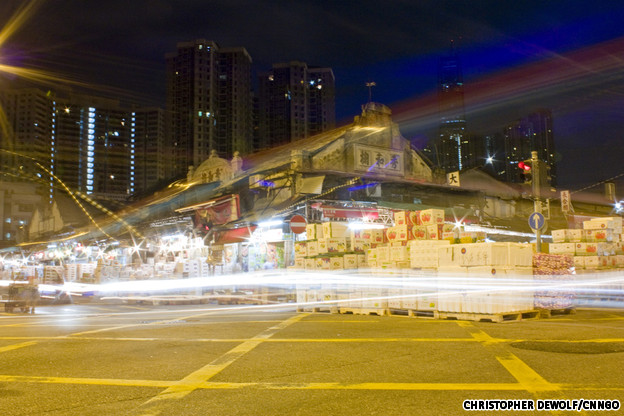
  2. Visit the “gwo laan”.  Gwo laan is the Chinese name for the wholesale fruit market in Yau Ma Tei.  I did that about 2 years ago around midnight and it was exciting to see fresh fruits arriving in boxes fresh from their source, and many of them come from Japan and the United States.  The fruits are fresh, and the prices are much cheaper than retail without the mark-ups.  The only draw back is that you have to buy in boxes, so be prepared to share it with your friends and family afterwards before they go bad.  Last but not least, have someone drive you.  It wasn’t much fun for me to carry a heavy box of Japanese peaches on the overnight bus that day.
  3. Take a red minibus to MongKok.  Or, I should say, take one from MongKok to anywhere in Hong Kong.  MongKok is like the center of nightlife in Hong Kong, and it is ready to transport people to everywhere else after you take everything out of it.  You will see every layer of Hong Kong population you can imagine on the minibuses and around the waiting lines.  Teenagers, working class, suits, drunks, you name it.  Plus you will get the most exhilarating ride you can ever imagine.  7 minutes will get from MongKok to the New territories.  It’s much more exciting than any roller coaster ride since the latter is definitely more safety proven than the former.  Take it at your own risk, please.
  4. Get lost on Cheung Chau.  Hmmm, this is something I never did at the wee hours at night since the last ferry back to the island departs around 11:00pm (or not? I don’t really know).  Cheung Chau to me is a bit too commercial within the many outlying islands of Hong Kong.  Though if you get to stay overnight there, the severely haunted holiday houses near the beach will surely make any scary movies ridiculously amateurish.
  5. Watch a rooftop movie.  Oh sorry, I don’t even know this existed to be honest.  In Hong Kong’s humidity, I think only tourists will find this enjoyable.
  6. Hang out at the beach.  Actually this is really a romantic thing, especially if you have a car, since it won’t be much fun to be stranded without return transportation.  But come on, it’s still only less than 30 minutes away from city center.  Where else can you find beaches that accessible on earth?  It’s a good place to chat, enjoy the silence and hear the soothing waves.  It can be a bit scary to stare at the dark waters, but isn’t it incredibly sweet to hold on to your companion’s hands to begin with? 
  7. Eat at an all-night dai pai dong.  This is also an amazing experience, but I will advise you to let your partner know of this ahead of time rather than swinging it out of nowhere.  As long as expectations are managed, the experience is down to earth, casual and oh-so-much-fun.  If your partner has his or her clubbing attire on, the scene can be a little ridiculous.  However if this is the contrast you are looking for, who cares?
  8. Get middle-of-the-night dim sum.  Well a lot of our midnight activities center around food, and I can’t find anything more applaudable  than the recent around the clock dim sum phenomenon.  There is nothing more satisfying than having freshly steamed dumplings, cheung-fan and beef balls when you have too much to drink.  I prefer that to the oily pizza slices, kebabs and hot dogs, any day.
  9. Walk with the ghosts.  Again I didn’t know there is such a tour of Wanchai’s ghostly neighborhood, until now.  A tour guide will “explain the abundance of ghosts stems from Wanchai’s long history and high rate of casualties.”  Hmm, I also believe this is really designed for tourists.  In densely populated Hong Kong, everywhere is a ghostly neighborhood.  Come on.
  10. Go for a bike ride.  Alright, at least there is some suggestion that is not food oriented.   I have a feeling however that this is also popular for someone aged under 25.  This is a subtle hint that I am nowhere qualified.

So, how many of the above have you done around midnight in this city?

I’ve gotten quite a number of questions from my previous post on healthy foods since most people know for a fact that fruits and veggies are good for them.  Despite this obvious and profound fact, we should always be reminded that any serving of fruits and vegetables equals to one less serving of unwanted carbs, fat and processed foods that we would otherwise be consuming in our daily diets.   Our food choices out there have gotten so incredibly confusing, hazardous and misleading that it just seems the more we eat, the more unhealthy we are.

That is when I find the following article by Courtney Hutchison of ABC News worthwhile to share.  Heart disease death rate drops with each added fruit and veggie serving we take in. 

“It’s time to make friends with the produce aisle: pumping your diet with fruits and vegetables isn’t just good for your waistline — it could save your life, according to new research from the University of Oxford.

While “5 a day” has traditionally been the mantra for fruit and veggie consumption, researchers found that those who consumed eight or more servings were 22 percent less likely to die from heart disease than those who consumed three or fewer servings a day.

Even among those who couldn’t manage the eight servings, more fruits and veggies consistently meant a lower risk; for every additional serving above two per day, researchers observed a four percent decrease in the rate of heart disease deaths.

Though past studies have linked the consumption of fruit and vegetables to heart health, many remain skeptical as to whether these foods have a direct protective effect on the heart. Given the size of Tuesday’s study (over 300,000 participants from eight different European countries) and the strength of its findings, some doctors feel that it may erase and remaining doubts concerning fruits and veggies, and cardiovascular health.

“This is probably the largest study of its type and should convince even the greatest skeptic of the value of fruits and veggies,” said Dr. Randall Zusman, director of the division of hypertension at Massachusetts General Hospital.

“This compares ‘enough’ fruit and vegetable intake to ‘more than enough’ and suggests that ‘more than enough’ is better,” said Dr. David Katz, director of Yale University’s Prevention Research Center. This could have big implications considering that the U.S. population “doesn’t even approximate the ‘enough’ target” as it is.

The study, which was published Tuesday in the European Heart Journal, is part of the EPIC trial, a long-term study in Europe initially set up to track the effect of vegetable and fruit intake on cancer.

In the U.S., the recommended consumption of fruits and vegetables has often been promoted as “five a day”. The Centers for Disease Control and Prevention moved away from that recommendation in 2007, to a more flexible approach, dubbed Fruits & Veggies – More Matters.

Instead of a flat recommendation of five servings a day, the new program changes recommendations based on age, sex and activity level. For a 40-year-old sedentary man, recommendations are now two cups of fruits and three cups of vegetables a day; for a sedentary woman of that age, the recommendation is 1.5 cups of fruit and 2.5 cups of veggies.

From 5 a Day to “the More the Better”

So what exactly would the eight portions a day observed in the study look like? 

“A large navel orange can easily weight close to 8 ounces and so does a large apple,” says Carla Wolper with the Obesity Research Center at St. Lukes-Roosevelt Hospital in New York. “That leaves a measly six ounces for salad, string beans, or other vegetables on the dinner plate, so yes people can easily eat this much,” she said.

Considering that the majority of the general population in the U.K. and the U.S. consume fewer than five recommended servings of fruits and vegetables per day, asking for eight may be a bit of a stretch, concedes Dr. Francesca Crowe, lead author on the study. 

Given that each additional serving suggested an additional heart health benefit, “it may be a relatively simple public health goal to encourage everyone to increase their intake of [fruits and vegetables] by a portion per day,” she says.

What Are Fruits and Vegetables Doing?

We all know that fruits and veggies are good for us, but why would eating them prevent death from heart disease?

The evidence points to a number of ways that these foods could work to boost heart health.

It could be that vegetables and fruits contain vitamins, minerals, and antioxidants that are having a specific effect on cardiovascular health, says Dr. Keith Ayoob, associate professor in the department of pediatrics at the Albert Einstein College of Medicine in New York City.

Another possible mechanism “is the impact of fruit and vegetables to lower inflammation, a known mechanism contributing to cardiovascular disease,” adds Dr. Stephen Devries, a preventive cardiologist at Northwestern Hospital.

No Harm in Piling on the Fruits and Veggies

It also may not be what fruits and veggies add to the diet, but what they replace. There’s less room in the diet for the high-fat, high-cholesterol, high-salt foods often associated with increased risk of heart disease when someone is consuming so many fruits and vegetables each day, doctors noted.

This makes for “lower blood pressure (because these foods are salt free), lower cholesterol (because they are fat free), lower weight (because they are likely to be associated with weight loss), [and] lower blood sugar (lower carbohydrate and sugar content),” says Zusman.

“Just by taking up a lot of room” in the stomach, [those] ounces of fruits and vegetables inherent in eight servings “will have a salutary effect vis-a-vis [cardiovascular disease],” Wolper says.

More importantly, there are few if any drawbacks to consuming a good amount of fruits and veggies .

“I tell my patients to eat whatever fruits and veggies they like at whatever means they can,” says Ayoob >. “They’re that good for you. Indeed Weight Watchers doesn’t even count them in their programs now. No one gains weight eating whole fruits and veggies.”


Do you agree with this list from Jennifer Chen of Travel + Leisure?  Make your own judgement.

Travel + Leisure’s list of world’s most underrated cities:

  1. Detroit
  2. Taipei (well for Hong Kongers it is not underrated at all!)
  3. Tucson Arizona (well my old school used to be at the neighboring state and you don’t see me returning after XX years…)
  4. Glasgow
  5. Nara, Japan
  6. Bratislava, Slovakia
  7. Providence
  8. Adelaide, Australia
  9. Valparaiso, chile
  10. Kotor, Montenegro
  11. Galway, Ireland
  12. Philadelphia (there is for sure a lot of culture there, but pardon me?)
  13. Antwerp, Belgium
  14. Merida, Mecixo
  15. Denver
  16. Valencia, Spain
  17. Montevideo, Uruguay
  18. Bologna, Italy
  19. Hangzhou, China (again, for Chinese they are not underrated either)
  20. Dusseldorf, Germany
  21. Granada, Nicaragua
  22. Calgary, Canada
  23. Bordeaux, France (hmmm….not for Hong Kong wine drinkers…)
  24. Durban, South Africa

For the full article and slideshow of why each of these cities are underrated, click here