Feeds:
Posts
Comments

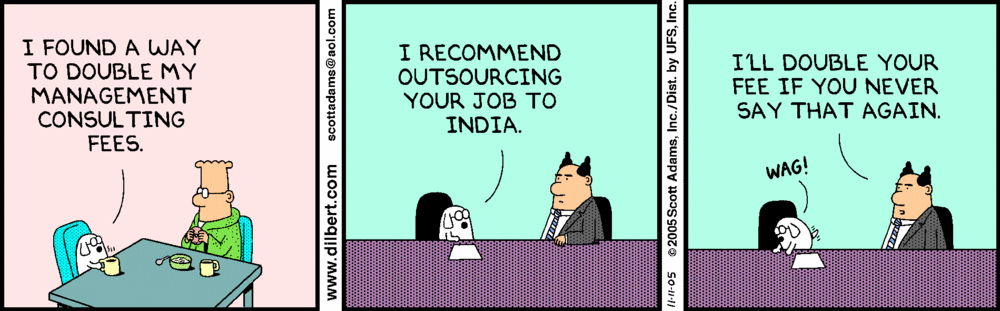
Multinational corporations rely quite heavily on external consulting firms for a number of reasons.  They need an outsider’s point of view.  They need experts with specialist knowledge on areas that can’t be found in-house.  They need to strategize privately and confidentially.  They need someone authoritative to back-up and conduct due diligence on something they have already decided to proceed.  They want someone impartial to make difficult and often unpopular decisions within the company.

No matter how many industry jokes there are about consultants (as if any profession is ever immune), one cannot deny the importance of at least one of the above reasons.  Corporations do not need to take time to pitch the change or promote the upcoming initiative the way they would proceed without the appointment of a consultancy firm, at least when the project is barely at its infancy stage.  Engagement is fast, cooperation is usually guaranteed much due to the fear factor, and in my opinion, much of the fees are also paid for the deflection of any future blame, should there be a failure of the deliverables.

So if there is money to spend that is authorized all the way from the top, it does sound like there is nothing to lose.

Well, that is rather a loose pre-requisite here, I admit.  Corporations nowadays do not have that much money to burn anymore, and every cent they spend is under close scrutiny by the shareholders.  Though consulting spend sometimes is considered untouchable or out-of-scope depending on the policies of specific corporations, I do get myself involved from time to time, as a procurement professional.  I am involved in the analysis and souring of consulting firms, through to the finishing touches of negotiating the terms, fees, contracts and team members to be deployed.   Realistically, procurement is only involved on engagements that are relatively less sensitive.  I still look forward to having myself signing a sacred non-disclosure agreement in order to get myself invited to negotiating a top-level super-sensitive consultancy engagement deal.

Why?  Consultancy engagements are lucrative, to say the least.  Engagements I have involved with start from a few million US dollars, easily.  No matter what the proclaimed return on investment is, it still constitutes a big percentage of discretionary spend to be forked out upfront.  We can attempt to build in all the pay-by-performance metrics all we want, but the truth of the matter is, if there is no one involved to conduct at least the minimum due diligence on the costing formula and the engagement brief, the company only has itself to be blamed for being ripped off, big time.

It’s always a sensitive area for procurement to be invited to the table, and that pitch may very well come from the consulting firms themselves.  In order to avoid the risk of conflict of interest, many consultancies could only embrace my presence to prove that they have nothing to hide – and that is the first and smart step.  Internally, when senior stakeholders are adamant about their preferred consultancy partner, I position my value as one who helps build structure, transparency, fairness and accountability to the engagement contract.  In more times than not, that equates to monetary savings, or at least money better spent.

Sam Reynolds wrote an informative article titled “Two Threats Facing The Consulting Industry” on vault.com.  How do MNCs deal with the imminent pressures of cost control in their needs of consulting help?  What is the future of the consulting industry in view of internal consulting units and consultant-managers?  Whether you are a consulting or a strategic procurement professional, Sam’s article is not to be missed.

A popular mainland Chinese cable TV show that attracts over 100 million viewers per episode continues to strike up controversies across the country.   It is similar to a condensed version of “The Bachelor” where 24 eligible ladies express their interests over 5 bachelors in each weekly episode, with the bachelors making their ultimate decisions after a few rounds of shortlists by the ladies. 

The show’s popularity lies largely on the eligible ladies.  Most are attractive models, former beauty peagent contestants or from well off families.  Yet like any other reality shows, viewers are mostly attracted by the unrehearsed snappy exchanges on stage.  For this show, there are plenty of this, from the bachelorettes.

“Is it because I’m just too beautiful?”

“I just know you need a beating the moment I hear you speak.  Let me get a whip now.”

“Looking at you make me realize that coming to this show is both a game and a dream.  Now I’m woken from my dream.” (upon seeing a bachelor with ordinary looks)

“We have to face the reality here.  The reality is that men turn bad when they got money.”

“Why is it me again? Damn, all I want is a low-profile life!” (upon selected by the bachelors repeatedly)

“Your clothes are from the 1930s.  Wait till it’s the 30s to look for your wife then.”

“I want the elite of the men, the talent of the elites, and the prince of the talented.”

“Never know what wine feels like till you are drunk, what love feels like till you have loved, what wealth means till you have been poor.”

“A person with my beauty and talent deserves no one less than David Beckham.”

“This is a dead-end with utterly no future.  Any woman who choose to be with you will never find light.”

The most renowned and controversial quote comes from a bachelorette in front of a bachelor who loves riding bikes.  “I’d rather cry on a BMW than laughing on a bike.”

Due to the candid exchanges on screen, the controversial show receives continuous censorship by the national broadcasting bureau on their “materialistic” influences.  However, the 100 million and plus viewers who tune in definitely find something that resonates: the overwhelming craving of wealth in today’s China.  Worse yet, everyone want to take shortcuts.  If you can capitalize on your looks, bodies, youth and social status, do it before it’s too late.  There is this oldest Chinese saying, “Laugh at the poor but not at the prostitutes,” that summarizes this prevailing but wicked notion in today’s China.  Well, if we are talking about those who are too underprivileged to even make their own living, the measuring stick may need a bit of fine tuning.  Though for a substantial portion of the viewing audience, plus those of the wealthy middle classes here in Hong Kong, the alarming phenomenon of generations X, Y and Z circulates around the dream of falling into the comfort of wealth and security right after coming out of college.  Paying the dues?  Going after my dreams?  No, not for me, if there is a bigger meal ticket up for grabs.  Dreams are far secondary.

Then there is this outcry of eligible ladies in their mid 30s in Hong Kong who complain that they can never find their other halves because no one is good enough for them.  Sure they are super eligible.  Most of them have successful careers and are financially independent.  They look down upon on guys who are indecisive and aimless.  They look for men who are secure, even more financially stable, and to top it off, willing to invest in extensive amount of time and efforts to woo them and make them feel like goddesses.  That’s not a bad dream, but you would think all that education and life experience would have prepped them to be a bit more realistic and tactful in the lesson of mutual support and give and take.  Think about the competition, ladies.  Be vulnerable, for once.  It’s no business transaction.

It certainly goes both ways for sure.  Too many men refuse to grow up and prefer to forever stay in our childhood utopia of computer games and instant gratification.  That is alright as long as a secure meal ticket is on the table.  “No, I just want a job that doesn’t take too much work and effort.  I can live with what I make now.”  The only thing is that they don’t realize they won’t stay 30 forever.  There will always be younger, fitter, and more aggressive new generation coming in and grabbing your jobs, in a second.  What’s the future, guys?

When young attractive people are going on television not to showcase their talents but to participate in some reality dating shows, I’m not sure whether I should shake my head or applaud them for making a run of fulfilling their childhood fantasies.  For many of them, I suspect that marrying someone rich literally is the bedtime story read by their parents.


I came across this interesting article on Men’s Health how some food ingredients can trick our bodies into not recognizing fullness, and we all know what happens after that.  We continue eating even after we have finished a satisfying lunch or dinner.  Men’s Health listed these 7 reasons from the book “The New American Diet” by Stephen Perrine and Heather Herlock.

1. You Drink Too Much Soda

Sodas and sweetened beverages contain high-fructose corn syrup, which according to new research from the University of California at San Francisco, can trick our brains into craving more food, even when we are full.  “It works by impeding the body’s ability to use leptin, the “satiation hormone” that tells us when we’ve had enough to eat.”

2. Your Dinner Came Out of a Can

“Many canned foods are high in the chemical bisphenol-A, or BPA, which the Food and Drug Administration recently stated was a chemical “of some concern.” Exposure to BPA can cause abnormal surges in leptin that, according to Harvard University researchers, leads to food cravings and obesity.”
 
3. Your Breakfast Wasn’t Big Enough
 
True.  A good breakfast drammatically cuts down my craving for a heavy greasy lunch.  “After following 6,764 healthy people for almost 4 years, researchers found that those who ate just 300 calories for breakfast gained almost twice as much weight as those who ate 500 calories or more for breakfast. The reason: Eating a big breakfast makes for smaller rises in blood sugar and insulin throughout the day, meaning fewer sudden food cravings.”
 
4. You Skipped The Salad
 
“…leafy greens…are rich in the essential B-vitamin folate and help protect against depression, fatigue, and weight gain. In one study, dieters with the highest levels of folate in their bodies lost 8.5 times as much weight as those with the lowest levels. Leafy greens are also high in vitamin K, another insulin-regulating nutrient that helps quash cravings. Best sources: Romaine lettuce, spinach, collard greens, radicchio.”
 
5. You Don’t Stop For Tea Time
 
Ok, easy.  They are not talking about those egg tarts, cakes and chicken wings you may be thinking about.   They are talking about actual tea here.   “According to a study in the Journal of the American College of Nutrition, people who drank one cup of black tea after eating high-carb foods decreased their blood-sugar levels by 10 percent for 2 and a half hours after the meal, which means they stayed full longer and had fewer food cravings. Researchers credit the polyphenolic compounds in black tea for suppressing rebound hunger.”
 
6. You’re Not Staying Fluid
 
Can’t be more true.  So many of us are simplying not drinking enough water.  “Dehydration often mimics the feeling of hunger. If you’ve just eaten and still feel hungry, drink a glass of water before eating more, and see if your desires don’t diminish.”
 
7. You’re Bored
 
I’ll be damned.  How many of us want to eat just because we hate to get back to work?  “Researchers at Flinders University in Australia found that visual distractions can help curb cravings. To test yourself, envision a huge, sizzling steak. If you’re truly hungry, the steak will seem appealing. But if that doesn’t seem tempting, chances are you’re in need of a distraction, not another meal.”
 
The book comes highly recommended from fellow readers.   Check it out even if you are not American – our diets are getting similar!


Other than the viral links circulating around Facebook these couple of days about Osama Bin Laden’s alleged bloody pictures or those “See Who Viewed My Facebook Profile” apps, one popular question on Facebook lately is the supposedly simple and straightforward math as follows.

6 / 2 (1 + 2) = ?

The question seems so straightforward (it’s fourth grade math) that 1.5 million adults answered online, and got it totally wrong.  That is, if you believe the answer is 1.

I think most remembered to add the bracketed 1 and 2 together first, but I, amongst the 1.5 million people so far (and still counting apparently…), totally forgot the cardinal rule of tabulating in the order of left to right.   So, for those who are 4th grade proficient, they know the correct answer is 9.  Those who answered wrongly with the answer 1 constitutes over 44% of the respondents.  Nothing to console myself about, really.

No, I’m not smarter than a 5th grader.  Now I’m depressed – again.

So I have a desktop computer at home, and a 16-inch laptop.  Oh yes I have another 10-inch netbook for my travels, and of course an iPhone.  I just ordered my iPad 2 a few days ago, which I am expecting in a couple of weeks. 

Things have definitely gone out of hand.

Now when I get an e-mail, I get it on my iPhone, on my computers, and on my Facebook if it’s a Facebook message.  When I work, I also have all my messages and e-mail forwarded to my work blackberry.  There are so many ways I can get in touch with my friends and it does take a while for the virtual party to figure out whether it’s best to text, whatsapp, MSN, Facetime, skype or Facebook chat with each other.  It just seems as if we are all too lazy to pick up the phone these days, and I am just as guilty as anyone I know.

If I ask you how you have been sending pictures to your contacts, I’m sure I will get quite a few different answers.  However, the trend is definitely moving toward personal mobile devices that can talk, text, take pictures, exchange info, entertain, and surf. 

I feel like we never have any so-called free time anymore.  In the city of Hong Kong, it’s like we have been trained to keep ourselves occupied 24 hours a day.  It’s a sin to stare blankly anywhere even for just a few minutes.  We are surfing Facebook, catching up with the news, playing games, and texting with our friends no matter whether we are on the subway, at the coffee shop, or quietly recuperating at home. 

I also feel at times that we are no longer actively using our brains.  Yes it’s been working but more often than not our brains have been passively bombarded with junk information that we can live without.  So much data is being pushed on us now and those who are not careful can very well lose track of who they are.  Why is it a crime to give ourselves a few minutes of free time to listen to our bodies and inner voices?  Are we feeling contented, or are we lost?  Are we designing our own destiny or are we following some set upon paths for us? 

Take a breather, get to the countryside, pack some light lunch, leave your gadgets and spend some quality time with yourself for an afternoon.  Think and be free.  We all deserve just that.


Talk about business title inflation.  I now see so many “Chiefs” around the corporate space.  Southwest Airlines has a Chief Twitter Officer. Coca-Cola and Marriott have Chief Blogging Officers. Kodak has a Chief Listening Officer.  When does it end?  As with everything else, title inflation just leads to value degradation.  In order to have the relevant stakeholder give you the time of day, you need to be appropriately titled or apparently you are a complete waste of their time.

Sometimes putting a chief officer in an area is to merely broadcast to the outside world that you are committed to such space, rather than doing anything fundamentally useful.  In larger multinational corporations we always hear of the company’s core values and principles.  Easy, we’ll name a chief officer for each of them.  Chief Integrity Officer.  Chief Teamwork Officer.  Chief Speed Officer (no it’s not what you think).  Chief Openness Officer.  Chief Fun Officer.  Chief Equal Opportunities Officer.  Chief Creative Officer (Microsoft).  You will definitely not go wrong.

What’s popular these days?  Facebooking, twittering, blogging, etc. leads to companies creating such chief officer positions like SouthWest, Coca-Cola and Marriott. 

Sign me up for Chief Recreation Officer any day.  I heard it’s such a tough job that I should remember to ask for more vacation days.

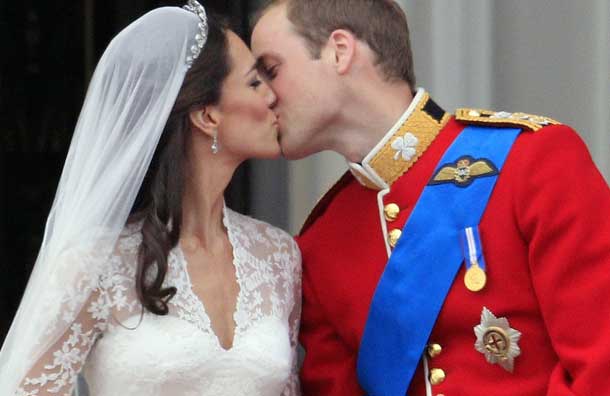
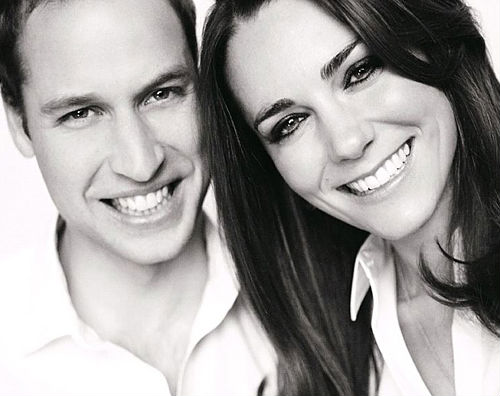
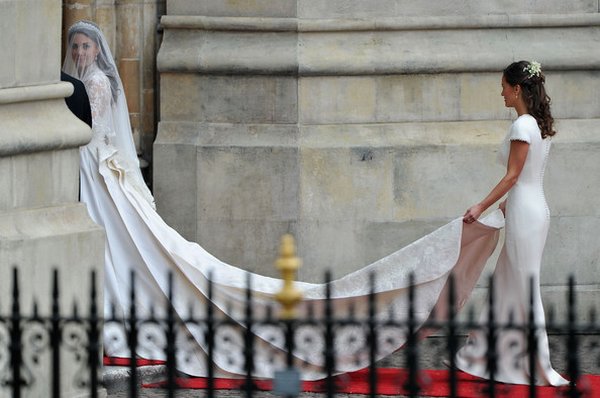
Even if you’re not a fan of the royal wedding, what’s not to like seeing two beautiful young people kissing over the glorious Buckingham Palace, Westminster Abbey, carriages and the royal guards in the background?

We are lucky to be in a place where the royal wedding isn’t the biggest news that people can ever talk about.  The live broadcasts are expected to begin sometime around our Friday afternoon, just when happy hour is about to begin.  In fact, this is going to be yet another highly anticipated long weekend, thanks to the labor day public holiday on Monday, and perhaps some folks are still vacationing somewhere.  When people are downing their beers and wines in pubs and lounges, I wonder whether they will choose to tune in to the wedding channel rather than the usual sports games.

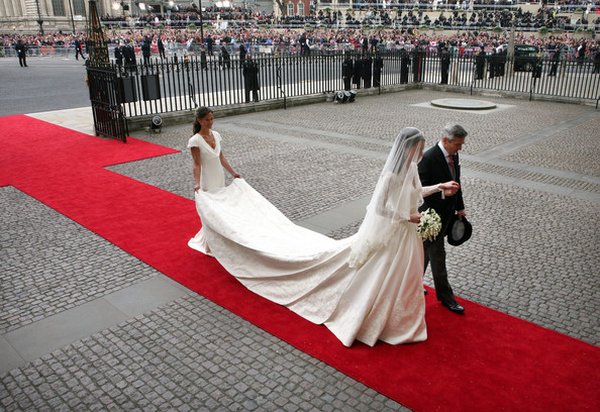
If you don’t have the slightest interest or curiosity over how glamorous and extravagant Kate Middleton’s wedding dress is going to be, here are a few ideas that you can do to “actively” avoid the royal wedding altogether, from mydaily.co.uk.

  • Rival the royals

Get married yourself and live-stream it internationally.  There’s nothing more healthy than a bit of competition so if you think you’ve got what it takes to outshine the royal couple then what are you waiting for?  Westminster Abbey will be busy but St Paul’s might be free, plus we reckon more than a few dress designers will have mocked up a spare royal gown or two just in case something dreadful happens to Kate’s at the last moment. 

  • Read a biography of Oliver Cromwell

This man knew how to organise an overthrow of the monarchy.  Fine, the whole thing collapsed pretty soon after his death and even a toddler could teach him a thing or two about international diplomacy, but if you’re looking for anti-royalist sentiment, Cromwell’s your chap.

  • Work on that novel

With everyone else heading to the pubs and the street parties you’ll finally have the house to yourself.   Add in the fact that every telly and radio station will be set to “wedding” and you’ll suddenly find the motivation to write your literary masterpiece.  That or you’ll spend eight hours watching old Buffy DVDs  and eating party rings.   Either way, well done you!

  • To infinity and beyond

Head to Florida (or indeed the internet) to follow the launch of space shuttle Endeavour from the Kennedy Space Centre.  The 14 day mission will see Commander Mark Kelly and his crew take Endeavour on its final flight to deliver an Alpha Mass Spectrometer and spare parts to the International Space Station.  Perfect for anyone who dreamed of being an astronaut instead of a princess.

  • Retail therapy

Make the most of the deserted town centre and go shopping for that Issa dress, Whistles blouse or crown you’ve always wanted.  Alternatively you could pop down to Wilkinson’s and see whether they have any guillotines in the DIY section.

  • Hijack a street party

If you’ve ever nursed even a small delusion of grandeur then the idea of your neighbours hosting a party in your honour will probably sound pretty good.  Simply sneak over and staple pictures of your own face over that of those of happy couple.   If you get caught just grab as many sausage rolls as possible and run.”

The royal wedding is just a day away, and for some reason the Americans seem to be way more excited than some Brits over the event.  All the prominent network news anchors will be reporting on location this week, and will be broadcasting live starting from 4am Eastern time on Friday.  Apparently, what’s happening in Libya, Syria or Japan aren’t going to cut it.  Are the Americans fantasizing over fairy tales of princes and princesses, or are they longing for some good news to divert their attention from all that suffering we see on the news?

I can’t help to notice that aside from the union of William and Kate, Friday’s spectacle is the ultimate public endorsement of the UK’s national standing and economy.  Take a look of these facts.

  • Some 550,000 people will experience the event in person in the Westminster environs, nearly a million plan to watch it on big screen and over twenty million will favour the convivial experience of huddling round a television. Half a million will watch it on the internet and 51,000 will watch it on a mobile phone.
  • 295,000 Londoners travel into Central London to experience the event.
  • Time off: Over six million adults will be taking extra holidays to make the most of the confluence of Easter, the bank holidays and the Royal Wedding. Workers from London (17%) and the West Midlands (17%) being the most likely to do this, while employee from the South West (7%) and Scotland (9%) the least likely.
  • Economic benefit: PwC calculates the commercial benefit to London from visitors’ expenditure to be £107 million.
  • 560, 000 adults are travelling to London from around the UK for the wedding – regional groupings ranging from 69,000 from Scotland to 17,000 from North East England. While the vast majority will be travelling with friends or family, over 50,000 will be travelling alone.
  • Travel: Travellers choose car, tube and train as the most popular form of transport to get to (Central) London for the wedding. Interestingly, the bicycle is a more popular choice of transport than the bus.
  • 37% of visitors will stay only for the day, but one in five intends to stay for two nights. Men intend to stay longer than women.
  • Accommodation: 185,000 people will stay in hotels, 50,000 in B&Bs. 18,000 will stay with friends.
  • A quarter of the visitors will spend between £50 and £75 a night on accommodation. One in five will spend between £100 and £149. Over 20, 000 people will spend upwards of £300 a night.
  • Shopping: Over two-thirds of visitors will go shopping while they are here and well over half intend to visit bars, clubs and restaurants. 58% say they will visit tourist attractions while they are in London, with 36% of visitors budgeting to spend between £75 and £99 per person per day on tourist attractions.
  • Shopping centres (eg. Westfield Centre, Brent Cross) will be the most popular shopping destinations followed by famous shopping streets (eg. Oxford Street, Carnaby Street) followed by well-known street markets (eg. Portobello Road, Brick Lane).
  • One in five people have budgeted £75-£99 for shopping per day while, at the more extravagant end, 13% say they have budgeted £200-299 per day.
  • The night economy: 60% of people intend to go to the pub, 45% are going to nightclubs, 40% will go to restaurants, 26% to theatres, 24% to cinemas and 7% to casinos.
  • Finally, when asked what they would spend their royal wedding budget on if they weren’t travelling to the wedding, 35% said general living expenses which may lead some to conclude the boost for the London business will be counterbalanced by a negative impact elsewhere. 27% said they would put the money into savings and one in four said they would make debt repayments or pay off credit card bills.

The survey was conducted by PwC.

Last but not least, London is expecting to bring in over 1 billion pounds (1.6526 billion U.S. dollars) from the sales of merchandise, estimating the sale of over 20 million bottles of beer and over 4 million bottles of champagne!  Hmm, I really can’t see myself toasting champagne over the royal wedding.  To be honest, I can think of a million better reasons to down my champagne, any day of the week.   

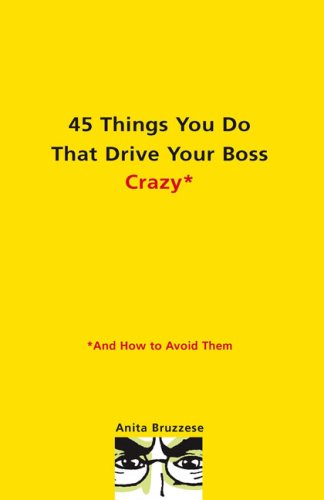
I was captivated by the title of this book by Anita Bruzzese a few years ago.  I think it was my wicked sense of humor to attempt to do some of these 45 things to get even with my boss at the time.  Yes I said it was wicked, and I plead myself guilty.  However, at the end of the day, I did nothing of the sort since I cared so much more about my own professional reputation rather than some silly grudges over the most childish cases of office politics.

Are you curious about what these 45 things are?  Well, they are not as obnoxious as you think.  Or are they?

  1. Treating the office like it’s your love shack
  2. Punching the soda machine when you’re stressed out and ticked off
  3. Goofing off on a business trip
  4. Earning a reputation as a whiner, drama queen or general pain in the neck
  5. Discussing your personal beliefs at work
  6. Telling dirty jokes and cussing on the job
  7. Having questionable personal integrity
  8. Blogging about your job (Oh no….)
  9. Having poor writing and spelling skills
  10. Failing to write thank-you notes
  11. Committing e-mail blunders
  12. Failing to speak intelligently
  13. Wearing the wrong thing to work
  14. Behaving immaturely at company parties
  15. Being disorganized
  16. Being a poor listener
  17. Losing sleep
  18. Using your personal cell phone too much
  19. Acting like a boot at business meals
  20. Not appreciating coworkers
  21. Failing to delegate
  22. Being intolerant
  23. Disrespecting a mentor
  24. Not getting to know others in the company
  25. Giving feedback that is deliberately hurtful
  26. Fostering an offensive workplace
  27. Gossiping
  28. Not giving or accepting an apology
  29. Crying at work
  30. Caving in to a bully
  31. Failing to learn from mistakes
  32. Being unable to overcome obstacles
  33. Having too much – or too little – confidence
  34. Neglecting to write things down
  35. Asking for a raise you don’t deserve
  36. Lacking knowledge of current events
  37. Holding grudges (bingo…)
  38. Giving lackluster speeches or presentations
  39. Squandering time at seminars
  40. Skipping company-sponsored events
  41. Ignoring the company’s goals
  42. Dodging meetings
  43. Not going beyond your job description
  44. Neglecting new coworkers
  45. Fighting change

I recommend this book if you are eager to find out how you can avoid the mistakes and mend things with your boss, or, if you have the same devious reason as I did.

Well, of course I’m kidding.