Feeds:
Posts
Comments

Archive for the ‘Frown’ Category

The “Today Show” had a segment this morning on the captioned which resonates with many people, I’m sure.  It seems that we are doing almost everything on our phones now but calls.  Aside from making the occasional calls for hotlines, reservations or for work, I don’t think I am really using my phone to talk to any of my friends now.  Instead, I test, I e-mail, I surf Facebook and I share news all on one simple handy device ironically named a mobile phone.

The segment profiles college students claiming that they are texting some 20,000 messages on a monthly basis, and some of them believe that they can express themselves better through texts than by speaking with their friends in person.  I don’t.  Though I find it extremely convenient to communicate via texts, it’s not really the reason why I seldom make calls.  I guess I just don’t enjoy chatting on the phone endlessly.  My phone conversations are always to the point and mission specific.  If I really want to catch the latest of a friend, I always prefer asking them out for a face to face chat rather than doing it on the phone. 

No doubt texts can never take the place of a live conversation.  There is a limit to how much you can convey through the 26 alphabets and emoticons available on the phone.   However, the slight delay in response time allows us to think for a bit before we reply, which is always nice.  It also gives me back my much-needed sanity from hearing people screaming and babbling on their phones in noisy subways and buses.  If you work in an office, you will definitely agree with me that texting is a lot more discreet for those small talks with your boyfriends or girlfriends than using the phones during office hours.  For the latter, half of the office would already have their ears pressed toward your cubicle the whole time.

Texting is also great to catch up with someone without overly disturbing them, especially for the people who you are not that close to, yet.  It helps to minimize awkwardness, rejection and anxiety.  The flip side of the coin of course is that you can be zapping 3,000 texts with someone and still haven’t had a good idea of who they are, or what you think of them.  Is it  time-saving or is it indeed a waste of time?  You be the judge.

Experts believe that phone calls will soon head toward extinction.  With so little practice in their personal lives, now I understand why so many people are horrible in phone etiquette at work.  I wrote about this in an earlier post, and would like to take this opportunity to also include some etiquette tips provided by the Today Show.

  • Speak in an “even” tone, and clearly: As speakers, we often “mumble, shout, whisper, or speak with food in our mouths,” Sue Fox, author of “Etiquette For Dummies” and “Business Etiquette For Dummies.” says.
  • Don’t talk while being distracted by all the technology around you. Go to a room or area where there is no other technology that can tempt you with interruptions. Find a comfortable chair (or area to stand), where you can just focus on the phone call, and not be lured by beeps, message flashes, screens and other white-noise interruptions of technology.
  • As a listener, your job is to “really listen,” says Fox. Sounds simple, but, she says, “as listeners, we do other things when we’re supposed to be listening, listen without hearing anything the other person says, or respond to another person’s question from left field — with an entirely different topic.”
  • “Find the correct distance from your mouth to hold the receiver so that your voice doesn’t sound like part of the ambient background, or like a hectoring protester speaking into a bullhorn,” she says.
  • “Exercise patience on the phone, and let other people finish their sentences.”
  • “Confirm you’re listening with periodic (verbal) sounds, such as ‘ah-hah’ ‘yes’ and the like.”
  • Believe it or not, your “posture when you speak on the phone strongly affects how you sound to the person on the other end” as well as “the energy that comes across on the telephone,” Fox says. “Don’t slump in your chair; sit up straight. Also, smiling while you speak can actually make the tone of your voice more pleasant.”
  • “Never use phone calls as an opportunity to get caught up with paper-shuffling,” she says.
  • “Remind yourself that feeling ‘out of control’ in a phone call is just a state of mind,” says Sherry Turkle, MIT professor. “You can warmly and firmly set boundaries in a phone call. Say: ‘I wanted so much to hear your voice … It always lifts me up. But I only had five minutes. So, if it’s okay with you, let’s chat for those five minutes. It would be precious to me.’ ”  Meaning, says Turkle: “Reaffirm what is precious about the phone call, that you will hear the voice — and take out of the phone call the thing that may mar it for you — the tension that it might interfere with other responsibilities, other pressing matters.”
  • You may not like to talk on the phone, but “keep up telephone contact with close friends,” Turkle says. “They have things to say that they don’t want to say in e-mail or text. Count on it. You will hear things in the cadence of their voice, their inflection. Learn to limit these conversations; it is a crucial life skill. Learning it with friends who care about you will put you in good stead for the rest of your life.”

Read Full Post »

I was totally stressed out the other night – but in a good way.  I was relaxing at home after midnight when a good friend of mine informed me of some unbelievably good deals on Cathay Pacific Airways that are only valid for a week.  Seeing that this is a fantastic opportunity to see the world, I jumped on the chance and booked a trip to Paris this May. 

The story doesn’t end here.  There are still so many other attractive destinations that I would like to go or revisit, namely Seoul, Tokyo, Osaka, Nagoya, Moscow, Phuket, Bangkok, Kuala Lumpur, Johannesburg, Shanghai, London and New York.  I had been flipping through my calendar, browsing hotel deals, texting my friends, checking seat availability, for a good 3 hours.  I haven’t yet made any confirmed decisions yet, and that planning will continue tomorrow and the few days ahead, provided, of course, that there are still seats available for the dates I am picking.

So this afternoon I was visiting a friend on Kowloon side.  Walking on the busy Nathan Road I could actually hear two separate conversations of people passing by chatting about the exact same online promotion.  Talk about Hong Kong people’s obsessive compulsion to get out of the territory, with every chance we get.  Why is that the case?

  • the fact that we work 14 hour days and still finding it hard to sleep at nights due to immense stress from work
  • we are living in shoebox-sized apartments that we can hardly see the sky
  • we have forgotten about how clean air smells like
  • we find ourselves pressed like sardines in shopping mall elevators even on supposedly relaxing Sundays
  • we cannot get our foot into any electronics stores because every one of the 38 available sales reps were mobbed by our mainland Chinese neighbors
  • tons of rude, impolite, inconsiderate and selfish pedestrians on the streets and on practically all forms of transportation, and most of them are locals
  • news programs are flooded by retarded policies and tactics of the government, and increasingly violent protests spearheaded by our post-80s and 90s
  • another excuse to take 15,000 digital pictures of yourself with exactly the same pose and gesture, in front of landmarks of the world but with hardly any real appreciation of its history or importance
  • one more excuse to take 3,000 more pictures of all the foreign food you are going to eat beginning with the in-flight meals
  • way cooler to check-in at impressive foreign landmarks on FaceBook rather than Central MTR station in Hong Kong
  • experience how checking work e-mails, twittering, and FaceBooking abroad is like
  • witness how devalued the Hong Kong dollar is
  • feel the victory and accomplishment of successfully grabbing the few Hong Kong Chinese newspapers on return flights from abroad
  • another chance to wear NorthFace down jackets together with oddly colored crocs and huge alien-like sunglasses
  • read as many Hong Kong tabloid magazines as possible while laying by the hotel pools
  • a chance to continue being selfish and rude to unsuspecting service people overseas

Alright this may be way too much ranting in one post, but what’s the point of repeating the same old routine or even bad habits when you have a week of vacation time to unwind?  Let’s relax, let our guards down, take a few steps backwards, and be positive and appreciative in our travel adventures.  Take a deep breath, soak in the nature and culture, and teach your children a lesson or two about civility and consideration.  Amen.


Read Full Post »

With the $6,000 Hong Kong government is giving to its people in the latest revision of the financial budget, aside from the inevitably disgruntled debates over eligibility and disbursement, the talk of the town these few days is focused on how we will dispose of this US$770 equivalent new-found cash.

Kid not, every other commercial establishment in town is hungrily eyeing this disposable income in the otherwise slower commercial season of March and April.  I am prepared, and it won’t make any difference even if I’m not, to be bombarded by hundreds of marketing programs and sales calls in the mailboxes, on the streets, in the malls, and on the internet.

I am interested to find out how Hong Kong people are planning to utilize this $6,000, in a city where consumption is the population’s number one pastime.  I posted a poll on my Facebook page, and I surveyed a few discussion forums in town on the internet to give you a summary of what our neighbors have come up with.  Of course, for those who are very much in need of this sum to manage their daily food and shelter expenses, they wouldn’t have the time and energy to take part in these surveys, and so their plans of consumption are always implied even if not stated below.

  • the brand new iPad 2 or the upcoming iPhone 5 (what are the chances of such convenient coincidence, with Apple launching iPad 2 the day after our handout announcement?  I have to take my hat off to Steve Jobs, once again, even if it was none of his intention whatsoever)
  • save it (no it’s not lame, since we practically spend so much on a daily basis without any need of excuses, anyway)
  • a vacation to Thailand, or Europe with savings (Hong Kong’s favorite pastime: getting the hell out of the city even for just a few days)
  • pay back credit card debts
  • take a break off my part-time job
  • grab my sister’s share of her $6,000 as well (siblings’ greed should never be underestimated)
  • pick up an English language course to stay competitive (admirable, if only it’s that easy)
  • put it all in the stock market
  • pay for a call girl
  • collect everyone’s share and buy back the Western Cross Harbour Tunnel (now that’s what I call innovative thinking!)
  • pay for condolence flowers for the government house
  • buy $6,000 worth of bananas and throw them at the two Mr. Tsangs and call it the “Long Hair Effect” (Donald Tsang as our Chief Executive and John Tsang our Financial Secretary)
  • a trip to Macau’s casinos
  • wait in line for Justin Bieber’s concert in May

Since the value of the dollar is different for everyone, I do not dare to draw any conclusions.  One thing I know, is that when I turned on the news yesterday and watched the unmistakably joyous face on the old lady who collects cardboard boxes for a living at $8 a day,  a portion of my share should go to the charity to help those who need much, much more than $6,000.

Read Full Post »

Watching the documentary Food Inc. is still disturbing considering it is already 3 years old.  The reality is terribly frightening.  The below summary is extracted from its website.

“In Food, Inc., filmmaker Robert Kenner lifts the veil on our nation’s food industry, exposing the highly mechanized underbelly that has been hidden from the American consumer with the consent of our government’s regulatory agencies, USDA and FDA. Our nation’s food supply is now controlled by a handful of corporations that often put profit ahead of consumer health, the livelihood of the American farmer, the safety of workers and our own environment. We have bigger-breasted chickens, the perfect pork chop, herbicide-resistant soybean seeds, even tomatoes that won’t go bad, but we also have new strains of E. coli—the harmful bacteria that causes illness for an estimated 73,000 Americans annually. We are riddled with widespread obesity, particularly among children, and an epidemic level of diabetes among adults.”

What I find most alarming is genetically engineered food products, all the way from the staple ingredient of corn to cows (who feed on corn nowadays) to all meats, soda and snacks.  As the end of the food chain, we human beings are unaware of how much genetically engineered products we have taken in on a daily basis.  I hardly think it is doing anything good to our bodies.

So I conduct a quick round of web research and I want to share the below from The Center For Food Safety.

“…By being able to take the genetic material from one organism and insert it into the permanent genetic code of another, biotechnologists have engineered numerous novel creations, such as potatoes with bacteria genes, “super” pigs with human growth genes, fish with cattle growth genes, tomatoes with flounder genes, and thousands of other plants, animals and insects. At an alarming rate, these creations are now being patented and released into the environment.

Currently, up to 40 percent of U.S. corn is genetically engineered as is 80 percent of soybeans. It has been estimated that upwards of 60 percent of processed foods on supermarket shelves–from soda to soup, crackers to condiments–contain genetically engineered ingredients.

A number of studies over the past decade have revealed that genetically engineered foods can pose serious risks to humans, domesticated animals, wildlife and the environment. Human health effects can include higher risks of toxicity, allergenicity, antibiotic resistance, immune-suppression and cancer. As for environmental impacts, the use of genetic engineering in agriculture will lead to uncontrolled biological pollution, threatening numerous microbial, plant and animal species with extinction, and the potential contamination of all non-genetically engineered life forms with novel and possibly hazardous genetic material.”

This is not an American problem.  This is evident in all parts of the world, and we can find traces of engineered corn as ingredients on mostly every food product label we see in supermarkets.   It’s difficult to fight all this as our food supply is highly monopolized by a handful of manufacturing giants in the global and regional markets.  Though as a rule of thumb, I am trying my hardest to get away from as much processed food as possible, and I am beginning to pay more attention to organic ingredients.  Fresh vegetables and fruits now become my main diet.  It’s not an easy journey and it takes work and money to lead a healthy and responsible lifestyle.   Yet even if we cannot avoid all hazardous ingredients at once, being aware of such risks and getting committed to be more selective in choosing what we put in our bodies, is never too late.

Be a smart shopper at the supermarkets, and go beyond bargain hunting.

 Check out the trailer of Food Inc. below. 

Read Full Post »

The Price Of Egotism

In this day and age you would think that business negotiations are conducted behind weeks of research, preparation and interests alignment.  Definitely true.  However the more I probe into business deals within even the biggest multinational corporations, the more I am surprised by how reckless some business decisions are made, or deals negotiated.  There are a few mistakes that shouldn’t even be accepted by 12-year olds.

  • Unclear and unaligned objectives.  When multiple beneficiaries are involved, negotiations have to be planned carefully with a clear chain of command.  I have seen negotiations that went on for months because certain stakeholders complained about being ignored or neglected.
  • Too short-sighted.  If the stakeholders are only keen on getting what they want now, unless we are talking about a product buying contract, there are bound to be issues with upgrading, maintenance, integration, servicing and performance management sooner or later.  Getting a cheap upfront offer but paying a huge price in the years ahead is no doubt a horrible deal.  Many of my clients used to bitch about the careless contracts that they inherited from their predecessors.
  • Caught by timeline.  This is a result of poor planning, or sometimes being totally conceited.  They believe the other parties will all cave in  regardless of how tight the deadline is, but little do they know everything comes with a price, and their companies sure aren’t prepared to pay more for their ego.
  • Not reading the fine prints.  I hate to believe that some people are just too stupid to not read the fine prints of the contract.  Then they must be so confident that their personal charisma is going to successfully seduce the other party into not executing the protection clauses. 
  • Fooled by the oldest tricks.  How many times have you heard the other parties saying “My god, you are such a tough negotiator!” or “I really like working with you – you are very reasonable.”?    The correct reflex action is run, splash cold water on your face, and review the terms once again.  Chances are, you are already in a shitty deal.

There you have it.  As I mentioned before, these silly mistakes (and many more) are still being repeated everyday no matter how advanced the company it is.  That’s why lawyers and procurement professionals still have jobs! 

Read Full Post »

I’m sure this is going to be a popular topic, and that’s exactly why I am attracted to the 2011 Office Romance Survey results published by Vault.com.   It’s probably because we are all working extremely long hours at the office these days, comparing with our time with families and friends, that there is an increasing opportunity to mingle with our dear colleagues.  The chemistry, may bubble over into relationships beyond the strictly professional.

Now cut to the chase.  And the survey results are in (drum roll…):

  • 59% of the respondents admitted that they have participated in an office romance. 

So if you have not done it, the colleague sitting next to you has!

  • More men than women reported having short-term flings with co-workers.  However, women are more likely than men to have had a long-term, serious relationship with a co-worker. 

Ok, not surprising here.

  • 65% of the respondents said the shaky economy has no effect on their willingness to take romantic risks at work.  Willingness decreases with age.

Hmm, it seems that passion really trumps career for most people.

  • Some relationships are more acceptable than others.  For example, the most unacceptable relationships are those of different levels, within the same department, or those working on projects together.                                                                                                                                                                                                                                                                                                                                                                                                         

Apparently, the further the couple is apart both physically and professionally, the better.  The point about different levels is interesting.

  • 60% of the respondents have avoided or curtailed a potential romance that they would have otherwise pursued specifically to avoid an “office romance”.

Some believes it’s the quickest means to tarnish our reputation.  The singles however often hold separate opinions.

  • 72% admitted they have an “office wife” or “husband”, someone they hang out with all the time during breaks and lunches, but not romantically involved.

This is just sad.

  • More people have dated with their office subordinates than superiors.

Managerial perks I see.

  • 33% of the respondents said they have had a tryst in the office.  More men than women.

How?  I think all offices have security cameras nowadays.  Bet it’s the thrill of excitement or getting caught.


  • 70% admitted that their office romances had impacted their personal or professional relationships with other co-workers.

Yes, someone always knows, and everyone tells as soon as they find out.  Many people find that they have lost respect from their subordinates once rumors spread.

  • 38% felt a co-worker gained a professional advantage because of a romantic relationship with a co-worker or supervisor.  31% felt uncomfortable because of co-workers’ intra-office romantic relationships.

“You do what you have to do to move up the ranks,” said one respondent.  “A co-worker had a relationship that ended in a break up […] she wanted people to take sides and the whole thing was horribly uncomfortable for ages”, another respondent wrote.

  • 63% said based on their previous experience in an office romance, they would participate in one again.

Forbidden is fun?

I find the survey very revealing, and I particularly adore the new term used here: “Colleagues with Benefits”.

Read Full Post »

I wrote earlier about corruption in procurement, and quite frankly this happens in just about any profession you can possibly imagine.  I really don’t get why people would find screwing up their entire careers such an easy decision.  Maybe everyone think they can outsmart others, and that no one would ever find out.  Come on, really?  Personal egos sometimes are just too compelling to overcome.

A whole team of Hong Kong based flight attendants were caught smuggling cigarettes through the Heathrow airport, without declaration of course.  Apparently it is not uncommon for flight attendants to pack a few cartons of cigarettes in their luggage and then release them to the dealers in Chinatown for a handsome profit.  We used to hear crew members buying Louis Vuitton bags in Paris for the Chinese and Japanese dealers at home, and it seems that there are now tighter restrictions on that.  Aside from obvious customs regulations, airlines have strict policies prohibiting their staff from taking airline properties from the plane and carrying illegal items on duty.  Yet, since crew bags are seldom checked at customs especially when they are in uniform, you won’t be surprised to find crew luggage filled with champagne and other spirits taken from the plane.

Again, the consequences of such actions could mean prosecution as well as termination of employment.  The team of flight attendants were detained by London authorities, and the airline offered little assistance in legal representation or logistics support.  All of them were fined and banned from ever entering United Kingdom again.  Needless to say, they were fired by the airline with immediate effect, and there should be little chance of any of them ever re-joining the inflight servicing industry, across the globe.

Is it worth it? I don’t need to interview the crew members to know the answer.  Are they evil people?  I don’t think so at all.  We are all normal people and we are all greedy in different ways.  However, we have to keep in mind that certain seemingly harmless decisions actually have detrimental effects on our lives.

But then we still hear about senior government officials scamming the authorities on housing allowances, education subsidies for their children, and tax evasions.  There must be a secret community out there for people to swap wicked ideas like that, in every workplace.  For those who have little willpower, choose your friends wisely!

Read Full Post »

The 5 Stages of Grief

Many people have heard about the 5 stages of the grieving process.  Maybe it’s a lucky thing that I wasn’t aware of it until a year ago when a good friend of mine introduced me to this.  With so much unwanted despair around our personal lives and from what we read on the news, I am revisiting this as well as sharing with my loved ones, all with the intention to look at the light at the end of the tunnel, in this upcoming new year.

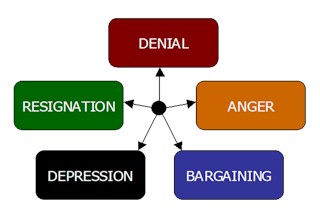
Regardless of the nature of the loss it might be, every one of us mourns differently.  According to Elizabeth Kubler-Ross, there are 5 common stages of grief a person goes through when mourning.  One has to note that we may not necessarily experience these stages in one fluid order.  We may actually go back a stage at one time, or go through some of the stages more than once.  Why?  Because there are triggering incidences everywhere.  It may be another friend’s stories, movies or TVs programs, or finding an old greeting card or an item of clothing stashed somewhere, unexpectedly.

  • Denial

No, this is not me.  It is not happening.  He/she will change his/her mind.  No one is dead, I am expecting him/her to walk through the door anytime soon.

  • Anger / Resentment

Why me?  Why did you do it?  Why are you deliberately hurting me?

  • Bargaining

If I do this, you will do that.  If you’ll stay, I will change.  If you bring him/her back God, I will be a better person.

  • Depression

It’s really happened.  Nothing is going to change.  Acknowledgement brings deep depression.  Often a quiet, withdrawn time.

  • Acceptance

This is what happened.  You can now begin to move forward. 

Speaking from experience, my advice is to really take the much-needed time to go through all 5 of the above stages.  There is no need to rush.  Someone who jumps right into acceptance the next day after a breakup or a loss in the family is only kidding himself or herself.  If we tell ourselves that it is okay to feel unhappy, lost, mad and disillusioned, it will help.  At times of despair, I seriously don’t think one needs to pretend he is a hero.

What my friends told me is so true.  Always, always take care of your own feelings.  Nurture yourself spiritually, emotionally, and physically.  No one else can do it but you.  Eat healthy, exercise and let yourself take time to grieve.  Needless to say, share with your trusted friends and advisers.  Showing signs of vulnerability is the strongest character building ritual everyone should go through, once in a while.


Read Full Post »

For many who own a slightly higher tiered credit or charge card in the city, they get to enter the Plaza Premium lounges at the Hong Kong International Airport while waiting for boarding.  Obviously it’s no The Wing, The Pier, The Cabin and The Arrival lounges operated by Cathay Pacific for its loyal customers, but over the years I have seen it revamping into a much improved product since inception. 

The lounge is heavily visited since it began to serve other airlines when CX either closes their doors or is simply too expensive for them.  I don’t know whether it’s mob mentality, but patrons here are generally not paying  hefty buffet charges.  Why are they devouring their food?  Sure there must be starving passengers somewhere who have been stranded for hours, but there is simply no point jamming in all those stale salads and sandwiches.  And what’s the deal with stuffing all those sodas and bottled waters in their carry-ons?

This reminds me, air travel is still considered a chore these days.  Surely it has been glamorized by fancy new seats and upper class cabins, but for the majority, cramming into those 3-4-3 economy seats for 6 to 14 hours is a nightmare.  No elbow room, no leg room, hardly any service, crying babies, rude passengers, smelly neighbors, long lines at the toilets, malfunctioned entertainment units, hardly covers all that to dread for.  Not to mention the multiplied misery if it is a business trip.

That explains why patrons at the airport lounges behave like inmates ready for detention.   To add-on, airports are notorious in charging exorbitant prices on food that is far below mediocre in city’s standards, and travelers just have to make do with anything free.

So this is all about supply and demand.  Since air travel is almost the only mode of transportation internationally (at least for most of Asia), the airlines can pretty much dictate what service levels they will provide or what food they serve.  The airports can make profits from their captive customers, and anything related to air travel including airport limousines, express railways and taxis are all entitled to charge much higher fees.

With that huge demand over limited or even monopolized supply, anyone who believe negotiations over price discounts, bonus offers or upgrades in the travel industry can produce material results, are seriously mistaken.  It’s still better than not doing anything, if the purchasing volume is sizable.  However, the results are not going to help you make any significant numbers. 

That’s why I prefer to leave travel procurement to my capable teammates, while I focus on reviewing the travel policy with our CEO.   Don’t expect miracles to happen there either, because as far as business travel welfare is concerned, I will never see the CEO picking the lounge where I am at today, over the champagne and caviar that he gets to enjoy on board.

Read Full Post »

Hell Cab

As I was chatting with friends today over lunch in Macau, my impression of a city is heavily influenced by its cab drivers.  Every single person will have a million (always horror) stories about cab rides somewhere, and it is exactly those 15 to 30 minute 1-on-1 encounter with a stranger that makes our lives so full and eventful. 

Hong Kong cab drivers have improved somewhat over the last 20 years or so.  The SARS period and the economic meltdown played a big part in toning down the temper of a few cab drivers.  The relatively intact public transportation network in the city also means that passengers have slightly more bargaining power when the alternatives are abundant.  I like this kind of co-dependency situation.  Yet I am completely sympathetic over innocent tourists still being gouged just because they look foreign or speak in another language.  I get so worked up over these scumbags tainting the image of our city.

Taipei cab drivers are very chatty.  I see it as a reflection of their friendliness culture.  They often ask me where I am from, what I am doing there and sometimes even comparing price levels of the two cities.  I guess most middle-aged cab drivers there are big fans of the many prime time political talk shows on TV.  I seldom run into cab drivers who don’t know exactly where he is going with the addresses provided.   So that’s good.

Bangkok cabs have plenty of reputation.  I don’t need to be rude at them, I just need to be forceful.  As long as the first 2 minutes of directions, meter pointing and mutual sizing up is past, I am usually relaxed for the 25 minute traffic jam.   Well, they almost never know where I am going other than the major tourist spots.  Apparently, local language instructions from the hotel doesn’t help either.  Great.   I was just lucky that I didn’t end up in Pattaya. 

Kuala Lumpar gave me one of the biggest headaches.  I am really hesitated to go back purely because of the city’s cabs.  I need to bargain, be rejected and almost laughed at.  The public transportation network wasn’t as established the last time I went, and hence I was quite discouraged to go out.   Sorry KL.

Singapore used to be efficient and predictable, but lately I can never hail any cab on the streets.   I was lining up with 10 other people for cabs to go to work from the Grand Hyatt stand, and after a hopeless 20-minute wait, the concierge politely asked me whether I would consider to call for one.  Why not?  Within minutes, an empty, not-for-hire cab who had been waiting by the curb for as long as I was standing there, pulled over to pick me up.  All that for the few dollars surcharge on top of regular fare.  Something is seriously wrong there.

One needs to be extremely fit physically to be in Shanghai.  There are always 50 people anxiously waiting for cabs with you on the same street at all times day and night, and everyone is picking their favorite strategic spots.  If you see one coming, just run along with the others toward it, regardless of whether it is occupied or not.   Just practice your elbow strength, vocabulary and running on heels before you land.  It will come in handy.  You think you will just wait patiently in lines outside hotels and shopping malls?  Tough luck, 49 people are hailing around the corner to make sure you will keep standing there till eternity.  And what’s with the locals always picking the front seat even when they ride alone?  Sorry, I have serious intimacy issues.

How can I leave out Macau?  I hopped on one this afternoon with my friends and we were going to this Portuguese restaurant with only an address.  The driver started driving with zero response.  “Do you know where it is?” No response.  So I asked the second time.  “Only if that is where you are going!”, he responded dismissively without looking at me.  Pardon me?  What have I done to offend you? 

It’s because of cab mentality like this in Macau, that I am glad I played a part in negotiating the city-wide free guest shuttle bus services my company built from scratch for our various properties.  Otherwise, there will not be any customers setting foot in our billion dollar investments.

Cheers.

Read Full Post »

« Newer Posts - Older Posts »