Feeds:
Posts
Comments

Archive for April, 2011

The term “office politics” sure has a negative tone.  Most people use sentences like “I hate that workplace because there is just too much office politics.”, or “I like working for myself so I don’t need to get involved with all that meaningless office politics.”  Yes we all have a million stories about how we end up being victims of cunning office preys and jealous co-workers.  It is certainly no fun to be involved in unproductive games and exchanges with people we don’t like, especially when we believe that is all they do at work. 

Yet when you think again, there really is no way to escape such dealings no matter where you work.  Even if you have your own business, your relationship with your employees as well as clients and partners constitute much of the same thing. 

My advice to almost every pet peeve is to embrace it with an open heart.  As long as you understand why people do what they do and what their intentions are, you will be able to rise above it and learn to tackle it with the right spirit.   Let me take a few common scenarios as examples.

  • Colleagues taking credit for your work

This is probably by far the biggest complaint anyone could have made, and sometimes it is your boss instead of a colleague who is in the wrong.  Instead of merely bitching about the nerves they have, put a mark on your work by making yourself more prominent but not in a cocky way.  If you still don’t know how to articulate that, you may deserve to be taken advantaged of.  No I’m not trying to be mean, but come on, bragging about something not yours is wrong, but letting people know of what you have come up with is your eternal right.  No one can take that away from you, so fight for your own recognition.  For bosses however, I learn to take a step back most of the time.  If my boss looks good, I look good too.  That’s why I get paid and I don’t mind contributing to the common good.  However, you better make sure you will be rewarded at the end of the day.  Knowing how to “tango” with your boss is an art that needs years of trust and mastering.  For that to happen, you have to be honest with each other.

  • Colleagues are lazy and they keep shredding their responsibilities

Yes most people don’t want to move their butts until they absolutely have to.  “It’s better be someone else’s problem than mine,” most would think.  I don’t care if they want to shred their responsibilities, because more often than not they would be caught sooner than you think.   I am eager to cross my arms and witness how it plays out.  However, why would I become the victim?  If you find yourself being blamed or positioned for something that you are indecently accused of, stand up for yourself.  No, not to your boss since it will look whiny and childish like getting abused in a school fight.  Stand up by following paper traits.  Put exchanges on paper.  Don’t resort to verbal fights as you will end of looking as bad as the other party.  Take a deep breath, write a calm and logical e-mail stating why it is in their own turf rather than yours, and state how sympathetic you are.  “Oh I just want to focus on the issue and have this resolved for the good of the department or the company, but would it work out even better if that comes from my dear colleagues instead?”  If you make it sound like you have risen well above the silly issue and manage to focus on the overall good, you can toast your victory.  Remember, let your boss know that you are a problem solver instead of whiner, even if it’s your arch-rival who has stirred all this up in the first place.  Being silent and passive is not likely to do yourself justice.

Chances are, someone is always going to review the facts if the issue turns bigger and uglier.  There is no way to ignore black and white texts on e-mails, so use that to your advantage, wisely.   Better yet, those who review it (including your boss) will realize that you are not to be underestimated.  Bravo.


Read Full Post »

CNNGo.com put up an article of “Life after dark:  10 things best done around midnight in Hong Kong“.   How appropriate.  One of the biggest reasons I still consider Hong Kong my most favorite place of abode is its ultimate accessibility.  Where else in the world could you find convenience stores, eateries, massage centers and karaoke boxes around the clock?  And you don’t even need to get on taxis if you don’t want to.  There are affordable enough buses and mini-vans to almost every corner of the territory, 24 hours a day.  I admit it, I am just spoiled, and I hope my fellow Hong Kongers could realize that they are amongst the luckiest ones on earth in terms of convenience and indulgence.  Of course, the price to pay is light, noise and crowdiness pollution.  There is just no way to escape it.

Alright, let’s see what 10 things CNNGo has in mind for us to do here past midnight.

  1. Go squid fishing.  Well, I think the only time I ever did that was over 15 years ago, and I think you don’t need to wait till midnight to do that.  You can rent your own junk or join one of those packaged tours with fellow passengers you don’t know.  I only remember that I was so excited to catch my first squid that I yanked it a bit too hard and found myself and my friends splashed by black ink all over our clothes.  Actually, I also remember that the squid didn’t taste that good afterwards.  I blame it on the primitive cooking techniques on the boat.  My point is, unless you are under 20 years old, don’t do it.
  2. Visit the “gwo laan”.  Gwo laan is the Chinese name for the wholesale fruit market in Yau Ma Tei.  I did that about 2 years ago around midnight and it was exciting to see fresh fruits arriving in boxes fresh from their source, and many of them come from Japan and the United States.  The fruits are fresh, and the prices are much cheaper than retail without the mark-ups.  The only draw back is that you have to buy in boxes, so be prepared to share it with your friends and family afterwards before they go bad.  Last but not least, have someone drive you.  It wasn’t much fun for me to carry a heavy box of Japanese peaches on the overnight bus that day.
  3. Take a red minibus to MongKok.  Or, I should say, take one from MongKok to anywhere in Hong Kong.  MongKok is like the center of nightlife in Hong Kong, and it is ready to transport people to everywhere else after you take everything out of it.  You will see every layer of Hong Kong population you can imagine on the minibuses and around the waiting lines.  Teenagers, working class, suits, drunks, you name it.  Plus you will get the most exhilarating ride you can ever imagine.  7 minutes will get from MongKok to the New territories.  It’s much more exciting than any roller coaster ride since the latter is definitely more safety proven than the former.  Take it at your own risk, please.
  4. Get lost on Cheung Chau.  Hmmm, this is something I never did at the wee hours at night since the last ferry back to the island departs around 11:00pm (or not? I don’t really know).  Cheung Chau to me is a bit too commercial within the many outlying islands of Hong Kong.  Though if you get to stay overnight there, the severely haunted holiday houses near the beach will surely make any scary movies ridiculously amateurish.
  5. Watch a rooftop movie.  Oh sorry, I don’t even know this existed to be honest.  In Hong Kong’s humidity, I think only tourists will find this enjoyable.
  6. Hang out at the beach.  Actually this is really a romantic thing, especially if you have a car, since it won’t be much fun to be stranded without return transportation.  But come on, it’s still only less than 30 minutes away from city center.  Where else can you find beaches that accessible on earth?  It’s a good place to chat, enjoy the silence and hear the soothing waves.  It can be a bit scary to stare at the dark waters, but isn’t it incredibly sweet to hold on to your companion’s hands to begin with? 
  7. Eat at an all-night dai pai dong.  This is also an amazing experience, but I will advise you to let your partner know of this ahead of time rather than swinging it out of nowhere.  As long as expectations are managed, the experience is down to earth, casual and oh-so-much-fun.  If your partner has his or her clubbing attire on, the scene can be a little ridiculous.  However if this is the contrast you are looking for, who cares?
  8. Get middle-of-the-night dim sum.  Well a lot of our midnight activities center around food, and I can’t find anything more applaudable  than the recent around the clock dim sum phenomenon.  There is nothing more satisfying than having freshly steamed dumplings, cheung-fan and beef balls when you have too much to drink.  I prefer that to the oily pizza slices, kebabs and hot dogs, any day.
  9. Walk with the ghosts.  Again I didn’t know there is such a tour of Wanchai’s ghostly neighborhood, until now.  A tour guide will “explain the abundance of ghosts stems from Wanchai’s long history and high rate of casualties.”  Hmm, I also believe this is really designed for tourists.  In densely populated Hong Kong, everywhere is a ghostly neighborhood.  Come on.
  10. Go for a bike ride.  Alright, at least there is some suggestion that is not food oriented.   I have a feeling however that this is also popular for someone aged under 25.  This is a subtle hint that I am nowhere qualified.

So, how many of the above have you done around midnight in this city?

Read Full Post »

I’ve gotten quite a number of questions from my previous post on healthy foods since most people know for a fact that fruits and veggies are good for them.  Despite this obvious and profound fact, we should always be reminded that any serving of fruits and vegetables equals to one less serving of unwanted carbs, fat and processed foods that we would otherwise be consuming in our daily diets.   Our food choices out there have gotten so incredibly confusing, hazardous and misleading that it just seems the more we eat, the more unhealthy we are.

That is when I find the following article by Courtney Hutchison of ABC News worthwhile to share.  Heart disease death rate drops with each added fruit and veggie serving we take in. 

“It’s time to make friends with the produce aisle: pumping your diet with fruits and vegetables isn’t just good for your waistline — it could save your life, according to new research from the University of Oxford.

While “5 a day” has traditionally been the mantra for fruit and veggie consumption, researchers found that those who consumed eight or more servings were 22 percent less likely to die from heart disease than those who consumed three or fewer servings a day.

Even among those who couldn’t manage the eight servings, more fruits and veggies consistently meant a lower risk; for every additional serving above two per day, researchers observed a four percent decrease in the rate of heart disease deaths.

Though past studies have linked the consumption of fruit and vegetables to heart health, many remain skeptical as to whether these foods have a direct protective effect on the heart. Given the size of Tuesday’s study (over 300,000 participants from eight different European countries) and the strength of its findings, some doctors feel that it may erase and remaining doubts concerning fruits and veggies, and cardiovascular health.

“This is probably the largest study of its type and should convince even the greatest skeptic of the value of fruits and veggies,” said Dr. Randall Zusman, director of the division of hypertension at Massachusetts General Hospital.

“This compares ‘enough’ fruit and vegetable intake to ‘more than enough’ and suggests that ‘more than enough’ is better,” said Dr. David Katz, director of Yale University’s Prevention Research Center. This could have big implications considering that the U.S. population “doesn’t even approximate the ‘enough’ target” as it is.

The study, which was published Tuesday in the European Heart Journal, is part of the EPIC trial, a long-term study in Europe initially set up to track the effect of vegetable and fruit intake on cancer.

In the U.S., the recommended consumption of fruits and vegetables has often been promoted as “five a day”. The Centers for Disease Control and Prevention moved away from that recommendation in 2007, to a more flexible approach, dubbed Fruits & Veggies – More Matters.

Instead of a flat recommendation of five servings a day, the new program changes recommendations based on age, sex and activity level. For a 40-year-old sedentary man, recommendations are now two cups of fruits and three cups of vegetables a day; for a sedentary woman of that age, the recommendation is 1.5 cups of fruit and 2.5 cups of veggies.

From 5 a Day to “the More the Better”

So what exactly would the eight portions a day observed in the study look like? 

“A large navel orange can easily weight close to 8 ounces and so does a large apple,” says Carla Wolper with the Obesity Research Center at St. Lukes-Roosevelt Hospital in New York. “That leaves a measly six ounces for salad, string beans, or other vegetables on the dinner plate, so yes people can easily eat this much,” she said.

Considering that the majority of the general population in the U.K. and the U.S. consume fewer than five recommended servings of fruits and vegetables per day, asking for eight may be a bit of a stretch, concedes Dr. Francesca Crowe, lead author on the study. 

Given that each additional serving suggested an additional heart health benefit, “it may be a relatively simple public health goal to encourage everyone to increase their intake of [fruits and vegetables] by a portion per day,” she says.

What Are Fruits and Vegetables Doing?

We all know that fruits and veggies are good for us, but why would eating them prevent death from heart disease?

The evidence points to a number of ways that these foods could work to boost heart health.

It could be that vegetables and fruits contain vitamins, minerals, and antioxidants that are having a specific effect on cardiovascular health, says Dr. Keith Ayoob, associate professor in the department of pediatrics at the Albert Einstein College of Medicine in New York City.

Another possible mechanism “is the impact of fruit and vegetables to lower inflammation, a known mechanism contributing to cardiovascular disease,” adds Dr. Stephen Devries, a preventive cardiologist at Northwestern Hospital.

No Harm in Piling on the Fruits and Veggies

It also may not be what fruits and veggies add to the diet, but what they replace. There’s less room in the diet for the high-fat, high-cholesterol, high-salt foods often associated with increased risk of heart disease when someone is consuming so many fruits and vegetables each day, doctors noted.

This makes for “lower blood pressure (because these foods are salt free), lower cholesterol (because they are fat free), lower weight (because they are likely to be associated with weight loss), [and] lower blood sugar (lower carbohydrate and sugar content),” says Zusman.

“Just by taking up a lot of room” in the stomach, [those] ounces of fruits and vegetables inherent in eight servings “will have a salutary effect vis-a-vis [cardiovascular disease],” Wolper says.

More importantly, there are few if any drawbacks to consuming a good amount of fruits and veggies .

“I tell my patients to eat whatever fruits and veggies they like at whatever means they can,” says Ayoob >. “They’re that good for you. Indeed Weight Watchers doesn’t even count them in their programs now. No one gains weight eating whole fruits and veggies.”


Read Full Post »

Do you agree with this list from Jennifer Chen of Travel + Leisure?  Make your own judgement.

Travel + Leisure’s list of world’s most underrated cities:

  1. Detroit
  2. Taipei (well for Hong Kongers it is not underrated at all!)
  3. Tucson Arizona (well my old school used to be at the neighboring state and you don’t see me returning after XX years…)
  4. Glasgow
  5. Nara, Japan
  6. Bratislava, Slovakia
  7. Providence
  8. Adelaide, Australia
  9. Valparaiso, chile
  10. Kotor, Montenegro
  11. Galway, Ireland
  12. Philadelphia (there is for sure a lot of culture there, but pardon me?)
  13. Antwerp, Belgium
  14. Merida, Mecixo
  15. Denver
  16. Valencia, Spain
  17. Montevideo, Uruguay
  18. Bologna, Italy
  19. Hangzhou, China (again, for Chinese they are not underrated either)
  20. Dusseldorf, Germany
  21. Granada, Nicaragua
  22. Calgary, Canada
  23. Bordeaux, France (hmmm….not for Hong Kong wine drinkers…)
  24. Durban, South Africa

For the full article and slideshow of why each of these cities are underrated, click here

Read Full Post »

In every job search opportunity the topic of remuneration and package always comes out one point or another.  Regardless whether you think you have any negotiation power on what’s on offer or not, you should know what you are worth.  If I were the employer, even if I don’t agree with the number you are proposing, you would still have gained my respect if you present a relevant logic of how you tabulate the number.

Salary surveys, benchmark reports, and insider information are all undoubtedly helpful in assessing how much your fair pay is going to be, but don’t apply yourself in everything you are hearing.  Each person has distinct characteristics and experience to offer and the higher the career ladder you are at, the bigger the variability.  So next time when the so-called headhunters coerce you in accepting an “unbeatable” offer, do your own research and make your own assessment.

What makes you stand out from the other candidates being considered for the same position?  Do you know who are out there and what level of experience they have?  The number one step is to know your competition.  Once you have been in a profession for some years, that should not be as hard to do as it seems.  You should have compared yourself with your colleagues in your own company, those in competitors’ organizations, at business seminars, trainings and cocktail parties.  In my line of work, I particularly pay attention to the personalities of my industry peers other than just their professional qualifications, because sometimes that is what it takes to tell a couple of similarly qualified candidates apart.

The hard qualifiers are easy.  Years of experience, number of subordinates, revenue numbers, savings figures etc. are all quantifiable.  Compare your accomplishments with the market to assess your net worth.  Why is your employer going to be “profitable” to bring you on board?  To drive revenue up?  To land more savings?  To re-energize the team?  Always make sure you will be delivering a much bigger number than what you want on your paycheck.  It’s simple math, and both sides have to win.

Yet it’s the soft qualities that few manage to notice.  Soft qualities like personalities, influencing skills, communication skills, staying power and leadership skills all have unlimited potential that no past accomplishments can truly showcase.  We have seen countless cases where a very competent high performer fails miserably in his new role because he does not have the leadership skills at the next level.  I wrote about that in my earlier post recommending Marshall Goldsmith’s book.   On the other hand, if you are confident that your soft skills are going to add great value to the post at hand, make sure you let your employers and headhunters know about it with examples, and then attach a dollar figure to it.  Yes how one sees this figure as relevant is a subjective issue, but as long as you can put together your logic behind it, there isn’t much to lose.

When negotiation is at stake particularly for a fairly big portion of your career life,  don’t be shy about it.   The key is to be as fact-based as possible, build a convincing proposition and articulate it skillfully.  If you are a good salesman at your job, why wouldn’t you do it for yourself?


Read Full Post »

Unless you have a clear and straightforward career path, you are likely to run into potential employers of a brand new industry.  I have plenty of experience in this area.  In my career life I have almost never repeated industries in my job moves, and I covered that on my About Me page.  Aside from obvious assessments of a potential new employer’s standing within my particular professional domain, I often need to run some “background checks” of my own.  What is this industry?  How do they rank relative to their competitors in the industry?  Are they performing well?  With help from the internet, while many employers are now Googling their candidates, it is just stupid if I am not doing my share in return.

Regardless of the actual likelihood of staying with any one employer for good, it is still prudent to presume that your next employer is a life-long dependable partner, very much like in the world of relationships.  Hence I also try to validate the long-term viability of the company’s business.  Do they stand a chance in the upcoming one to two decades?  I generally prefer not to take risky odds unless I know full well that my role is going to be consultative and transitional based.

So when IBISWorld identified 10 key industries that will for sure decline even after the economy revives, I was captivated by the title.  According to IBISWorld, “Of these 10 chosen industries, they all generally exhibit one or more of the following detrimental factors…

  • Damaging external competition
  • Advancements in technology
  • Industry stagnation”

For the full March 2011 IBISWorld special report by Toon Van Beeck, click here.

It’s no rocket science really, but I still feel it’s valuable enough to pass it on.  Thanks to Vault.com, who has put together a nice little Top 10 Dying Industries slide show accordingly. 

Read Full Post »

How many of the following do you think are out-dated or behind the times?  Alternatively, how many of the following are long-gone and you just wish they would make a second coming?  The ony thing I know for sure is that I am hopelessly attracted to people who have good manners, and even though I am hardly the perfect gentleman, I would like to see myself striving to become one.  I like Emily Post’s saying: Manners are a sensitive awareness of the feelings of others.  If you have that awareness, you have good manners, no matter which fork you use.”

Good Old Fashioned Manners

  1. Saying please and thank you
  2. Never intentionally embarrassing another
  3. Never talking only about oneself
  4. Not gossiping
  5. Not prying
  6. Not asking personal questions
  7. Not staring
  8. Not pointing at someone
  9. Dressing appropriately
  10. Not talking loudly
  11. Not asking intrusive personal questions

A list of Good Greeting Manners

  1. Smile
  2. Repeat that person’s name when introduced to you
  3. Remember their name!
  4. Ask How are you?
  5. Answer your questions with positivity
  6. Respect boundaries especially if it is a first time meeting
  7. Say nice to meet you, lovely meeting you.

A list of Good Dining Manners

  1. Sit with good posture
  2. Lay the napkin on your lap
  3. Start eating only when the host has started
  4. If there is no obvious ‘host’, wait for everyone else before you start eating.
  5. Keep your mouth closed when chewing.
  6. Take small bites.
  7. Eat quietly.
  8. Say excuse me when you have to use the restroom
  9. Keep your area clean and tidy.
  10. No double dipping unless you are dining with a culture where all the dishes are shared.

A list of Good Miscellaneous Manners

  1. Sit and walk straight. Maintain good posture at all times.
  2. Laugh, smile, giggle, cry with dignity. Do not make a scene.  Do not slap your knees, jerk forward or roar with your mouth wide open when you laugh or bawl loudly at the sidewalk when you are sad.
  3. Try to make as little noise as possible in all situations. (when you eat, walk, talk, sit, run etc.) No slurping, chewing noisily, crunching, e.g. cracking knuckles.
  4. Mobile Phone Etiquette: Do not be occupied with your phone when with people.
  5. Smile, be interested in the surroundings. ‘Reverse engineer’. Can you imagine Audrey Hepburn looking bored at a dinner party, even though she has attended hundreds?
  6. Dress appropriately. It is generally rude to call a certain attention to yourself. Such as wearing jeans to a wedding, looking sloppy etc.
  7. Speak properly.  Make it habit to pronounce your words and use correct grammar. Refrain from mumbling or speaking too fast. Avoid slang, calling people by their pet names or short forms unless you are close to them. Speak as grammatically correctly as you can.
  8. Never assume anything about anyone.  “She’s so rich, it’ll be okay if I don’t pay her back for lunch.”   “He’s the guy, I should not offer to pay for parking.”   “Someone will take surely give you a lift home.”
  9. Never touch another person’s things or children unless invited to.
  10. To be on the safe side, never talk about money. “How much does it cost?”, “What did you pay for your house?”, “How much do you earn?”, “How much do you make from your business.”,”What is your commission like?” etc.

Read Full Post »

Dating has definitely turned digital.  The following interview by Kurt Gregory of NBC news sure explains why many says the excitement, mystery and the butterfly feelings at the early stages of dating will soon go extinct.  It’s definitely easier and time-saving, but somehow it’s also quite sad. 

Dining experts say smartphones and social networks are changing the way America dates.

“21% of our surveyors say that they are more likely to ask out a date via text message or e-mail or Facebook versus only 9% who said that in our 2009 survey”, says Tiffany Herklots, Zagat’s Director, Communications.

Zagat’s Dating & Dumping Survey also reveals that like today’s employers, a large number of digital daters do their homework.  52% of Zagat’s surveyors admit to Googling their date before they meet.

Other dos: find your date’s likes and dislikes, food and drink included, and pick a place where you can have both good food, and good conversation.  And, there are the digital don’ts.

“Using their mobile phone or their blackberry at the table, texting and tweeting, is a sure-fire way to turn off your date,” says Herklots.  And if the date and/or relationship just isn’t working, “21% of our surveyors have admitted to breaking up over e-mail.  11% of them have admitted to breaking up via text message”.

Digital dating – helping you to love them or leave them.

Read Full Post »

Today is April Fool’s day.  To be honest I don’t quite get why the day is invented, or I should just admit that I am not that much of a fun-seeker in seeing other people’s miseries.  Likewise, I also hate to be pranked when I feel that I have been pouring my heart out to those I care about. 

Well there are however exceptions to everything.  I would be more than glad to see the following on today’s news:

  • The entire radiation scare in Japan is nothing but an elaborate drill to initiate awareness of nuclear energy safety;
  • The MTR price hike announcement is nothing but an attempt by the bus companies to attract new passengers;
  • The rains in southern Thailand, the volcanos in Japan, and numerous other weather abnormalities are one big-budgeted media promotion for the latest Hollywood blockbuster titled “It’s Not Even 2012.”

Of course, unfortunately none of the above are joking matters, and my heart goes out to all those who are severely affected in this daunting time.

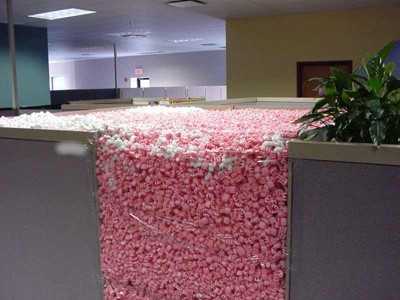
The same goes for pranks in the workplace.  When there are those of us who are taking our jobs way too seriously (actually why shouldn’t we?), anyone who attempts to pull some pranks at the expense of our commitment, time and energy is inexcusable.  In the following examples, the pranksters ended up getting sacked.  So, be warned!

“Pushed to the Limit

Ever work yourself into a frenzy worrying about a deadline? That is exactly what happened when Glenn Howlett’s coworkers sent him a memo saying his big report was due early. The “hint” to Howlett should have been the April 1st date on the memo – unfortunately, Howlett received the news while on vacation and didn’t clue in. He cut his vacation short, gathered up the troops and prepared to get to work. However, as the new deadline approached he worked himself up into a panic and started experiencing heart palpitations. He finally collapsed from stress and had to take a leave of absence. When he finally found out this was all due to an April Fool’s prank, he sued the company, resulting in a company-wide ban on future pranks.

Terror Alert

You can see how this April Fool’s prank started out amusing, especially for two teenage boys. Two 18-year-old coworkers at Westlakes in the U.K. decided to pick up and move another coworker’s car from one parking lot to another. This should have simply ended in some frustration and a few laughs — unfortunately they unintentionally moved the car into a restricted parking lot for a nuclear services industry. This resulted in the nuclear company evacuating its entire staff, fearing a terrorist threat. When the truth came out, the pranksters were arrested for unlawful taking of a vehicle and a bomb hoax, as well as suspended from work.

Fiery Fun

Well, who doesn’t think the potential of lava pouring into your home is funny? This must have been the mindset of Boston’s Channel 7 pranksters when they ended a 1980 news broadcast with a special bulletin: The Great Blue Hill – a 635-foot hill in Milton, MA – had erupted and lava and ashes were raining down from the skies. Supposedly a chain reaction from the then-recent eruption of Mount St. Helen’s, the channel played an audio tape of President Carter and the Governor of Massachusetts declaring the eruption a “serious situation.” Footage was shown of lava pouring down the hill. Once again ill-timed, the reporter ended the segment holding an “April Fool” sign, but not in time to squelch the flood of frantic phone calls from viewers. One man, so convinced, even carried his sick wife to safety. Later that night, embarrassed by the tumult their prank had caused, Channel 7 apologized and the executive producer responsible was fired.”

Get the picture now?  When there is so much stress, tension and suffering in today’s world, we really don’t need another senseless prank in our lives.  Read this on Vault.com for the rest of The Joke’s On You: 7 April Fool’s Pranks That Ended With A Pink Slip.

Read Full Post »

« Newer Posts