Feeds:
Posts
Comments

In Part One I wrote about procurement salaries and I recently come across new United Kingdom data from The Chartered Institute of Purchasing & Supply (CIPS).  For those who are curious over the profession’s earning power, read on.

Earning Power

By Supply Management magazine

Purchasing managers are more highly paid than their colleagues in marketing, HR sales, IT and finance. Members of the Chartered Institute of Purchasing & Supply (CIPS) earn £1,500 more a year than purchasing professionals who are not members. The pay gap between men and women is virtually non-existent in procurement. And more than half of purchasing professionals say they have good or excellent job satisfaction.

Figures like that make procurement a real contender in the graduate jobs market. The profession is seen by many organisations as the department that saves money, and while purchasers were not immune to job cuts during the recession they have generally escaped the worst of the cull. And now, procurement recruiters are reporting a buoyant market post-recession as posts open up and buyers become more confident about switching jobs.

And salaries are holding up well. The general complaint in this resurgent procurement jobs market isn’t that there aren’t enough applicants, but that there aren’t enough of the right calibre, so employers are willing to pay more than average to get the right people.

For junior managers, which is entry level for graduates, pay is about on a par with the national average for similar jobs in other professions: £30,000 compared with an average of £29,650, according to the 2010 Purchasing & Supply Rewards research from CIPS and Croner Reward. This is ever so slightly less than you’d get in an equivalent position in IT (£30,904) or sales (£30,441), but a bit more than in finance, HR and marketing.

As you rise through the profession, though, you can expect the gap to grow. At senior manager level you would probably be earning in the region of £52,500, about £10,000 more than you would be in HR or marketing, and compared with a national average at this level of £45,000. The trend continues right up to director level, where the average for purchasing is £90,000. For HR this is £72,611, against a national average of £80,000.

It is only at director level that there is any discrepancy between the genders, with the women who responded to the survey (10 per cent of the directors who responded were female) saying they earnt an average of £78,000, compared with an average of £90,000 for the men.

Average bonuses reported in this year’s survey were £2,500, with the top earners getting £4,800. Middle managers generally ended up with about £2,160, and 29 per cent of all respondents received a bonus averaging £1,200.

Of course, reward isn’t all about the pay. Working conditions and job satisfaction are also part of the package. The news isn’t quite as rosy as far as working hours go. There has been a general increase over the past year in the number of hours procurement professionals work, although this is by no means unique to purchasing. The Chartered Institute of Personnel and Development has recorded a rise in the number of hours worked across the UK as the economy recovers and labour demands grow. In procurement, this has meant that the biggest proportion of employees work 41 to 45 hours a week; last year the biggest proportion worked 40 hours a week.

Despite this, 54 per cent of survey respondents rated their job satisfaction as good or excellent. Almost all of them said that their job security was fair to excellent, and 77 per cent said they thought their total pay package was equal to or above market rates. A happy bunch, then – and with the right skills and abilities you could be well placed to join them.”

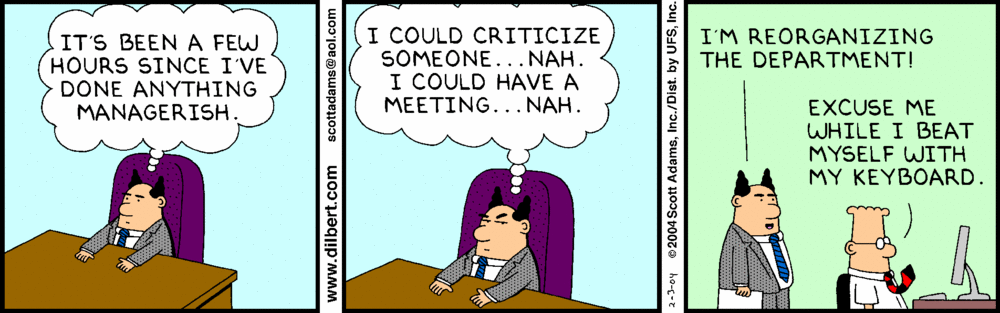
Centralize, decentralize, reorganize, re-engineer, grow, downsize, externalize, outsource, insource…

These are just a few of the most heard-of verbs in today’s corporate workplace.  Some are well warranted, but I bet some of you must have chuckled over the various reorganization episodes in your work lives.  Can you honestly tell me the following thought have not come into your mind?

Developing procurement talent is an art by itself, particularly when I still see many leaders having a less than adequate understanding of how this profession has evolved.  It is a highly fluid practice and it requires professionals with great adaptiveness and agility.  Paul Teague, US contributing editor of Procurement Leaders, published a blog post recently on the topic that is worth sharing.

“How to Develop Procurement Talent

By Paul Teague

Stephen Hester, vice president and CPO of Smith International, was the first to raise the issue at a recent Procurement Leaders roundtable on risk management,sponsored by Emptoris. Procurement, especially in the oil and gas industry from which he hails, has a people problem. Specifically, he said, the need is to develop the next generation of procurement professionals, to groom executives who will have the broad knowledge and international savvy required for success in a global economy.

One by one, the other roundtable members echoed his sentiments when talking about the risks they face. You can read what they said in a report on the Roundtable in the next issue of Procurement Leaders.

I heard similar views expressed at a previous roundtable sponsored by AT Kearney on data analytics. Ahmet Hepdogan, vice president of procurement at Fresh Start Bakeries North America, called for a new generation of procurement executives with “holistic” knowledge.

There have been whole conferences on  talent development, including Procurement Leaders’ Forums. Procurement Leaders formed a knowledge group on talent management. Recently, the Procurement Intelligence Unit called talent management a key priority for CPOs. Google even has a special project on people skills, specifically management skills.

I thought of all that when I read the US News and World Report magazine’s most recent ranking of the best US colleges for studying supply chain management. Here are some of the courses those “top schools” will teach future procurement and supply chain leaders: finance and accounting (Massachusetts Institute of Technology and Pennsylvania State University), law and marketing (Pennsylvania State) and negotiations (Michigan State University), all areas of knowledge procurement professionals need. But, I saw only one course each in global supply chain management (Michigan State) and international business and finance (The University of Michigan).

Gadzooks! Given the globalization of business, the apparent lack of recognition among some of the curriculum planners of the importance of international studies is stunning. Even the Harvard Business Review touted the importance of international experience and knowledge for procurement and supply chain management. I guess the rest of the proverbial ivory tower has no windows through which to look at the world.

So what should the ideal curriculum include? Introductory courses in engineering concepts (to give them an appreciation for product design and manufacturing); corporate finance (so they will see how CFOs look at a business); business law, marketing and advertising, personnel management, and logistics (so they can truly understand the issues those functions face); risk management (think of commodity-price fluctuations, Middle East turmoil and Japanese earthquakes and tsunamis); computer science and statistics (to get them used to using software for analytics); and, especially, courses in international relations/culture/communications (because the world really is flat).

And, rather than study versions of those courses tailored for procurement and supply chain management, they should attend the same classes that engineers, finance students, political science majors and others who will make their careers in those disciplines attend. May as well get them used to collaborating with those folks early.

Oh, and once they get their first job in procurement, I suggest assigning them to those other functions for three to six months each to further appreciate the roles of the people they will serve.

Maybe the best academic program is not one entitled “supply chain management,” but a broad, interdisciplinary program called “business-cycle management.” That may better reflect the role future practitioners will play.”

One thing for sure, those who are trained following Paul’s prescription will no longer be labelled as just a “buyer”.  Let’s announce to the rest of the world how much value we can add.

I cannot resist the temptation to post this up and I don’t think this needs any more elaboration on my part.  Some people just don’t realize how naked they are of their insecurities in front of colleagues, friends and even family members.  Please, don’t live in your own little bubbles.  Allow me to vent a little bit here, but consistent to my belief, I never leave criticisms alone without some recommendations.  This time around, they come from Michael Bucci of AskMen.com.  The last paragraph sums all of this up well.

Learn How To Brag Discreetly

By Michael Bucci

So here you are, sitting at the bar of a trendy restaurant lounge, enjoying a fine drink with a few of your friends. You are easing into the night and having a merry time doing so. You will soon be meeting some associates and lady friends for an evening out on the town.

It’s A Pleasure To Meet You

I’ve already discussed the importance of making a good first impression, but just as a reminder, know that people will form an impression of you within the first few minutes of contact. More likely than not, the impression they get will be reinforced over the next few hours.

Suppose you are talking to an attractive woman that is to your liking, or perhaps you are talking to a potential friend or business associate, how can you get the point that you are successful (or at least on the ball and soon to be successful) across?

What To Avoid

You are doing well for yourself; you’re a junior partner at a prosperous law firm. You’re on the fast track and you want people to know this, so you buy yourself a big diamond ring and tell anyone who’s willing to listen about how great your new Mercedes SLK-500 is and how much you prefer it over the BMW 740i or the Lexus. You also go out of your way to specify that anyone not driving such an expensive car is a big loser that is worth less than a bag of cheap fertilizer.

So what have you just achieved? Sure, everyone present will know you are making some green and are climbing the corporate ladder, but they will also hate your guts for being such a braggart. You’ll alienate everyone there, not to mention make a few enemies in the process. Not exactly the desired effect.

By following some simple tips, you’ll have a heads up on the competition and still keep your modesty intact.

Don’t Flaunt It

The old expression, “If you got it, flaunt it,” does not apply in this case. In fact, it rarely applies in any case. The last thing you want to do is come off sounding like a constant bragger. You don’t have to make it known that you drive a Ferrari by telling people directly. Instead, you can discuss cars in general with others and wait for them to ask what you drive.

When you tell them you drive a Beemer, say it matter-of-factly. Don’t add more details unless they ask you the questions. The trick is not to sound like you’re bragging, and don’t purposely make the other person feel small because they don’t drive a fancy car.

This way, they’ll know you drive a nice car and they will respect the fact that you don’t attach this to your ego too much (even if they attach a lot of meaning to what you drive).

The same goes for your clothing. You can wear classy tailor-made suits and Brioni shirts, but there’s no need to announce it to the world. People will notice you are well dressed, more so than the average man, and they will make a mental note of it. Just because they don’t comment, that doesn’t mean they don’t notice.

So how do you appear super successful and stay humble?

1. Never say how much you earn

Maybe you are knocking down $500,000 a year, but you should not make a point of telling everyone you meet what your take-home is. If people ask (which is impolite to begin with), just smile and say you do well for yourself and you are very happy with how things have turned out. Don’t offer more detail; to do so is somewhat crass.

2. Compliment others

A good way to brag discreetly is to compliment others on their clothes, car, jobs, etc. By doing so, it makes you seem like a nice guy for noticing other people, and they will in turn be flattered by the attention. Furthermore, they will likely compare themselves with you on the very things you are complimenting them on.

For example, if you tell Bob that’s he’s got a nice car (slick, fast, tears up the road, etc.) he’ll be proud of his car. He will immediately wonder what you drive. If you are driving a similar or better car, he will automatically raise you to his level, if not higher. Objective achieved: you bragged discreetly and so did he.

3. Just the facts ma’am

The worst thing you can do is embellish everything you say. People will catch on that you’re all about hype over substance rather quickly. Instead of telling long stories about how you single-handedly slayed the giant dragon, opt to emphasize the hard work and team effort that went into achieving the goal.

Mention that you are only part of the team and stick to facts. If it is a fact, then no one can argue or hold it against you. If you closed the big deal, then you will be recognized for your accomplishment, even if you give credit to others. The point is to avoid hogging all the glory or you will make enemies — a lot of them.

4. Your crew

Who better to sing your praises than your friends? This one is simple; just have your friends chime in once in a while with some tidbit about you that you can’t mention because it would be bragging. They can praise you and get away with it, so long as you act modestly about the thing in question and don’t talk about it much, if at all.

5. Never sound pretentious

There are geniuses in this world, and they do things with ease that amaze most mortals. However, no one will hold this against them unless they are pretentious about their achievements. Never make your success sound like it was a walk in the park. You don’t have to tell people it was the hardest thing in the world, but never make things sound too easy or people will resent you for thinking you’re better than everyone else.

Make it sound like they could have accomplished the same thing as you; this will reassure them of their abilities and they won’t feel threatened by you. Internally, they’ll probably admit to themselves that they would not have been able to succeed as you did, but as long as only they know this fact, they’ll be saving face.

Remember, you can be better than everyone else. In fact, you can even know that you are better; just never say so out loud and you’ll do great. So go out there and be modest, downplay your achievements and learn to brag discreetly. Once you get good at this, you’ll realize that this is the way the game has been played all along.”

“Did you know that Guiness employees…

  • Enjoy free happy hours on Thursday nights at a onsite pub;
  • Receive a liquor allowance each quarter;
  • Can take advantage of partially paid gym memberships;
  • Enjoy on-site services such as health clubs, laundry and dry cleaning services, film development, tailoring and banking services;
  • Are paid well and receive great benefits?”

This is an e-mail I received from Vault.com to market its company profile and insider information services aimed at job seekers. 

Interesting.  Free alcohol on work site.

Though this is hardly unorthodox at all.  At least they are an alcoholic beverages producer, and who can testify their products better than the employees?  I once conducted a e-sourcing training program for Nestle in Beijing.  During break I found fridges packed with ice cream bars that are free for employees to indulge themselves, let alone all the other coffees and soft drinks.  How they managed not to weigh 200 pounds was a mystery to me.  What’s truly amazing, is when companies like accounting firms, investment banks and law firms, offer Friday parties and fully paid gym memberships to the employees as an attempt to promote workplace harmony and work-life balance.

Undoubtedly we all love our perks and benefits.  Other than the critical medical and insurance benefits that I think everyone should be entitled to, I am not too crazy on the perks above.  It’s a nice gesture, but I do get a paycheck from my employer.  If I think that paycheck is fair, I will be as loyal to the company as the reciprocal treatment is evidential.  If my colleagues want to complain about not getting free wine, free office furniture, free fancy stationery or even free meals on company dime, I am happy to see them leaving for the folks that do.  We all have a choice, and it’s not like our employers have tricked us staying for good.  They might have in other aspects, but that is a whole different story, and one that shouldn’t be mixed in the same pot.

At the end of the day, all I am saying is that as long as I am compensated appropriately, I’d rather make use of my paycheck and spend it on dinner parties, gym memberships, home furnishings, investment and vacation plans with my family and friends, my way my time.  If you find that you are not receiving your paychecks lately, call the Labor Department now instead of stealing office supplies.

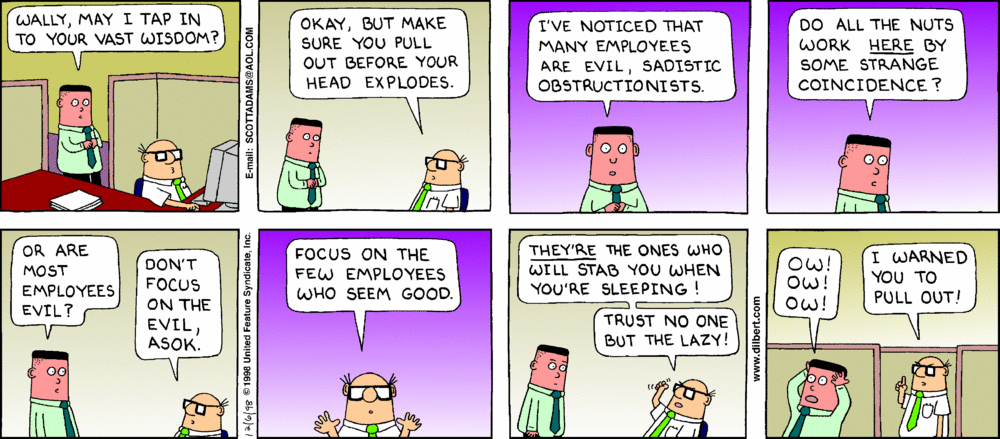
What a term: Evil, Sadistic Obstructionists.

Thanks you Dilbert, you have brightened my day, even if it is only in form of dark humor.

Gluing myself to the TV news seems like all I’ve been doing in every waking moment at home this week.  The daily developments are painful to watch, and it just appears as if the worst is always yet to come.  At work, we all are beginning to reflect upon how this epic disaster will have its effect toward our companies and commodities.  Business continuity plans need to be in-effect.  What about our staff, suppliers, partners, stakeholders, and customers in the zone of terror?  How will the utility crisis brought by the Fukushima Daiichi nuclear power plant turn out for the rest of the world?  Regardless of which line of work you are in, believe me, you will be affected. 

Jason Busch from Spend Matters has the following to say in how procurement and supply chain practitioners should be prepared for in this latest crisis.

“Spend Matters suggests an earthquake/tsunami procurement, commodity management and supply chain action plan based on the following steps for companies anywhere in the world in the following industries: automotive, diversified manufacturing (including transportation equipment and electrical machinery), aerospace and defense, high technology, consumer products, chemical/process. A plan should include at least the following steps:

  • Fully understand your extended supply chain and supplier locations and facilities — two, three or even four levels down
  • Stay in constant communication with your suppliers and send resources, if possible, to monitor production ramp-up at key facilities. Lessons from supply chain history suggest that what suppliers might be telling you on the phone in situations like this might be very different from reality. Those buying organizations who are on-the-ground first working closely with their suppliers are likely to receive more favorable treatment in capacity-constrained situations
  • Understand the geographic concentration of suppliers in potential regions in the area (and potential geographic concentration from a port standpoint as well). Even in a multi-source arrangement, natural disasters can help cancel out most of the insurance a split-of-business sourcing strategy provides when geographic concentration exists
  • Offer to help purchase raw materials and lower tier parts/components if necessary on a demand aggregation basis (your purchasing power as a larger organization may help secure supply given the constraints created by the disaster); provide resources to support the sourcing of materials necessary to get supplier facilities back up to production levels and understand, on a bill of material level, the raw material specifications that comprise a finished part, component, SKU or product (i.e., what your suppliers must buy)
  • Monitor the situation (and your supply chains) in neighboring countries as well as those throughout the Pacific that may be impacted by the disaster
  • Prepare to rely heavily on airfreight in the coming weeks and offer to step in and help suppliers from a logistics standpoint — despite the high costs, those who can rapidly secure sufficient capacity and favorable terms with airfreight working closely with carriers directly or indirectly through their 3PL partners are likely to face less; move quickly in general and consider charter situations based on industry, volume and the degree of impact
  • Put friendships and relationships with supplier personnel first — factories can be rebuilt, facilities can be overhauled, ports can be brought back online. Human lives and the spirit of connection are temporal. We must all remember that relationships need to come first — not the bottom line.”

I cannot agree more to the last advice, ever. 

Do I believe in bonuses for procurement professionals?  Why wouldn’t I?   And it’s not just because we don’t want to be singled out as the only profession not getting any, it’s more toward the pay-by-performance concept that I believe in.  Otherwise, it’s human nature to be complacent.

Yet there are still many opinions within my profession who opt against the idea because of integrity, measurement and benchmarking concerns.  I acknowledge those concerns, but I think they are addressable through rigorous control mechanisms rather than taking away the incentives for precision, innovation, effectiveness and efficiency.

The issue is well addressed in the following article by Rima Evans, projects editor for CPO Agenda.   The pros and cons of bonus schemes are covered, together with an implementation checklist.  For those organizations who are not convinced of rewarding their champions of change, I hereby recommend this article to them.

“Because You’re Worth It

By Rima Evans

Procurement has been widely credited for showing its mettle during the downturn and delivering value to businesses, but has this been supported by adequate financial reward?

Amid the current period of fragile and uncertain recovery, now is not a great moment for pay rises – in fact, the latest CPO Agenda economic survey showed a considerable drop in the number of companies approving pay increases (from 25 per cent in May 2010 to 9 per cent in November 2010.) But bonuses may be an option for CPOs currently wanting to redefine or improve the way their teams are rewarded while having to adhere to strict mandates to keep salary bills under control.

Although bonuses are not uncommon in procurement (sector and level of seniority are obviously big influencing factors), there is still some way to go in terms of catching up with other professions.

Andrew Coulcher, director of business solutions at CIPS, says its annual salary survey with Croner Reward in 2010 showed about a third of procurement and supply professionals received a bonus.

Most FTSE organisations offer bonuses ranging between 10 and 30 per cent as the average value, although these figures don’t just apply to procurement staff.

Mark Childs, director at Total Reward Group, points out that the higher the salary, the higher the bonus procurement can command. “If you are earning £60,000 you might expect a 15 per cent bonus, but on £100,000 you might be offered a 50 per cent bonus,” he says.

This type of financial incentive has its obvious advantages – it promotes improved performance and results by being tied to personal objectives.

Jonathan Bean, managing consultant at Purcon, an executive recruitment company specialising in procurement and supply chain management, says: “Do bonus schemes work? Ordinarily they do.

Procurement professionals are tasked with delivering results – not always savings, but often performance that is quantifiable – and a bonus is a great way to acknowledge performance.”

He adds: “The size of the achievement does not always correlate to the size of the bonus and as long as the mechanisms for bonus entitlement encourage sustainable solutions rather than short-term actions, there is no reason why bonuses should not motivate over-achievement.”
Childs agrees. “Bonuses work – partly because people believe they work. In procurement if the lifecycle of the thing or service that is being procured can be measured over time then bonuses are worth looking at.”

A recruitment tool

There are added benefits, Childs explains. Not only can they increase the retention value of reward packages – which is an advantage for CPOs trying to keep talent from walking out the door – they can also be used as a recruitment tool to differentiate your organisation from the competition. 

For employers, bonuses are an effective way of keeping a proportion of employment costs variable, which offers flexibility when employment costs need to be reduced quickly, for example, during a downturn.

At an individual level, “providing a line of sight between their activity and earnings promotes a healthy psychological contract”, Childs also explains. “Often the consequences of not providing a bonus are more detrimental than the positive effects.”

Not all procurement leaders, however, are convinced by their worth and they remain a contentious issue for some practitioners.

CIPS also warns that while bonuses do have their merits, it is a particularly sensitive issue given the austere economic cutbacks being implemented in many countries, and employers should tread carefully.

Performance incentives

Coulcher says: “In times of recession and economic turbulence, retaining good staff and keeping them motivated can sometimes be a challenge. Of course procurement and supply management professionals should be offered incentives in the way other professions are and it’s just one way of keeping the high performers. Yet, with all the controversy around bank bonuses, naturally there is a degree of uncertainty on how this should be approached, and with public sector cuts even more sensitivity is needed.”

Martin Blake, head of corporate procurement at London Probation Trust, a UK public sector organisation, admits to much deeper concerns about the principle of bonuses, describing them as incompatible with the aims, integrity and effectiveness of procurement.

“They can create a negative effect for an organisation, especially when buying services. Reducing cost and making savings is easy – but at what cost to quality? Procurement professionals must act with integrity and in the interests of the greater good of the organisation rather than merely looking after their own interests. A salary should be sufficient.”

However, Blake concedes that the effectiveness of a bonus depends on the nature of what is being purchased. “If you are buying commodities or products that are very discrete, bonuses may not be so detrimental. But in services it’s a different kettle of fish. How do you put a bonus on such intangible aspects as creating robust contract terms to protect the business, or important factors such as flexibility? Procurement adds a lot more value to the organisation, for example risk management, but how do you measure that for a bonus?”

Motive to influence

By contrast, Dirk Zemke, director of strategic procurement, ESAAP, at Sensus, thinks if other departments such as sales are offered bonuses, procurement should be included in the deal too. “Purchasing has to convince other departments to change so why not motivate them with a bonus to change the thinking of others? As service levels are defined and agreed with other departments I do not think a bonus creates negative effects for an organisation.”

Zemke says there is a bonus scheme in place at his company, offering 10 per cent. “It does work. It helps to define the priorities clearly and helps people focus on these priorities. I think it’s important with a scheme such as ours offering 10 per cent to keep people focused on two or three projects a year. With a team of five that is at least 10 major projects or activities you can achieve per year.”

So what elements make bonus schemes work, how can they be structured and what criteria should CPOs set down for the individuals’ and organisation’s benefit?

First of all arrangements will differ according to role and job. Childs explains there is a key distinction between a bonus, and commission or incentive plan. A procurement manager is likely be on a more general bonus plan, driven by the profitability and results of the company, as well as having to meet personal objectives. Whereas more junior staff carrying out transactional work might more commonly be on a commission-based arrangement, directly linked to individual results.
“For junior staff, where there is a more direct relationship between what they do and results achieved in the short term, they tend to want to see the reward more quickly. So they might earn £20,000 basic but be able to increase that to £500-£1,000 more per quarter in commission,” says Childs.

Broadly speaking, there are a number of criteria or KPIs that may be common to procurement bonus plans:

1. Savings
On the face of it, this is a logical way for procurement’s performance to be measured, but there are challenges. According to Bean: “As savings can be captured in a variety of ways, such as negotiations, cost avoidances or specification changes to reduce costs, it is not always a clear-cut issue. One problem often experienced within procurement is of course the validity of savings and how they are measured or recognised within the business. If you change the specification of a material used in production, is that a saving that can be banked against procurement for identifying an alternate grade, or against finance as the cost of manufacturing the product is reduced?”
Bean also warns that the contribution by procurement can also be muddied if savings are reinvested but overall budgets stay the same.

Childs says procurement enjoying a share of the savings they make is not as common as one might expect. “It’s more likely to happen among outsourcing procurement providers, where their revenue is tied in with savings achieved. Where procurement is not the core activity of the business they are more likely to be on a conventional management scheme.”

2. Contract compliance
Candidates are often measured on this, says Bean, as well as spend coverage managed or influenced by procurement. “It can be quantifiably measured while at the same time showing how much leakage there is in contracts set up with suppliers.” It’s not completely watertight however. Procurement can often bank a saving based on anticipated budget. But the savings might not be fully realised as compliance or buy-in to a deal is poor.

3. Customer or internal stakeholder feedback 
This can often be used to validate activities and satisfaction levels and can be used as a KPI, especially if the business is encouraging experts in their field and wanting customers to have full confidence in procurement, says Bean.

4. Compliance to follow the sourcing process
A measurement that can be adopted especially within organisations keen to make sure their interaction with suppliers is fair, auditable and transparent.

5. Quality and outcomes

Offering bonuses that hold individuals to account for outcomes is an area of opportunity for innovation, explains Childs, particularly in long-term, major contracts or purchases of large capital items.

“An element of the bonus could be deferred and remain at risk subject to long-term outcomes. So if a person cuts a deal and claims a certain amount of success, but 18 months later there were outcomes or quality issues that were not so great, that person can be held to account. So a person can’t just walk away after a deal has been cut.”

Childs adds: “This is much like what is going on in the financial services. I haven’t come across a scheme like this in procurement yet.”

The value of bonuses is hugely variable – some meritocratic organisations offer up to 98 per cent bonuses, according to Bean, but he adds that it is not usual for companies to directly relate the bonus value to value of savings delivered. “Ordinarily it is a combination of company, function and individual performance,” says Bean.

Coulcher thinks the split should be about 75 per cent/25 per cent with reward linked to overall company performance and supply chain performance.

However, Bean also advises: “A typical CPO will have a pot of money that will need to be sliced and diced for team members and the exact value an employee receives is affected by whether they have hit or exceeded expectations. There is no guarantee that a higher performer will always get a generous bonus, especially if peers are also performing well and the pots needs to be divided equally.”

Ensuring an effective bonus scheme requires there to be clarity about its purpose and reason. Being clear to staff on what the bonus represents – reward for contribution over and above a job or role and how it differs from salary, which is an employers’ contribution for doing a job, is paramount to avoid confusion. Its benefits should also be clearly spelled out.

They also have to be part of a long-term strategic approach rather than about encouraging short-term wins, says Coulcher. “Otherwise it may not encourage the right behaviour in staff. There may be consequences with supplier relationships if any incentives are based on cost savings.”
Childs warns that many managers place too much faith in bonus plans and are over-reliant on them as a tool for management control. “It’s the combination of the bonus plan and management support that makes a difference to performance. You can have the most generous bonus in the world but if you don’t enjoy working at an organisation it won’t make any difference,” he says.

He also advises that plans be designed so targets can be easily modified when necessary, which will also avoid allowing schemes to get stale.

Can bonuses be taken away? Usually they are discretionary, but not always. However employment contracts rarely refer to bonuses being guaranteed, says Bean.

They are usually cut when people are more concerned about job security than they are about earnings. “It’s very difficult to take bonuses away in boom times,” Childs warns. 

Checklist

Five tips for implementing a bonus scheme

Align performance measures to your procurement function needs for both now and the medium term.

Keep bonus schemes fresh. Periodically change performance measures and be prepared to revise targets to reflect changing circumstances.

Align payment frequency to the procurement cycle. If you are letting long-term contracts then consider deferring some element of the bonus to be able to measure on outcomes and quality.  If you are trying to incentivise short-term, tactical, small-scale results, consider monthly or quarterly payments.

Think about the total reward package on offer to staff. It’s not just about earnings from a bonus. Personal development is also important, so too are opportunities to climb the career ladder, and the culture of the business plays an important part in motivating teams.

Be situational. Don’t look for best practice or compare with another organisation’s bonus plan. Have the confidence to do what’s best for your own business.”

Getting people to stop whining is one of my most favorite catch phrases.  You will often find my Facebook updates filled with reminders to look at how fortunate we all are despite our beliefs.  If none of that was convincing before, what happened in Japan last Friday sure brings us back to perspectives in the most unfortunate fashion.

Every disaster is a test of our faith and endurance, and I believe that even though I am an atheist.  When one of the world’s most prepared nations for earthquakes and tsunamis was hit, there is just no way of telling how we can make sense of all this.  In the middle of all those hard-to-watch videos and news clips of the disaster, I have been in awe of the unity and perseverance of the Japanese people.

While they are still looking for the whereabouts of their loved ones, scrambling for food and shelter, and assessing immense damages of their properties, many Japanese offer to lend help to vulnerable foreigners and visitors who have had no experience or expectation of such disaster.  They offer precious water and food, look for transportation information for those who are hurrying to leave the affected cities, as well as to provide recommendations and options even with the slightest understanding of the English language.    If that’s not being considerate and compassionate, I don’t know what is.

So what does that tell us when we see this happening in our city every day?

  • when asked by local reporters whether he may risk airport chaos in Japan, a Hong Kong gentleman about to leave for his vacation answered: “Of course not, I know the Hong Kong government will charter flights to take us home”;
  • people jumping queues at bus terminals, subway stations, and even while waiting for elevators;
  • bitching at the government that they don’t have enough money to buy the HK$6 million show flats after graduation;
  • renowned for our checkbook charities instead of making a physical effort to help the needy

While trying my best not to turn into a grumpy old man bitching at the senseless cruelty of everything happening about us these days, I restore my faith when I see there is still goodness in people. 

And my dear Japanese friends, your spirits and strengths will pull you out of this disaster in no time.  I will make sure I learn from you.

The “Today Show” had a segment this morning on the captioned which resonates with many people, I’m sure.  It seems that we are doing almost everything on our phones now but calls.  Aside from making the occasional calls for hotlines, reservations or for work, I don’t think I am really using my phone to talk to any of my friends now.  Instead, I test, I e-mail, I surf Facebook and I share news all on one simple handy device ironically named a mobile phone.

The segment profiles college students claiming that they are texting some 20,000 messages on a monthly basis, and some of them believe that they can express themselves better through texts than by speaking with their friends in person.  I don’t.  Though I find it extremely convenient to communicate via texts, it’s not really the reason why I seldom make calls.  I guess I just don’t enjoy chatting on the phone endlessly.  My phone conversations are always to the point and mission specific.  If I really want to catch the latest of a friend, I always prefer asking them out for a face to face chat rather than doing it on the phone. 

No doubt texts can never take the place of a live conversation.  There is a limit to how much you can convey through the 26 alphabets and emoticons available on the phone.   However, the slight delay in response time allows us to think for a bit before we reply, which is always nice.  It also gives me back my much-needed sanity from hearing people screaming and babbling on their phones in noisy subways and buses.  If you work in an office, you will definitely agree with me that texting is a lot more discreet for those small talks with your boyfriends or girlfriends than using the phones during office hours.  For the latter, half of the office would already have their ears pressed toward your cubicle the whole time.

Texting is also great to catch up with someone without overly disturbing them, especially for the people who you are not that close to, yet.  It helps to minimize awkwardness, rejection and anxiety.  The flip side of the coin of course is that you can be zapping 3,000 texts with someone and still haven’t had a good idea of who they are, or what you think of them.  Is it  time-saving or is it indeed a waste of time?  You be the judge.

Experts believe that phone calls will soon head toward extinction.  With so little practice in their personal lives, now I understand why so many people are horrible in phone etiquette at work.  I wrote about this in an earlier post, and would like to take this opportunity to also include some etiquette tips provided by the Today Show.

  • Speak in an “even” tone, and clearly: As speakers, we often “mumble, shout, whisper, or speak with food in our mouths,” Sue Fox, author of “Etiquette For Dummies” and “Business Etiquette For Dummies.” says.
  • Don’t talk while being distracted by all the technology around you. Go to a room or area where there is no other technology that can tempt you with interruptions. Find a comfortable chair (or area to stand), where you can just focus on the phone call, and not be lured by beeps, message flashes, screens and other white-noise interruptions of technology.
  • As a listener, your job is to “really listen,” says Fox. Sounds simple, but, she says, “as listeners, we do other things when we’re supposed to be listening, listen without hearing anything the other person says, or respond to another person’s question from left field — with an entirely different topic.”
  • “Find the correct distance from your mouth to hold the receiver so that your voice doesn’t sound like part of the ambient background, or like a hectoring protester speaking into a bullhorn,” she says.
  • “Exercise patience on the phone, and let other people finish their sentences.”
  • “Confirm you’re listening with periodic (verbal) sounds, such as ‘ah-hah’ ‘yes’ and the like.”
  • Believe it or not, your “posture when you speak on the phone strongly affects how you sound to the person on the other end” as well as “the energy that comes across on the telephone,” Fox says. “Don’t slump in your chair; sit up straight. Also, smiling while you speak can actually make the tone of your voice more pleasant.”
  • “Never use phone calls as an opportunity to get caught up with paper-shuffling,” she says.
  • “Remind yourself that feeling ‘out of control’ in a phone call is just a state of mind,” says Sherry Turkle, MIT professor. “You can warmly and firmly set boundaries in a phone call. Say: ‘I wanted so much to hear your voice … It always lifts me up. But I only had five minutes. So, if it’s okay with you, let’s chat for those five minutes. It would be precious to me.’ ”  Meaning, says Turkle: “Reaffirm what is precious about the phone call, that you will hear the voice — and take out of the phone call the thing that may mar it for you — the tension that it might interfere with other responsibilities, other pressing matters.”
  • You may not like to talk on the phone, but “keep up telephone contact with close friends,” Turkle says. “They have things to say that they don’t want to say in e-mail or text. Count on it. You will hear things in the cadence of their voice, their inflection. Learn to limit these conversations; it is a crucial life skill. Learning it with friends who care about you will put you in good stead for the rest of your life.”