Feeds:
Posts
Comments

Archive for the ‘Hope’ Category

In Marshall Goldsmith’s book “What Got You Here Won’t Get You There“, the renowned executive coach writes about how the very characteristic that you believe got you where you are, may exactly be the one that is holding you back.

On the back cover of the book, it writes: “Your hard work is paying off.  You are doing well in your field.  But there is something standing between you and the next level of achievement.  That something may just be one of your own annoying habits.  Perhaps one small flaw – a behavior you barely even recognize – is the only thing that’s keeping you from where you want to be. “

“The Harvard Business Review asked Goldsmith, “What is the most common problem faced by the executives that you coach?”…he answers this question by discussing not only the key beliefs of successful leaders, but also the behaviors that hold them back…. Say, for example, you have an extremely loyal and talented staff.  You are known for spotting and nurturing talent.  Your inner circle of employees regularly gets assigned the plum projects.  You may think you are building a solid team, but from the outside looking in, you are encouraging sucking up.  You are guilty of Habit # 14: Playing favorites.  Goldsmith outlines twenty such habits commonly found in the corporate environment and provides a systematic approach to helping you achieve a positive change in behavior.”

The so-called 20 habits are the most common flaws, but they are not flaws of skills, intelligence or personality.  They are challenges of interpersonal behavior, often leadership behavior.

  1. Winning too much:  The need to win at all costs and in all situations – when it matters, when it doesn’t, and when it’s totally beside the point.
  2. Adding too much value:  The overwhelming desire to add our two cents to every discussion.
  3. Passing judgement:  The need to rate others and impose our standards on them.
  4. Making destructive comments:  The needless sarcasms and cutting remarks that we think make us sound sharp and witty.
  5. Starting with “No,” “But,” or “However”:  The overuse of these negative qualifiers which secretly say to everyone, “I’m right.  You’re wrong.”
  6. Telling the world how smart we are:  The need to show people we’re smarter than we think we are.
  7. Speaking when angry:  Using emotional volatility as a management tool.
  8. Negativity, or “Let me explain why they won’t work”:  The need to share our negative thoughts even when we weren’t asked.
  9. Withholding information:  The refusal to share information in order to maintain an advantage over others.
  10. Failure to give proper recognition:  The inability to praise and reward.
  11. Claiming credit that we don’t deserve:  The most annoying way to overestimate our contribution to any success.
  12. Making excuses:  The need to reposition our annoying behavior as a permanent fixture so people excuse us for it.
  13. Clinging to the past:  The need to deflect blame away from ourselves and onto events and people from our past; a subset of blaming everyone else.
  14. Playing favorites:  Failing to see that we are treating someone unfairly.
  15. Refusing to express regret:  The inability to take responsibility for our actions, admit we’re wrong, or recognize how our actions affect others.
  16. Not listening:  The most passive-aggressive form of disrespect for colleagues.
  17. Failing to express gratitude:  The most basic form of bad manners.
  18. Punishing the messenger:  The misguided need to attack the innocent who are usually only trying to help us.
  19. Passing the buck:  The need to blame everyone but ourselves.
  20. An excessive need to be “me”:  Exalting our faults as virtues simply because they’re who we are.

If any of the above sends a chill up your spine when you read it, good.  It’s better realizing it than never.  If you are doubting Mr. Goldsmith’s observations, you may want to know he has been the personal coach of corporate CEOs including American Express, Boeing, GlaxoSmithKline, U.S. Army, Sun Microsystems, GE, Goldman Sachs, etc..  His credibility is second to none.

I seriously recommend this book to everyone who want to be more successful from where they already are.  Learn from Marshall Goldsmith, and learn from the corporate world’s biggest CEOs.

Read Full Post »

Feeling Lonely?

It seems that the biggest fear of most people in the city is feeling lonely.  The feeling is even more compelling when you know that you are in the middle of the most populated metropolitan cities of the world and yet you still feel alone.  That feeling is quite chilling indeed.  Singles are longing for relationships because they are sick and tired of being alone, and at the same time, couples split up because they feel alienated by their partners in various means.  Usually, the pain of being alone is the number one hurdle anyone needs to endure over a breakup or a divorce. 

According to relationship coach (!) Rinatta Paries, “One of the marks of maturing emotionally is learning to bear with or even thrive when alone.  And your successful ability to be alone is what allows you to have the best relationships of your life. The successful ability to be alone can mean the ability to feel alone and lonely without the need to seek someone out to fill the void.  It can also mean being alone but not being lonely, with the void filled with creativity of self-expression, or passion for pursuit of something that matters to you.”

It sounds really pathetic, cause we have always been taught that we should both take care and at the same time depend on each other in a meaningful relationship.  However it is somehow also this dependency that causes friction and mistrust between a couple, leading to an eventual breakup.  How disillusioning?

Well, the reality is that there is really no way around it.  We just have to be better at combating loneliness in life.   Seeing how others behave, I am advocating the following “Don’ts” in times of vulnerability:

  • Don’t pity yourself in emotional songs, movies, novels  or TV.  Some people tell me that they need a good cry, but I have the feeling that we already have enough material ourselves to make us cry our eyes out.  So wallowing in romantic tragedies only makes us fall deeper into our depression, which also makes it harder and longer to regain confidence in starting over.
  • Don’t resort to fortune-telling or tarot cards or the like.  I know it’s tempting to try to get some sensing out of all the broken pieces, but such baseless advice may prolong unsubstantiated pain or misery, over some “miracles” that could never happen.  Fate is in our own hands.
  • Don’t over occupy yourself.  Some people prefer to take up projects that will make themselves busy, be it taking up a new hobby, adopting a pet, or renovating their homes.  While there is nothing wrong with these constructive activities, rushing into things too soon may reinforce the reality of loneliness further.   Substituting intimacy with other human beings for a big project may pave a longer path of unhappiness.

So what are the “Dos?”

  • Talk to your friends that you trust.  Open yourself up with people and try to move a little closer emotionally to people you like.  Enough with the superficial chats.  Your friends can only be as close to you as you are with them.
  • Learn how to strike up meaningful conversations with new people.  Again, I’m not talking about the easy exchanges on what’s good to eat or meaningless gossips over other people.  Come on, aren’t these “friends” or acquaintances the reason you feel lonely in the first place?  It’s not the 798 friends on your Facebook profile page that makes your life fulfilling.
  • Surround yourself with the right crowd of friends.  Okay, I don’t mean to sound like an elitist, because there is no definition as to what the right crowd means to everyone.  I am told that the right sorts of people are those they give you energy instead of taking it away from you.  I like this definition because I think it’s very powerful.
  • Don’t demand sympathy.  Your true friends will surely take care of you, support you and encourage you without you even asking.  There is a difference between opening up yourself, asking for help, and being whinny and needy.

It certainly takes a great deal of courage and determination, but what doesn’t?

Read Full Post »

No one should ever underestimate the criticality of employee recruitment and retention, and so is the procurement community.  The biggest reason I see people leaving a role in strategic sourcing, other than purely monetary attractions of another role, is job dissatisfaction.  In my early posts of this blog, I wrote quite a lot about the constant struggles, frustrations and challenges of our roles.  The procurement profession is undergoing a transition phase –  transitioning from a back-office operational function to a more strategic business consultative role.  However, if the leader is not in tune with the expectations of the company, or if he or she lacks the vision and stamina to put forward a compelling case in front of top management, there might be a high risk of losing good people.  Since we are advocating strong influencing capabilities and stakeholder management skills, new joiners will consume costly months of time to reestablish connections with business partners, usually not something the organization can afford often.  As I have said before, strategic procurement is a people business.  The deliverables and results of each project varies significantly by the strategies and personalities of the individual project leads.  No negotiations can be cloned.  Results are different in different counties and different time zones.   Unlike what we buy, staffing should never be commoditized.

I recently come across an excellent article on CPO Agenda titled Stars of Tomorrow, written by Helen Gilbert.  Selling the industry as a long-term career choice, is what she advocates.  If everyone thinks that stepping out of the profession is the only way to progress their careers, there is a big problem. 

Raising the awareness of the profession is critical in recruiting and retaining talent.  I wish that I am modestly playing my part in this space.

Read Full Post »

Today I have an update to my last entry which I titled Biggest Flop 2010.  Quite honestly I am hardly surprised to see the latest development based on my earlier observation.  Since the disaster in securing top management buy-in, the organization is now put in a very vulnerable situation.  The business lines are all taking a bite off the procurement department, and its head is constantly kept in a defensive mode.  He is often summoned by other department heads to provide quick fixes that are hardly strategic or measurable.  The middle to upper management team is always called for ad hoc customer meetings where they have little idea how to respond, and whether or not to make certain commitments due to limited departmental resources.  The organization is in a complete state of chaos.

Based on the unfavorable circumstances, I can offer a few recommendations which can hopefully improve morale and make the situation slightly more bearable.

1. Salvage the situation

For the immediate period, nothing much can be done in terms of changing the corporate management’s views.  The best tactic is to embrace it gracefully, while striving to develop success cases from the ground up.  Having top-down mandate is ideal, but it’s not the end of the world even with its absence.  This is how true leadership emerges and shines.  Pick the best people to put in front of selected customers where there is the highest hope to succeed both in terms of quality assurance, savings potential and improved efficiency.  Convince the customers upfront that you are not expecting anything from them other than their cooperation.  Work from the bottom up.  Take care of all the paperwork, liaise with legal, compliance, finance and investigation, represent the clients well in front of suppliers, and make the customer experience a pleasant one. 

All this is needed to be put into the credits bank so that when the right moment comes, these customers are going to root for you in front of top management.  The best salesmanship technique is to have your customers sell for you, instead of doing so yourself.

2. Renegotiate goals

Now is the golden time to renegotiate goals.  Since a substantial spend area is taken away, the cost savings expectation should be adjusted.  In every case, link addressable spend with potential savings as tightly as possible, even if we know it may not always be a directly proportional relationship.  Merely negotiating terms and conditions without having the power to affect sourcing decisions will not bring in cost savings.  The moment top management is convinced and concerned over lost savings, they will change their minds and come knocking.

3. Retreat

For the spend area that is taken away (in this case above-the-line marketing), retreat completely.  Follow exactly the order of top management.  I am more than happy to be a good corporate citizen all along, but since my contribution is now deemed useless by corporate, I won’t be uttering a word.  In my many years of corporate experience, there will be plenty of crisis situations soon enough (knock on wood) where marketing will come screaming for help.  Their major supplier is asking for a 50% price increase and they are left with no alternatives.  The supplier is claiming structural damages compensation for incidents that need mediation.  The company is undergoing corruption and antitrust investigations by the local authorities.  Marketing is being criticized by internal and external auditors for their approval and authorization inadequacies.  When they come knocking – sorry, I can’t comment since I was not involved in the first place.

This isn’t meant as petty revenge, but no one will appreciate the criticality of a function (procurement) until they are bombed with crisis situations.  Let these risks speak for themselves.

4. Energize the team

No matter how one keeps the recent top management discussions in closed wraps, everyone in the procurement team will hear about it in less than 2 hours.  Words spread fast, especially bad news.  The team is going to view it as failure of the leader, and all these rumors are devastating. 

Leaders should address the team in plain language, and advocate that this is all just a transitional phase.  Unity is crucial.  The function’s credibility should never be tainted.  And leaders are working on renegotiating the goals with top management only as a tactic to regain power. 

When team members understand the leaders’ plan of attack, there will be better hopes of instilling confidence and morale.

5. Contain the virus

Keep your ground and don’t let the same happens with other business units or spend areas.  There is a likelihood that other business leaders will follow suit and take a shot of procurement.  Visit these leaders and explain to them of this exceptional and transitional development.  If they have concerns, ask them to come to you instead of escalating straight to the COO.  Depending on the party, different tactics may need to be deployed, ranging from “be your buddy” to scare tactics.  You just cannot afford to have more spend areas fall through.  Otherwise, you may as well propose to have the whole function redesigned as a purely operational cost center with no cost savings responsibility.  The function can then be outsourced to India, Philippines, or China!

Well, these are the top 5 steps that I can think of almost immediately.  Will they adopt any of that in the near future?  That’s what I am eager to find out soon.

Read Full Post »

We so-called city folks are full of ourselves.  We think we are street-smarts and hence we are constantly guarded against everyone around us.  Indeed there are loads of crooks out there prying on the least prepared and the most gullible.  Though as residents of almost every fast-paced city, we should all learn to be a bit more accepting, and a bit more compassionate to people around us. 

We never want to lose out, so when we interact with people, a mental calculator surfaces that shows us what potential benefits, or trouble, we can get from the other party.  Shall we be friendly, or shall we just nod along politely?  What are the odds that we will be taken advantage by him or her?  What do they want from me? 

Not until I left the city and entered into a new surrounding did I realize how ridiculous our behavior could be.  I came into contact with all kinds of people in Taipei, and I received a lot of friendly treatments from all of them.   The people I met genuinely wanted to share life stories with me.  They opened up, and they took the time to invest in conversations. 

And I don’t mean hollow conversations where people only talk about what food they have eaten, cars they drive, or how much money they make.  I don’t think people should need these topics to justify their existence or value on the planet. 

I was greeted by very sincere folks in Taipei who were genuinely interested in knowing about each other.  I met people who openly shared their darkest secrets and insecurities with me, a stranger from Hong Kong whom they had never met before.  Though I cannot recall the last time I experienced it here at home, I didn’t find that odd at all.  It should be human nature.  The conversations I was engaged in were always candid, honest and at times vulnerable.  I like that on people.

In my mind, everyone should possess a certain level of confidence.  Showing your vulnerabilities is not a sign of weakness.  If you have inner qualities that excel amongst others, people will feel it without you needing to flaunt it.  Confident people, as long as they are not cocky, are incredibly attractive.  Insecure people, on the other hand, are usually despised and almost hated by others.  When I see people who are humble and willing to improve upon themselves, you will see me throwing myself at them like a moth to a flame.

Sounds like a bunch of random thoughts, but I owe it to Taipei who reaffirmed me on the goodness of people in the start of 2011.  Thank you.


Read Full Post »

Taiwan is famous for its book scene.  I seldom see Hong Kong people holding a book in subways, buses, coffee houses or restaurants anymore.  Instead, we fiddle with our blackberries, smart phones, PSPs and NDS whenever we go.  Even if you think the launch of Kindle and iPad will re-ignite our passion of reading electronically, I often see people reading online newspapers, magazines and comic books instead.  Well, to be fair I do think having the proper infrastructure does play a big part in cultivating the reading phenomenon in Taiwan.  The city is filled with gynormous-sized book stores that open way into the night.  The stores are cozily decorated, quiet and artfully displayed.  There is plenty of seating, and flipping through every page of the book for hours in a row is not frowned upon.  The stores look more like libraries instead of commercial sales points in Hong Kong.  The latter, is definitely not an enjoyable experience.  No wonder Hong Kong people do not find reading pleasurable.

You can tell a city’s culture pretty much by the bestselling books on display.  Yesterday night when I did my last round of bookstore surfing after a soothing day of hot springs and comfort food, I paid attention to the bestsellers’ rack.  The titles (translated from Chinese) include:

  • The Anatomical Chart of Homes
  • Tokyo Design Life 100+
  • The 14 Economic Wars that China will Face
  • The Elements: A Visual Exploration of Every Known Atom in the Universe
  • Simplexity: Why Simple Things Become Complex (And How Complex Things Can Be Made Simple)
  • The Goldman Sachs Conspiracy
  • The Secret Laws of Management
  • Getting Organized in the Google Era
  • Living Life Out of Relaxation

…to name a few…

I am quite impressed.   Most titles I come across center around self-improvement, emotional quotient and living well-balanced and full lives.  Bravo.

So what are some of Hong Kong’s bestselling Chinese titles?

  • Land and The Ruling Class in Hong Kong
  • Taipei Travel Guide 2010-2011 Updated Edition (surprise…surprise!)
  • My Retarded Way of Raising My Baby (comic book I believe…and excuse me for my literal translation)
  • Tokyo Travel Guide 2011-12 Eat, Play, Buy Ultimate Edition
  • Learning English with Regina
  • Out of Control Hong Kong’s Kids

…and I am skipping 258 titles of “How to Get Rich”, “Investing in Property”, “Stock Market 101”, “How to Read Just Enough to B** S*** Your Way through Wine Appreciation”, “How to Get Your Kids into the City’s Hottest Kindergartens”, “Year of the Rabbit Fortune Telling”…

This is the fast food reading culture of Hong Kong.  We are all too goal-oriented, as if there has to be a definitive purpose to pick up a book and read.  It’s good that we like to be informed and knowledgeable at all times, but reading 698 pages of Eat+Play+Buy travel guides is not going to do yourself too much good when you find yourself exhausted running around a foreign city like a maniac.  The how-to guides are necessary evils but should be tamed down a notch.  I seldom hear people make good money from reading those get-rich guides either.  If we can all just pick up a handful of titles that are intriguing enough to our minds, I am confident this mental exercise we do will benefit us a whole lot more, and that may very well include living a positive life, maintaining healthy relationships and ultimately, building an emotional wealth that no money can buy.

Read Full Post »

2010 In Review

The stats helper monkeys at WordPress.com mulled over how this blog did in 2010, and here’s a high level summary of its overall blog health:

Healthy blog!

The Blog-Health-o-Meter™ reads This blog is doing awesome!.

Crunchy numbers

Featured image

A Boeing 747-400 passenger jet can hold 416 passengers. This blog was viewed about 1,500 times in 2010. That’s about 4 full 747s.

In 2010, there were 40 new posts, not bad for the first year! There were 85 pictures uploaded, taking up a total of 32mb. That’s about 2 pictures per week.

The busiest day of the year was November 24th with 81 views. The most popular post that day was About Me.

Where did they come from?

The top referring sites in 2010 were facebook.com, linkedin.com, alphainventions.com, WordPress Dashboard, and lmodules.com.

Some visitors came searching, mostly for http://www.elavatorspeach2010.com, vendor management and corruption, and reciprocal trading in procrement.

Attractions in 2010

These are the posts and pages that got the most views in 2010.

1

About Me November 2010
1 comment

2

Up In The Air … As Trainer (Part One) November 2010

3

Measure Me This November 2010

4

Professionals Anyone? November 2010

5

The Sale Must Go On December 2010

Read Full Post »

You see them staring at you on 5-storey high billboards.  You see their dashing smiles and authoritative poses on the city’s buses.  You see them on full-page newspaper ads where they are pictured with hundreds of students holding up their straight-A report cards.  Yes, they are the city’s star tutors, though they dress and behave like your TV and movie idols.  This, is a multi-billion dollar industry.

When I grew up there were a few tutor schools where we got ourselves enrolled to brush up for upcoming public exams.  Those were usually a few sessions only for each subject and the fees as I recall were nothing like what students today are paying.  The star tutors today have evolved to almost replace the normal daytime schools that students go to.  Their curriculum is tailor-made to survive public examinations, and hence the star tutors spend a considerable amount of time researching the latest examination trends and marking schemes.  Many of them possess enough star qualities to lure aspiring students.  They are well-groomed, articulate, and hardly much older than the kids themselves, making them extremely relatable and approachable – comparing to the day school teachers.  They hire assistants to help them prepare fancy notes and even run errands because their tutoring schedules are so hectic from running around several tutor centers in the city, usually on a daily basis.  They hire image consultants together with professional make-up artists, photographers and designers to make sure they are marketable in this lucrative business. 

I am not here to criticize whether these star tutors have twisted the idea of education, or whether it is unethical to make money out of young kids.  In fact, this is a common trend of fast food mentality of Hong Kong where everyone focus on only the results rather than the means.  The blame is with everyone.  I just see this as a classic example why training and teaching techniques need to be evolved according to times.  Everyone can find subject literature in books and over the internet, and they need no one to simply read to them and repeat case studies from textbooks. 

Students want to hear relatable material so that it helps with digesting and understanding the subject at hand.  In my field of strategic procurement training, we always make use of real life case studies to illustrate the theories we advocate.    Public sector case studies are often popular due to their wide coverage over TV and newspapers.   On the other hand, the trainees also don’t want to be preached  like young school kids.  They want to feel that they are also contributing to the class and hence we are often moderators instead of trainers.   I like the idea that the star tutors are organizing social activities to help bond with the students.  I know, you may argue that they are in fact sucking up to their paying customers, but if the students do not feel that the classes are enjoyable and effective, there are tons of other tutors out there.

I dream of the day that there will be similarly inspired tutor centers some day where we can offer consulting advice to working procurement professionals, whether it is in terms of career progression advice or anonymous yet real life work issues.  As the next generation of public-exam-tutors, will there also be star tutors for new career professionals?  Come to think of it, the “rules at work” are even less scripted and way more challenging.

Read Full Post »

I was looking for salary survey information for some research and just realize that the latest figures won’t be available until first quarter next year.  While surfing the two main industry certification bodies, namely The UK-based Chartered Institute of Purchasing & Supply (CIPS), and US-based Institute for Supply Management (ISM), I come across some interesting facts of the year 2009.

I know and I have been advocating all along that the procurement profession has undergone a major transformation over the last few years.  However I am still quite shocked to read from the CIPS – Croner Reward salary survey (conducted between October and December 2009) that procurement and supply professionals get paid more than peers in marketing, finance, IT and human resources in graduate careers.  Salaries obviously reflect experience, qualifications and ability, so graduates entering the profession need to prove themselves by showing a willingness to learn, independent thinking and determination. 

This is definitely great news for us to recruit graduates into the profession. 

In terms of experienced procurement professionals, the ISM 2010 Salary Survey (covering 2009 data) shows average salaries by titles range from US$50,506 for entry level positions to US$240,408 for chief procurement officers.  Total average annual compensation is US$98,200, and 34% of respondents reported earning a salary of US$100,000 or more.  The reported high salary was US$620,000 for the men and US$690,000 for the women.  Bonuses are already included in these figures.

I know, salaries shouldn’t be the only luring factor for graduates, but I truly believe that it has to be appropriately measured up against the value and results we deliver.  There is never any excuse for corruption or bribery activities, but face it, the likelihood of that happening is higher with underpaid procurement professionals.  As covered in my pervious posts, we should always uphold the highest level of integrity at all times.

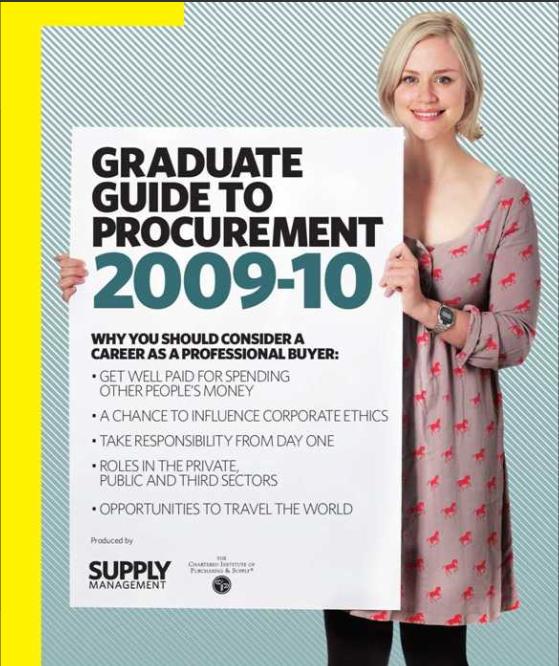
On the same CIPS site I discover a fabulous Graduate Guide to Procurement, aimed at introducing what procurement is to graduates.  It provides a wealth of information including industry 101, salaries, environment, industry outlook, job hunting, CV writing, personality tests, and a number of corporate case studies including British Airways, Rolls-Royce, Starbucks and Apple.  Highly recommended even for those who are just interested in knowing what we do for a living!

Read Full Post »

I applaud what the territory’s Ombudsman Alan Lai Lin said during a press conference over the Water Supplies Department’s mixed-up meter readings screw-ups over the last 20 years.  Apparently over 100 cases of water-meter mix-ups are reported each year.  A complainant received water bills up to HK$900 even though her flat was vacant for 6 months.   The Ombudsman pointed out that although the installation of water meters has been contracted out in recent years, greater supervision is needed by the Department.  “Even though the work is contracted out, the responsibility should not be contracted out.”, said Mr. Lai.

This couldn’t be more spot on.  Whenever I lead contract negotiations on outsourcing deals, mediate issues and performance complaints with incumbent outsourced providers, or conduct qualification analysis over whether or not to outsource with senior business partners, I always see people with the wrong understanding over the objectives of outsourcing, or contracting out in the above scenario.  Aside from obvious savings on costs and headcount, many corporations look at moving part of their processes offshore so as to focus on core elements of their businesses.  This has been gaining traction over the last 10 to 15 years.  In fact, no one would be surprised to see that a lot of the customer facing functions are being contracted out.  Call handling, customer services, direct selling, payroll, HR, and installation like what we see above for water-meters.  Oh yes, procurement can be outsourced as well.

Many clients think that the worst is over once the decision is made and endorsed by management.  They believe that they can then sit comfortably and bark orders at the outsourced providers and transferring all business targets onwards.  These are clearly the most irresponsible clients.  Experienced leaders understand how much more difficult it is to manage outsourced providers, much more so than running their own team of staff in-house.   Businesses need to undergo what we call risk analysis.  They need to brainstorm and  list out everything that could go wrong, and then place relative likelihood and precautionary as well as handling guidelines for each scenario.    They need to assign specific resource (in-house) who is tasked with managing the outsourced provider on a daily basis.  Sometimes this resource needs to work on-site with the provider.  Accountability has to be set right from the start with clear distinctions.   I have seen too many clients who think that the outsourced providers are the only party shouldering responsibilities.  In fact they themselves are equally liable to provide the necessary direction, management and rectification whenever they see problems ahead.  Laying the blame on the outsourced provider only proves how incompetent the client really is.  To me, they share the biggest part of the blame.

Most outsourced relationships fail because of issues like this.  There is nothing wrong about the concept.  Technical competencies maybe, but it could easily be rectified by trainings and investment.  I see time and time again that my clients fail to grasp the right techniques, processes and mentality to manage the providers.  Whenever catastrophes appear like the water bill foul-ups cases above, they pass on the blame and ask for more money from the top!


Read Full Post »

« Newer Posts - Older Posts »