Feeds:
Posts
Comments

What makes someone the happiest person in America? 

For three years the Gallup-Healthways Wellbeing Index asked a series of questions to learn the answer.   Apparently you will be if you are…

  • older
  • married
  • Asian American Jew

Based on job satisfaction, health and comfort, as well as the Gallup results, The New York Times also has the following instruction manual to be happy:

  • Be a man.  Men report being happier than women.
  • Move to Hawaii.  No surprise it’s the happiest place in the country.
  • Find God.  Faith gives people purpose.
  • Jews and Asian Americans age over 65. Hmm…

Looking at it from another angle, can a positive outlook keep your heart healthy?

Yes according to Dr. Redford Williams of Duke University Medical Center. “Positive people have less distress in their lives.  Their optimistic attitude cause them not to be so stressed by things that are going wrong, and that can lead to less stress hormones, less adrenaline, less cortisol, and these could all contribute to lowering their cholesterol level, lowering their blood pressure, and even contribute to making their platelets less sticky in stressful situations unlikely to clog their coronary artery.

Although I do not fit into any of the happy criteria of the Gallup poll, I truly believe in the benefits of maintaining a positive outlook.  Being happy can change things.  In case you still find it hard to believe, what Mr. Alvin Wong’s life philosophy is so true:  “If you can’t laugh at yourself, then life is going to be very hard on you”.

Who is Alvin Wong?  He is a 5-foot-10, 69-year-old, Chinese-American, Kosher-observing Jew, who’s married with children and lives in Honolulu.  

What does it tell you when you find a dog, men’s best friend, more reliable and loyal than your partner? 

I know it’s a sick thought, but that is what I felt when I bumped into the world’s friendlist golden retriever tonight.  The love it generates is the most selfless and unconditional, ever.

Whenever I feel disllusioned towards relationships, I can’t help to turn towards dogs.  Is it pathetic?

I was totally stressed out the other night – but in a good way.  I was relaxing at home after midnight when a good friend of mine informed me of some unbelievably good deals on Cathay Pacific Airways that are only valid for a week.  Seeing that this is a fantastic opportunity to see the world, I jumped on the chance and booked a trip to Paris this May. 

The story doesn’t end here.  There are still so many other attractive destinations that I would like to go or revisit, namely Seoul, Tokyo, Osaka, Nagoya, Moscow, Phuket, Bangkok, Kuala Lumpur, Johannesburg, Shanghai, London and New York.  I had been flipping through my calendar, browsing hotel deals, texting my friends, checking seat availability, for a good 3 hours.  I haven’t yet made any confirmed decisions yet, and that planning will continue tomorrow and the few days ahead, provided, of course, that there are still seats available for the dates I am picking.

So this afternoon I was visiting a friend on Kowloon side.  Walking on the busy Nathan Road I could actually hear two separate conversations of people passing by chatting about the exact same online promotion.  Talk about Hong Kong people’s obsessive compulsion to get out of the territory, with every chance we get.  Why is that the case?

  • the fact that we work 14 hour days and still finding it hard to sleep at nights due to immense stress from work
  • we are living in shoebox-sized apartments that we can hardly see the sky
  • we have forgotten about how clean air smells like
  • we find ourselves pressed like sardines in shopping mall elevators even on supposedly relaxing Sundays
  • we cannot get our foot into any electronics stores because every one of the 38 available sales reps were mobbed by our mainland Chinese neighbors
  • tons of rude, impolite, inconsiderate and selfish pedestrians on the streets and on practically all forms of transportation, and most of them are locals
  • news programs are flooded by retarded policies and tactics of the government, and increasingly violent protests spearheaded by our post-80s and 90s
  • another excuse to take 15,000 digital pictures of yourself with exactly the same pose and gesture, in front of landmarks of the world but with hardly any real appreciation of its history or importance
  • one more excuse to take 3,000 more pictures of all the foreign food you are going to eat beginning with the in-flight meals
  • way cooler to check-in at impressive foreign landmarks on FaceBook rather than Central MTR station in Hong Kong
  • experience how checking work e-mails, twittering, and FaceBooking abroad is like
  • witness how devalued the Hong Kong dollar is
  • feel the victory and accomplishment of successfully grabbing the few Hong Kong Chinese newspapers on return flights from abroad
  • another chance to wear NorthFace down jackets together with oddly colored crocs and huge alien-like sunglasses
  • read as many Hong Kong tabloid magazines as possible while laying by the hotel pools
  • a chance to continue being selfish and rude to unsuspecting service people overseas

Alright this may be way too much ranting in one post, but what’s the point of repeating the same old routine or even bad habits when you have a week of vacation time to unwind?  Let’s relax, let our guards down, take a few steps backwards, and be positive and appreciative in our travel adventures.  Take a deep breath, soak in the nature and culture, and teach your children a lesson or two about civility and consideration.  Amen.


With the $6,000 Hong Kong government is giving to its people in the latest revision of the financial budget, aside from the inevitably disgruntled debates over eligibility and disbursement, the talk of the town these few days is focused on how we will dispose of this US$770 equivalent new-found cash.

Kid not, every other commercial establishment in town is hungrily eyeing this disposable income in the otherwise slower commercial season of March and April.  I am prepared, and it won’t make any difference even if I’m not, to be bombarded by hundreds of marketing programs and sales calls in the mailboxes, on the streets, in the malls, and on the internet.

I am interested to find out how Hong Kong people are planning to utilize this $6,000, in a city where consumption is the population’s number one pastime.  I posted a poll on my Facebook page, and I surveyed a few discussion forums in town on the internet to give you a summary of what our neighbors have come up with.  Of course, for those who are very much in need of this sum to manage their daily food and shelter expenses, they wouldn’t have the time and energy to take part in these surveys, and so their plans of consumption are always implied even if not stated below.

  • the brand new iPad 2 or the upcoming iPhone 5 (what are the chances of such convenient coincidence, with Apple launching iPad 2 the day after our handout announcement?  I have to take my hat off to Steve Jobs, once again, even if it was none of his intention whatsoever)
  • save it (no it’s not lame, since we practically spend so much on a daily basis without any need of excuses, anyway)
  • a vacation to Thailand, or Europe with savings (Hong Kong’s favorite pastime: getting the hell out of the city even for just a few days)
  • pay back credit card debts
  • take a break off my part-time job
  • grab my sister’s share of her $6,000 as well (siblings’ greed should never be underestimated)
  • pick up an English language course to stay competitive (admirable, if only it’s that easy)
  • put it all in the stock market
  • pay for a call girl
  • collect everyone’s share and buy back the Western Cross Harbour Tunnel (now that’s what I call innovative thinking!)
  • pay for condolence flowers for the government house
  • buy $6,000 worth of bananas and throw them at the two Mr. Tsangs and call it the “Long Hair Effect” (Donald Tsang as our Chief Executive and John Tsang our Financial Secretary)
  • a trip to Macau’s casinos
  • wait in line for Justin Bieber’s concert in May

Since the value of the dollar is different for everyone, I do not dare to draw any conclusions.  One thing I know, is that when I turned on the news yesterday and watched the unmistakably joyous face on the old lady who collects cardboard boxes for a living at $8 a day,  a portion of my share should go to the charity to help those who need much, much more than $6,000.

I couldn’t put the book down and finished reading it within a day.  It’s the New York Times bestseller Buyology: How Everything We Believe About Why We Buy Is Wrong, by Martin Lindstrom.   Lindstrom is one of the world’s most respected marketing gurus, and he has been traveling around the world advising the biggest Fortune 500 companies, at least 300 days of a year.  Most of us believe that we are smart shoppers, and that we are careful with how we make our buying choices through conscious thinking.  In fact, we are far from there.  And as Lindstrom points out, we are actually getting worse and worse.

The better we think we are, the more we let our guards down, and the more vulnerable we are for everything happening around us.  One example, a supermarket with a whole stack of canned soups priced at $1.95 receives no customers.  The next day, the store puts up a giant sign saying “Maximum 6 cans per customer”, and the soups are flying off the shelf at the same $1.95 price tag.  Mind games working, huh?

On the book’s back cover, Lindstrom lists out a few intriguing questions:

  • Why did so many people who took the “Pepsi challenge” say they preferred Pepsi, only to carry on buying Coca-Cola?
  • Why do the majority of anti-smoking campaigns inadvertently encourage people to smoke?
  • Why does the scent of melons help sell electronic products?

Lindstrom addresses all these questions with his main theme of neuromarketing.  We used to rely on old school questionnaires and focus groups to study what customers want.  The fact that more and more of these traditional studies failed miserably has led to the widespread effectiveness and popularity of neuromarketing.  It is very well a science for subjects’ brains to be scanned when shown various advertisements and marketing programs.  The results are startling, and in many cases, contradicts completely with what we would admit, on paper.

I find the topic of product placement and the American Idol example fascinating.  With Idol’s 3 main sponsors, Coca-Cola, AT&T and Ford, who do you think gets the most of their advertising money’s worth?  Who fails miserably?  Why do some product placements fail?  Do you remember Elliott places pieces of Reese’ Pieces candy to lure E.T. out of his hiding 19 years ago?  Tom Cruise with his Ray-Ban sunglasses in 1983’s Risky Business, Top Gun and the later Will Smith in Men in Black II?

In the next chapter, Lindstrom describes how mirror neurons are responsible for why we often unwittingly imitate other people’s behavior.  Apple and its iPod sensation.  Abercrombie & Fitch with their all gorgeous American popular teens image that is ever so irresistible for 14 year-olds.

Do subliminal messages exist?  Yes, but its power has little to do with the product itself.  Instead, it lies in our own brains.  Tobacco companies spend huge percentage of their marketing budget into subliminal brand exposure.  “…Philip Morris, for example, offers bar owners financial incentives to fill their venues with color schemes, specifically designed furniture, ashtrays, suggestive tiles designed in captivating shapes similar to parts of the Marlboro logo, and other subtle symbols that, when combined, convey the very essence of Marlboro – without even the mention of the brand name or the sight of an actual logo.”  It’s an irony that because of government bans, tobacco companies have been forced to develop a whole new set of marketing skills, a set that is now vastly copied by many other industries.  Don’t let yourself fall prey to them.

Other topics of ritual, superstition, faith, religion, our somatic markers, senses, and sex are expressly covered.  Does sex really sell, or are consumers too distracted from the steamy images that they have forgotten entirely about the product?  Is it the sex that is selling or is it the controversy?  Well the latter is actually the more potent factor, though mirror neurons explain why sex and beauty continues to be popular in advertising everywhere around the world.

I highly recommend Lindstrom’s book and it’s one of the best investments I had made, considering the subliminal messages I was put through from his various appearances on CNBC prior to my purchase.   We will continue to shop for sure, but if we can all at least remember bits and pieces of this mind-provoking book and pause for a while before we take out our credit cards, we can at least delay the unavoidably path of becoming worse and worse shoppers, as Lindstrom predicted.

I don’t believe in that “Boys Don’t Cry” crap.   Well, as long as you are not like John Boehner, Speaker of the House of Representatives who cries over not only on his rise from humble beginnings as a janitor, to talking about his hopes for children, winning the election, and even debating over bills with the opposite party.   That’s probably a bit much, even for me.

I believe in internal strength rather than the ability to hold back pain and tears.  It takes more of a man to own up responsibilities, fights for what he believes in, carries through to the end and even admitting defeat.  If you can’t do any of this, you won’t earn my respect even if you are a macho cowboy on the outside. 

I think I inherited my sensitive side from my mother.  Back when I was small I could see my mother tearing up softly over some stupid local soap operas on TV.  I would chuckle over it because I always thought the plots were lame and intentionally sentimental even at my age.  Then one time my parents took me and my elder sister to go to see the 1982 hit movie E.T.: The Extra-Terrestrial.  I was excited to see a sci-fi movie with tons of cool graphics and special effects, and all the marketing programs in town were hard to miss.  I do not recall much of the plot now (other than being reminded on every E! feature of Drew Barrymore), except that I cried my eyes out by the end of the movie.  My parents had to console me walking out of the movie theatre.

Then the next crying moment was a much more serious matter, and it was the June 4th Beijing massacre in 1989.  I was watching the Hong Kong TV news program with tears when millions of otherwise politically immune HK citizens went to the streets to protest against the Chinese government, shortly after seeing what happened in Beijing.  I cried over the unity of the people from all levels.  I cried over how helpless we were at the moment.

Fast forwarding 11 years later, Korean soap operas were starting to create a sensation in Hong Kong, which had been largely dominated by the Japanese for those who were not content with local TV programing.  I never found myself having the patience to sit through 18 to 24 episodes of a soap opera series, so when I learned that there was a 2-hour director’s cut version of the year’s (2000) hottest soap opera Endless Love, I grabbed a copy to see what the big fuss was about.  I didn’t see it coming.   Yes the plot was super lame and cheesy, and the characters were unreal.  Though there was something about the characters crying on set for over 90% of the show, coupled with emotional soundtrack and poetic scripts, that caused me a panic attack.   I told my colleagues about it the next day at work, and everyone were eager to get the DVD from me.  For the next few weeks, all I saw were colleagues with red swollen eyes showing up at work in the morning. 

The sad thing is that Korean soap operas somehow failed to innovate over the years.  So after 4 dozens of story lines about babies being switched at birth, handicapped girlfriends with blood cancer, kids being abused and harassed by school teachers, and grandparents donating their organs for their kids, our senses have become numb once again.

Ang Lee’s Brokeback Mountain was another all-time hit in Hong Kong in 2005, though for some reason I couldn’t see it at the movie theatre when it opened.  The extremely moving ending brought me to tears for a good half hour.  Thank goodness I was at home with an abundance supply of tissue paper.

The critically acclaimed 2010 local production Echoes of The Rainbow, directed by Alex Law, was a movie that resonates with many of us in terms of how we grew up and how we were raised.  I cried because it brought back memories of my time with my parents and sister when I grew up.   The movie was also shot in Sheung Wan which was within a block away from my childhood home.   If I bring back a DVD to my parents’ place, I’m sure there wouldn’t be a dry eye in the family.

Crying because of immense emotions, reflections or gratitude is a natural outlet, as long as it’s done in a controlled manner.   It’s only those crying out of fear or with an attempt to deflect blame that should be despised.  Mr. John  Boehner?  I think he needs to pick his moments more carefully. 

Watching the documentary Food Inc. is still disturbing considering it is already 3 years old.  The reality is terribly frightening.  The below summary is extracted from its website.

“In Food, Inc., filmmaker Robert Kenner lifts the veil on our nation’s food industry, exposing the highly mechanized underbelly that has been hidden from the American consumer with the consent of our government’s regulatory agencies, USDA and FDA. Our nation’s food supply is now controlled by a handful of corporations that often put profit ahead of consumer health, the livelihood of the American farmer, the safety of workers and our own environment. We have bigger-breasted chickens, the perfect pork chop, herbicide-resistant soybean seeds, even tomatoes that won’t go bad, but we also have new strains of E. coli—the harmful bacteria that causes illness for an estimated 73,000 Americans annually. We are riddled with widespread obesity, particularly among children, and an epidemic level of diabetes among adults.”

What I find most alarming is genetically engineered food products, all the way from the staple ingredient of corn to cows (who feed on corn nowadays) to all meats, soda and snacks.  As the end of the food chain, we human beings are unaware of how much genetically engineered products we have taken in on a daily basis.  I hardly think it is doing anything good to our bodies.

So I conduct a quick round of web research and I want to share the below from The Center For Food Safety.

“…By being able to take the genetic material from one organism and insert it into the permanent genetic code of another, biotechnologists have engineered numerous novel creations, such as potatoes with bacteria genes, “super” pigs with human growth genes, fish with cattle growth genes, tomatoes with flounder genes, and thousands of other plants, animals and insects. At an alarming rate, these creations are now being patented and released into the environment.

Currently, up to 40 percent of U.S. corn is genetically engineered as is 80 percent of soybeans. It has been estimated that upwards of 60 percent of processed foods on supermarket shelves–from soda to soup, crackers to condiments–contain genetically engineered ingredients.

A number of studies over the past decade have revealed that genetically engineered foods can pose serious risks to humans, domesticated animals, wildlife and the environment. Human health effects can include higher risks of toxicity, allergenicity, antibiotic resistance, immune-suppression and cancer. As for environmental impacts, the use of genetic engineering in agriculture will lead to uncontrolled biological pollution, threatening numerous microbial, plant and animal species with extinction, and the potential contamination of all non-genetically engineered life forms with novel and possibly hazardous genetic material.”

This is not an American problem.  This is evident in all parts of the world, and we can find traces of engineered corn as ingredients on mostly every food product label we see in supermarkets.   It’s difficult to fight all this as our food supply is highly monopolized by a handful of manufacturing giants in the global and regional markets.  Though as a rule of thumb, I am trying my hardest to get away from as much processed food as possible, and I am beginning to pay more attention to organic ingredients.  Fresh vegetables and fruits now become my main diet.  It’s not an easy journey and it takes work and money to lead a healthy and responsible lifestyle.   Yet even if we cannot avoid all hazardous ingredients at once, being aware of such risks and getting committed to be more selective in choosing what we put in our bodies, is never too late.

Be a smart shopper at the supermarkets, and go beyond bargain hunting.

 Check out the trailer of Food Inc. below. 

One of the keys to surviving before excelling in the corporate world is knowing how to read hidden agendas.  As an agent of change, I need to interact with a large number of internal colleagues before I can go about exercising what my clients want with the outside partners and suppliers.  What we call stakeholder management skills need to come into play.  However, never, ever assume people’s intentions with only the titles on their name cards.

Do you want to be judged by the book cover?  Of course not.  Do you like to be stereotyped by the function or line of work you take part in?  In order to ensure that one genuinely adds value to a decision, he or she has been prepared to announce something new, something bold, or something clever.  Whether you agree with that or not never is the issue.  It is the individual’s hidden agenda that you want to uncover through the conversations you carry out with each and every one of them.  Listening, and reading minds, therefore, is the real key to success.

A newly on-board executive who is badly in need to prove himself.  A neighboring department head who is plotting to eat up your team or even the department.  An overworked manager who cannot be bothered by another new initiative.  A VP who tries to make influencing decisions in using a partnering firm that he has close ties with. 

It doesn’t take a genius to come up with tons of examples like the above, but it does take one to identify and draw such agendas out of everyone before designing tactics accordingly.  It is not easy to be seen, since most of your colleagues have been in the corporate workplace for years.  They are masters of sugar-coating intentions.

So whenever we go about talking with business partners, always consider these questions:

  • Why is this happening?
  • Who are the players?
  • What are the benefits?
  • What are the players each benefiting from, and how?
  • What can I get out of it?
  • How do I go about getting what I want?
  • What are the risks?
  • Are my benefits worth the risks?
  • Is this really what it appears to be?

In my experience it is always this last question that is most valuable, and it isn’t too hard to figure out once you conduct your share of due diligence. 

Last word of advice:  If you want to stay in one piece, you better keep these hidden agendas in the wraps, as long as they are legal!

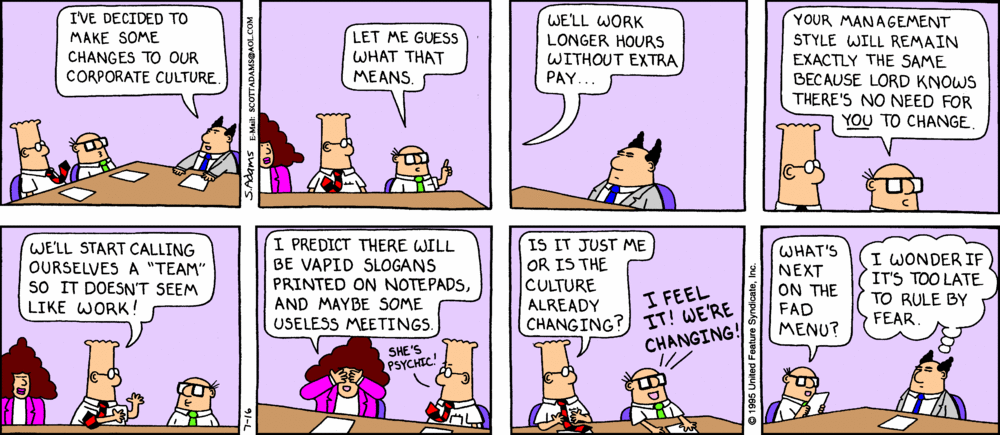
If you are working in a sizable multinational company, or have the experience working in one before, chances are that you have already undergone countless number of company prep talks on corporate culture, employee welfare, and training sessions on change management, handling virtual teamwork, and last but not least, team building activities and outings in all shapes and forms.

Pep Rallies

Such trainings and workshops are undoubtedly beneficial and inspirational for fresh graduates when they are new to the corporate world. However, are you still pumped and excited over these sharing and physical activities when you have sat through eight of them across various employers in your career? Furthermore, as your experience grows, you start to realize that nothing ever change after every motivational prep talk or initiative. People fall back to their original bad habits, and because of normal attrition everyone need to take the refresher talks to keep the new joiners up to speed. The worst of course, is if you find yourself forced to listen to pointless motivational speeches by what you label as hypocrites in the workplace. Alright, that’s politically incorrect, but face it, they are everywhere.

How to sit through these workshops gracefully and attentively while trying my hardest not to roll my eyes is probably my biggest accomplishment over the years.

Please Make Us Better

How about those anonymous employee surveys? I completely respect my human resources colleagues and their profession in designing and collating the results and meanings of these surveys. There is indeed a scientific backbone to all this. Though after all these surveys done every quarter or so, I find that I can’t feel anything anymore. I don’t want to be perceived as a whinny weasel who complains about anything. When I sign in to a job, I know what I am getting into and I seldom ask for more other than proportional recognition of my work performance. If I find my job or my company starting to fade away from my aspirations, in whatever means, I will make it clear to my superiors and consider my options if the gap can’t be bridged. I really don’t believe any anonymous venting can bring about substantial changes. No matter how comprehensive the privacy measures are carried out and announced, most survey participants are still apprehensive of the consequences. To flip the coin to the other side, you may also find it frustrating to see your work being criticized by anonymous comments of other colleagues that are borderline hateful. Why do we now have to resort to using surveys to replace face-to-face discussions in a civilized, dignified manner? We all better “man-up” for our opinions as well as mistakes. It’s gutless to hide behind a survey.

Want Fun?

The team building activities have changed color progressively. It started with gut-wrenching physical stunts like those you would see in “Fear Factor”. We are supposed to learn how to face our fear, unleash hidden talents, build inner-strength, and develop trust amongst team members during the exercises. Then slowly because of cost constraints and the increasing trend of virtual teams across countries and continents, such activities become less viable. In some cases a few teammates of the same office are given a certain budget to conduct their own team building activities. Nothing stereotypical here, but in Asia it often means eating it away. Okay, perhaps we will put on same colored shirts while we are at the dining table, take a few snapshots, and e-mail them across the global team, as proof that food brings everyone together.

Freebies Anyone?

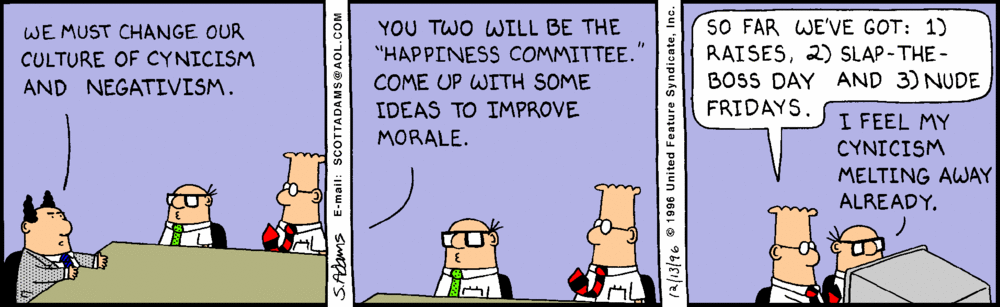
Since the dawn of very high-profile survey of “best companies to work for” in America, all major companies have put employee welfare as one of their high prioritized goals. Staffs are sometimes “encouraged” by their management to “vote” for their company in the annual survey. The better companies also make it an effort to establish company-wide social clubs, or nicely labeled employee engagement committees. I have the privilege to be invited to join or even chair a few of these committees across several of my employers in my career. It is no easy work. It takes us literally weeks to plan every activity, from the most popular annual balls, spring dinners to bowling or mahjong tournaments, open days for kids, charity visits and auctions, to distributing free t-shirts, windbreakers, umbrellas, breakfasts, lunches, so that there is always some kind of giveaway or activity for the staffs every month. To be honest, this sounds more like bribery to me. I enjoy my time working with my fellow committee members, but at the end of the day, all of us care most about getting satisfaction from the jobs we do and paid for. Getting a pat on the back for a job well done by my boss beats getting a free mug from the office safety club, hands down.

In this day and age you would think that business negotiations are conducted behind weeks of research, preparation and interests alignment.  Definitely true.  However the more I probe into business deals within even the biggest multinational corporations, the more I am surprised by how reckless some business decisions are made, or deals negotiated.  There are a few mistakes that shouldn’t even be accepted by 12-year olds.

  • Unclear and unaligned objectives.  When multiple beneficiaries are involved, negotiations have to be planned carefully with a clear chain of command.  I have seen negotiations that went on for months because certain stakeholders complained about being ignored or neglected.
  • Too short-sighted.  If the stakeholders are only keen on getting what they want now, unless we are talking about a product buying contract, there are bound to be issues with upgrading, maintenance, integration, servicing and performance management sooner or later.  Getting a cheap upfront offer but paying a huge price in the years ahead is no doubt a horrible deal.  Many of my clients used to bitch about the careless contracts that they inherited from their predecessors.
  • Caught by timeline.  This is a result of poor planning, or sometimes being totally conceited.  They believe the other parties will all cave in  regardless of how tight the deadline is, but little do they know everything comes with a price, and their companies sure aren’t prepared to pay more for their ego.
  • Not reading the fine prints.  I hate to believe that some people are just too stupid to not read the fine prints of the contract.  Then they must be so confident that their personal charisma is going to successfully seduce the other party into not executing the protection clauses. 
  • Fooled by the oldest tricks.  How many times have you heard the other parties saying “My god, you are such a tough negotiator!” or “I really like working with you – you are very reasonable.”?    The correct reflex action is run, splash cold water on your face, and review the terms once again.  Chances are, you are already in a shitty deal.

There you have it.  As I mentioned before, these silly mistakes (and many more) are still being repeated everyday no matter how advanced the company it is.  That’s why lawyers and procurement professionals still have jobs!