Feeds:
Posts
Comments

You see them staring at you on 5-storey high billboards.  You see their dashing smiles and authoritative poses on the city’s buses.  You see them on full-page newspaper ads where they are pictured with hundreds of students holding up their straight-A report cards.  Yes, they are the city’s star tutors, though they dress and behave like your TV and movie idols.  This, is a multi-billion dollar industry.

When I grew up there were a few tutor schools where we got ourselves enrolled to brush up for upcoming public exams.  Those were usually a few sessions only for each subject and the fees as I recall were nothing like what students today are paying.  The star tutors today have evolved to almost replace the normal daytime schools that students go to.  Their curriculum is tailor-made to survive public examinations, and hence the star tutors spend a considerable amount of time researching the latest examination trends and marking schemes.  Many of them possess enough star qualities to lure aspiring students.  They are well-groomed, articulate, and hardly much older than the kids themselves, making them extremely relatable and approachable – comparing to the day school teachers.  They hire assistants to help them prepare fancy notes and even run errands because their tutoring schedules are so hectic from running around several tutor centers in the city, usually on a daily basis.  They hire image consultants together with professional make-up artists, photographers and designers to make sure they are marketable in this lucrative business. 

I am not here to criticize whether these star tutors have twisted the idea of education, or whether it is unethical to make money out of young kids.  In fact, this is a common trend of fast food mentality of Hong Kong where everyone focus on only the results rather than the means.  The blame is with everyone.  I just see this as a classic example why training and teaching techniques need to be evolved according to times.  Everyone can find subject literature in books and over the internet, and they need no one to simply read to them and repeat case studies from textbooks. 

Students want to hear relatable material so that it helps with digesting and understanding the subject at hand.  In my field of strategic procurement training, we always make use of real life case studies to illustrate the theories we advocate.    Public sector case studies are often popular due to their wide coverage over TV and newspapers.   On the other hand, the trainees also don’t want to be preached  like young school kids.  They want to feel that they are also contributing to the class and hence we are often moderators instead of trainers.   I like the idea that the star tutors are organizing social activities to help bond with the students.  I know, you may argue that they are in fact sucking up to their paying customers, but if the students do not feel that the classes are enjoyable and effective, there are tons of other tutors out there.

I dream of the day that there will be similarly inspired tutor centers some day where we can offer consulting advice to working procurement professionals, whether it is in terms of career progression advice or anonymous yet real life work issues.  As the next generation of public-exam-tutors, will there also be star tutors for new career professionals?  Come to think of it, the “rules at work” are even less scripted and way more challenging.



For those of us bloggers who are also partly creating a brand of ourselves, it is this time of the year where we could conduct an interesting assessment of our online identity.   If you have tried Googling yourself like most people did, you are in search of your online identity.   There is nothing narcissistic about this, as it is now what everyone should do on a periodic basis to help protect your reputation and security.  In today’s overly public sharing of status updates, work information and personal data on Facebook, LinkedIn and Twitter etc., you will not be surprised to see unflattering comments, pictures or even videos of yourself in some simple searches over the internet.

According to ExecuNet Study 2007, “83% of recruiters use search engines to learn about candidates and 43% of recruiters admit to eliminating candidates based on information they found online.” 

Sounds pretty scary, but for sure real.  I have recently come across this OnlineID Calculator tool from Reach Communications Consulting.  By answering a few simple and quick questions through this free online tool, you will able to discover whether your online identity turns out to be digitally distinct, disastrous, dabbling, or dissed.

After getting my results, I am now ready to start making plans to continue building my brand in the new year!

I was looking for salary survey information for some research and just realize that the latest figures won’t be available until first quarter next year.  While surfing the two main industry certification bodies, namely The UK-based Chartered Institute of Purchasing & Supply (CIPS), and US-based Institute for Supply Management (ISM), I come across some interesting facts of the year 2009.

I know and I have been advocating all along that the procurement profession has undergone a major transformation over the last few years.  However I am still quite shocked to read from the CIPS – Croner Reward salary survey (conducted between October and December 2009) that procurement and supply professionals get paid more than peers in marketing, finance, IT and human resources in graduate careers.  Salaries obviously reflect experience, qualifications and ability, so graduates entering the profession need to prove themselves by showing a willingness to learn, independent thinking and determination. 

This is definitely great news for us to recruit graduates into the profession. 

In terms of experienced procurement professionals, the ISM 2010 Salary Survey (covering 2009 data) shows average salaries by titles range from US$50,506 for entry level positions to US$240,408 for chief procurement officers.  Total average annual compensation is US$98,200, and 34% of respondents reported earning a salary of US$100,000 or more.  The reported high salary was US$620,000 for the men and US$690,000 for the women.  Bonuses are already included in these figures.

I know, salaries shouldn’t be the only luring factor for graduates, but I truly believe that it has to be appropriately measured up against the value and results we deliver.  There is never any excuse for corruption or bribery activities, but face it, the likelihood of that happening is higher with underpaid procurement professionals.  As covered in my pervious posts, we should always uphold the highest level of integrity at all times.

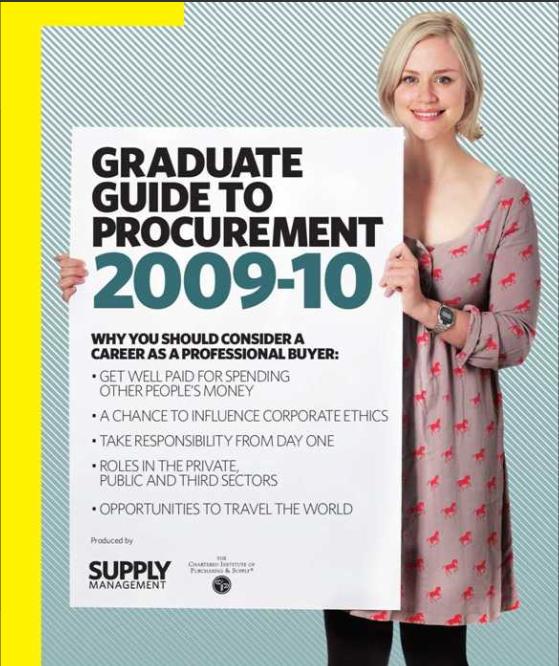
On the same CIPS site I discover a fabulous Graduate Guide to Procurement, aimed at introducing what procurement is to graduates.  It provides a wealth of information including industry 101, salaries, environment, industry outlook, job hunting, CV writing, personality tests, and a number of corporate case studies including British Airways, Rolls-Royce, Starbucks and Apple.  Highly recommended even for those who are just interested in knowing what we do for a living!

U Buy I Buy?

In The United States, there have been over 200 sites, led by Groupon, offering discounted deals to the public over volume buying.  The leader Groupon is rumored to have rejected numerous buyout offers from Yahoo and Google offering as much as 6 billion US dollars.  Now the trend has blown to Hong Kong and China and some of those newly established sites are also rumored to be approached by Groupon itself (the tackily named local site UBuyIBuy).  It all sounds like a promising new shopping phenomenon.

In the States the targeted demographics is supposedly young, educated female customers.  I would say it is probably similar in this neck of the woods.  The deals I hear are largely focused on health, fitness, beauty and dining areas.  There are a lot of vacationers here and so I also see a whole lot of travel and hotel deals as well.

One common sociological drawback of buying coupons is that customers are always tempted to buy without really needing the merchandise.  The deals and coupons are so tempting that it feels stupid not to take advantage of them.  These bargain hunters fall into traps where they are stuck with expiring coupons and unwanted products.  In a highly competitive city like Hong Kong, I see people lining up for sales all the time, and more often than not, the need of not missing out on any opportunities shared or overheard from their friends and colleagues far outweighs the need of buying exactly what’s on offer.

No wonder why merchants see these portals as fantastic business partners to boost sales.

On the corporate side however, suppliers hate to recognize how much collective buying power we have, even within the same group of companies.  They can make more money by selling separately to different business groups, departments or users.  They will also try to differentiate as much as possible the requirements so that every sale appears to be a standalone product or service.  When we come on board, the number one task we perform is to go through the company’s spend records and run a full list of spend by suppliers.  With that we can approach each of them and negotiate the lowest price that benefits all cost centers of the company.  That also explains why we are now sourcing regionally if not globally, so that we can cover the biggest volumes possible.

So when I know my customers do check with their friends and relatives for bulk bargains in their personal lives, I do not understand why they wouldn’t pick up the phone and call us for assistance in the work place.  Well, is it just because it is the company’s money and not theirs?

Saw this joke on the internet today.  I think it applies to every profession really!

Employer: “For this buyer’s job, we need someone who is responsible.”
Applicant: “I’m the one you want. In my last procurement job, every time there was a problem, they said I was responsible.”

Courtesy of Top 10 Supply Chain Jokes by Bill DuBois.

I applaud what the territory’s Ombudsman Alan Lai Lin said during a press conference over the Water Supplies Department’s mixed-up meter readings screw-ups over the last 20 years.  Apparently over 100 cases of water-meter mix-ups are reported each year.  A complainant received water bills up to HK$900 even though her flat was vacant for 6 months.   The Ombudsman pointed out that although the installation of water meters has been contracted out in recent years, greater supervision is needed by the Department.  “Even though the work is contracted out, the responsibility should not be contracted out.”, said Mr. Lai.

This couldn’t be more spot on.  Whenever I lead contract negotiations on outsourcing deals, mediate issues and performance complaints with incumbent outsourced providers, or conduct qualification analysis over whether or not to outsource with senior business partners, I always see people with the wrong understanding over the objectives of outsourcing, or contracting out in the above scenario.  Aside from obvious savings on costs and headcount, many corporations look at moving part of their processes offshore so as to focus on core elements of their businesses.  This has been gaining traction over the last 10 to 15 years.  In fact, no one would be surprised to see that a lot of the customer facing functions are being contracted out.  Call handling, customer services, direct selling, payroll, HR, and installation like what we see above for water-meters.  Oh yes, procurement can be outsourced as well.

Many clients think that the worst is over once the decision is made and endorsed by management.  They believe that they can then sit comfortably and bark orders at the outsourced providers and transferring all business targets onwards.  These are clearly the most irresponsible clients.  Experienced leaders understand how much more difficult it is to manage outsourced providers, much more so than running their own team of staff in-house.   Businesses need to undergo what we call risk analysis.  They need to brainstorm and  list out everything that could go wrong, and then place relative likelihood and precautionary as well as handling guidelines for each scenario.    They need to assign specific resource (in-house) who is tasked with managing the outsourced provider on a daily basis.  Sometimes this resource needs to work on-site with the provider.  Accountability has to be set right from the start with clear distinctions.   I have seen too many clients who think that the outsourced providers are the only party shouldering responsibilities.  In fact they themselves are equally liable to provide the necessary direction, management and rectification whenever they see problems ahead.  Laying the blame on the outsourced provider only proves how incompetent the client really is.  To me, they share the biggest part of the blame.

Most outsourced relationships fail because of issues like this.  There is nothing wrong about the concept.  Technical competencies maybe, but it could easily be rectified by trainings and investment.  I see time and time again that my clients fail to grasp the right techniques, processes and mentality to manage the providers.  Whenever catastrophes appear like the water bill foul-ups cases above, they pass on the blame and ask for more money from the top!


Buying apartments in Hong Kong is almost like shopping for groceries in the territory.  There is no advance appointment required, no checking on your credit, needs or even your affordability.  Just last Saturday I accompanied a friend to visit a property agency as walk-in customers, and within minutes, we were led to inspect a few open houses in the area.

Aside from the apartments being inspected, I paid some close attention to the realtor who served us.  I am quite impressed with her handling skills and I could relate a bit of what characteristics she possesses that are actually universal across industries, as salesperson.

1. Listening Skills

Hong Kong people are notoriously impatient and none of us would spend the time to answer a long list of questions of why we want what we want.  In order not to offend us, she decided to take the time during the inspections to figure out what we were focusing on.  We were looking for apartments that are elderly friendly, easily accessible and managed by a respected management firm.  She knew from our conversations that we weren’t particularly picky on views and club facilities.  This saved us a lot of time.

2. No Nonsense

I despise realtors who make false conclusions or assumptions about the neighborhood, resale value or interior design.  I know this is a very subjective matter particularly of the latter, but smart realtors would shut up and take the time to listen and define what kind of customers we are.  My theory is that unless you are an absolute genius about a topic or the neighborhood you are showing me, do not make generalizing statements or smart ass comments.  Your credibility is barely hanging by a piece of thread.  Our realtor this time around is a no nonsense kind of person.  She provided us with the facts and shut up.  When we raised standard questions about flat sizes, layout and facilities, she could download like a computer.  I like this type of realtors.  She is someone I could count on.

3. Reading People

A good salesperson should always master how to read people and characters.   Without asking specific questions, good salespeople can gauge customers by their education level, lifestyle and etiquette by many obvious traits.  Of course it can’t be all that accurate all the time, but I can always use this simple test to filter out those who won’t get my business.  They could tell whether you will be a potential long-term customer with return businesses.  Similarly, they know whether you are wasting their time.  While treatment appears to be identical on the surface, there are a few subtle handling differences.  In addition, some bad realtors can’t seem to take clues.  They keep babbling on and on regardless of my reactions, on top of using a few scare tactics.  To me, this type of salesmanship skills is so behind the times.

4. Tough

Ok, I know it’s a rather broad term, but we all need to keep ourselves physically fit for the jobs we do.   Last Saturday, we walked up and down the hill a few times and it is harder than it seems, particularly in Hong Kong’s humidity.

5. Follow-through

Finally, we all know how frustrating that is when someone doesn’t follow through promises or every bit of details that you depend upon them.  I have my share of complaints with bank relationship managers and headhunters, for example. 

Well well, I think I just figured out what I will write later!

Trying to take advantage of all the bargains and promotional offers in town is not an easy task.  It takes efforts to do the necessary homework to hopefully save a few bucks.  Lately I have been following closely to all the promotional cash back deals offered by virtually every other credit card issuing bank in the city, and I have to admit it is much harder than it looks.

A couple of years ago cash back promotions were less common.  The banks were more focused on acquisitions and to grow their card holder base as quickly as possible.  Most deals were focused on flat screen TV, Sony Playstation, or the latest mobile phone model as welcome gifts.  It seems that most cardholders nowadays own enough cards that the acquisition base is getting smaller.  The issuers need to now focus on initiating spend value on cards.  If we don’t swipe, they will not make merchant fees. 

So you now have all the major supermarkets, electronics stores, department stores and pharmacies linked up with different card issuers, offering cash back to induce spend on cards.  The catch is that they make it so complicated that it requires diligence, preparation and photographic memory to figure all this out.

1. Get the mailings

First you need to know what deals there are available for your card(s).  Some issuers send you direct mailing, but usually by the time you receive them, a few days have passed since the limited promotional period begins.  For those issuers who have a huge card base, they advertise on newspapers instead since direct mailings are relatively more expensive.  The digitally inclined may get to hear about the offers via e-mail. 

2. Remember the promotional period

Each offer is valid only through limited time.  Most concentrate around the holiday season when we do most of our purchases.  Some however limit the offers only from Fridays to Sundays. 

3. Know the qualification spending threshold

Each offer requires a minimum spending amount per transaction in order to qualify for the cash back.  It’s not entirely out of reach, but it means you should accumulate your purchases to a particular day during the weekend to meet the threshold.

4. Register

I don’t know why they cannot let everyone just enjoy the offer provided the above criteria is met.  No no, they need you to register for it by dialling their hotline, or online via their website.  If you don’t, you have no cash back.

5. Figure out how much cash back you are entitled

They make it so tempting on the flyers that your cash back entitlement can go as high as 50% of your purchase amount.   So when you register, you will get into a draw and realize how much percentage cash back you will get for the entire promotional period.  You register once and the same percentage stays on throughout the whole period.  Of course, I presume most cardholders get the lowest cash back entitlement, which is normally around 8%.

6. Understand the maximum cash back you can get

Even if you are satisfied with the 8% cash back (a penny is a penny), they also tell you what maximum cash back amount you can ever get within the period.  So no point of making any advance purchase if you have already met your rebate ceiling.

7. When will I see the cash?

Finally, you will be pleased to find out the rebate will be credited back into your account 6 months after the promotional period ends.  Remember to check your account, and hopefully you wouldn’t have forgotten about the whole thing or terminated your card for whatever reason.

Alright, multiply the above steps by 3 or 4 times for the total participating issuers and I guarantee you will be as lost as I am.  Now when I need to make a purchase, I have lost count as to what else I should buy, which card I should use, what day today is, and most likely, why I am seduced to spend more by the illusionary savings programs. 

Bravo on the marketers!

Elevator Speech

It was about 12 years ago when I attended an intensive 2-weeks graduate training at ExxonMobil Chemicals.  A group of us from around the region literally lived and studied together inside a hotel in Singapore.  The training was indeed a survival course of corporate culture, business line introduction, management techniques as well as a whole bunch of soft skills training.  One topic which I still vividly remember until this date, is conducting your elevator speech.

A typical elevator ride in your office building will not last more than 15 to 30 seconds.  If you happen to ride with your friends and colleagues, you normally exchange polite and casual remarks on the weather, workload, and where to go for lunch, dinner or drinks after work.  What happens when your General Manager or the company CEO steps in?  He or she is smiling at you while introducing themselves.  What else are you going to say aside from your name?  Are you just going to report your department or to whom you work for, hoping the executive will ask follow-up questions afterwards?

In the training we were taught to make good use of this brief elevator encounter, and we were asked to draft our 15 seconds elevator speech.  The objective is to make an impression without making a fool of ourselves.  In today’s corporate world, the trainer told us that every word and remark counts, and how confident and humble we are acting in front of everyone is a clear statement of how we want to be perceived and remembered. 

The key to drafting the contents of the speech is to think of the recipient.  What matters for the CEO?  The speech needs to be timely as well because the priorities of the CEO changes day by day.  Merely reporting what team or department you work for isn’t going to make much of an impression, but hearing that you have been leading the transformation team of the most recent global outsourcing project may raise an eyebrow.  Obviously, my thoughts are that it is not a job interview.  I honestly think it’s going be a bit awkward if I start to throw out numbers and accomplishments in an elevator.  It will appear a bit too scripted and inhuman. 

Again, I think personality stands out.  The elevator conversation should be able to help project a lasting impression of what you do and your personality.  If you think you can articulate an idea accurately through your words and gestures, it’s okay to exert an opinion on a task or project at hand even if it is not mainstream.  Of course, if you know you will get easily nervous in a timed scenario, forget about it or you will be remembered as a weirdo or even a whiner.  Leaders love to see how composed and relaxed their employees are, because that is critical management material.  After all, I think preparing an elevator speech isn’t really about the details of the contents.  If you have envisioned this day to come anytime in the future, you will be less nervous if the CEO comes out to shake your hands asking how things are.  You will be more relaxed and composed, and more often than not, your natural charisma is going to come out and dazzle everybody.

So what is your elevator speech going to be?

Setting cost savings targets for the team is a daunting task.  It is always a stretched goal but it has to be realistic and attainable at the same time.  Although it is often the collective hard work of a team or even the entire regional organization, the company will always convince you that your personal bonus is tied to how well you are achieving your cost savings targets. 

Very well.  Let’s be realistic for a moment.  Even though there are plenty of other measurement metrics like customer satisfaction, employee retention, training & development, or policy & regulatory compliance to report, the single biggest and most representative proof of why we are worth our paychecks is how much cost savings we are delivering to the company.  Finance is all about numbers, and we know the rules of the game from day one.

So how to come up with the target is an art by itself.  The more experienced your boss is, the easier and more straightforward that conversation will go.  I have had this past experience that my boss had absolutely no idea what addressable spend is, nor what pass-through costs mean.  There are also financial controllers who mix all things up in one pot, which I can understand since they only care about the bottom line and not the details.  I just cannot imagine some senior procurement executives simply put a percentage of total spend as savings target.  They usually have relatively less experience with services buying and the outsourcing arena.

The key to having a civilized discussion with your boss on target setting is to be entirely fact based.  Get the top 80% spend supplier list ready.  Go through each one and identify what is negotiable and what not.   And with that, check if there is any room for negotiations in the coming year.   Next go through businesses one by one.  Discuss what each of their priorities are next year.  What are their budget plans?  How can we get in and help?   Finally go through the areas which are not attacked so far and explore tactics to engage.  Who should do it and how?  What are the carrots we can provide?  Do we have enough resources for it and does it make sense?

With a bottoms-up approach the conversation usually can turn more comfortable.  Don’t skip the details including inflation and currency appreciation factors.  Your boss may not find it welcoming to hear so many bad news at once, but we have to acknowledge collectively that it’s no longer an easy job for anyone.  I don’t want to be penalized at the later end of the year that I have not provisioned for the risks of the target.  So I make sure I document all my points with as much facts and evidence as possible, in case there are colleagues who have forgetful minds.

My other advice is to set accountability right from the start.  Some accountability are totally within the team in terms of project execution and quality, but a few dependencies are entirely top-down.  Someone needs to get management buy-in, and to what level that buy-in will require depends on the company and/or business line culture.  We all need to get off our butts to knock on stakeholders’ doors to get new businesses.   I have done my very good share of going to people 3 or 4 levels above my rank for new businesses, so I get quite irritated if I see a leader not doing just that when all of us have exhausted our abilities to get roadblocks removed solely due to a lack of seniority on the corporate ladder.

I have seen tons of organizations with low morale mostly due to unattainable savings targets.  Leaders who alienate themselves from team members because they don’t want to know the details or have no intention to dive in to play his or her part only makes the matter much much worse.   That’s usually how companies lose their brightest people, and it’s one mistake no company can afford to bear.