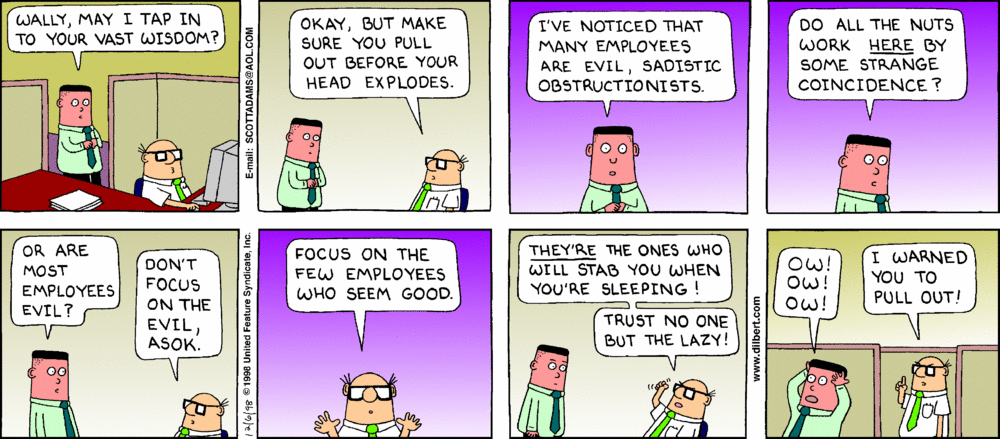
What a term: Evil, Sadistic Obstructionists.
Thanks you Dilbert, you have brightened my day, even if it is only in form of dark humor.
Posted in Grin, tagged employee, leadership on March 17, 2011| Leave a Comment »
What a term: Evil, Sadistic Obstructionists.
Thanks you Dilbert, you have brightened my day, even if it is only in form of dark humor.
Posted in Frown, Grin, tagged call etiquette on March 11, 2011| Leave a Comment »
The “Today Show” had a segment this morning on the captioned which resonates with many people, I’m sure. It seems that we are doing almost everything on our phones now but calls. Aside from making the occasional calls for hotlines, reservations or for work, I don’t think I am really using my phone to talk to any of my friends now. Instead, I test, I e-mail, I surf Facebook and I share news all on one simple handy device ironically named a mobile phone.
The segment profiles college students claiming that they are texting some 20,000 messages on a monthly basis, and some of them believe that they can express themselves better through texts than by speaking with their friends in person. I don’t. Though I find it extremely convenient to communicate via texts, it’s not really the reason why I seldom make calls. I guess I just don’t enjoy chatting on the phone endlessly. My phone conversations are always to the point and mission specific. If I really want to catch the latest of a friend, I always prefer asking them out for a face to face chat rather than doing it on the phone.
No doubt texts can never take the place of a live conversation. There is a limit to how much you can convey through the 26 alphabets and emoticons available on the phone. However, the slight delay in response time allows us to think for a bit before we reply, which is always nice. It also gives me back my much-needed sanity from hearing people screaming and babbling on their phones in noisy subways and buses. If you work in an office, you will definitely agree with me that texting is a lot more discreet for those small talks with your boyfriends or girlfriends than using the phones during office hours. For the latter, half of the office would already have their ears pressed toward your cubicle the whole time.
Texting is also great to catch up with someone without overly disturbing them, especially for the people who you are not that close to, yet. It helps to minimize awkwardness, rejection and anxiety. The flip side of the coin of course is that you can be zapping 3,000 texts with someone and still haven’t had a good idea of who they are, or what you think of them. Is it time-saving or is it indeed a waste of time? You be the judge.

Experts believe that phone calls will soon head toward extinction. With so little practice in their personal lives, now I understand why so many people are horrible in phone etiquette at work. I wrote about this in an earlier post, and would like to take this opportunity to also include some etiquette tips provided by the Today Show.
Posted in Grin on March 10, 2011| Leave a Comment »
What makes someone the happiest person in America?
For three years the Gallup-Healthways Wellbeing Index asked a series of questions to learn the answer. Apparently you will be if you are…
Based on job satisfaction, health and comfort, as well as the Gallup results, The New York Times also has the following instruction manual to be happy:

Looking at it from another angle, can a positive outlook keep your heart healthy?
Yes according to Dr. Redford Williams of Duke University Medical Center. “Positive people have less distress in their lives. Their optimistic attitude cause them not to be so stressed by things that are going wrong, and that can lead to less stress hormones, less adrenaline, less cortisol, and these could all contribute to lowering their cholesterol level, lowering their blood pressure, and even contribute to making their platelets less sticky in stressful situations unlikely to clog their coronary artery.“
Although I do not fit into any of the happy criteria of the Gallup poll, I truly believe in the benefits of maintaining a positive outlook. Being happy can change things. In case you still find it hard to believe, what Mr. Alvin Wong’s life philosophy is so true: “If you can’t laugh at yourself, then life is going to be very hard on you”.
Who is Alvin Wong? He is a 5-foot-10, 69-year-old, Chinese-American, Kosher-observing Jew, who’s married with children and lives in Honolulu.
Posted in Grin, Hope, tagged relationships on March 9, 2011| Leave a Comment »
What does it tell you when you find a dog, men’s best friend, more reliable and loyal than your partner?
I know it’s a sick thought, but that is what I felt when I bumped into the world’s friendlist golden retriever tonight. The love it generates is the most selfless and unconditional, ever.
Whenever I feel disllusioned towards relationships, I can’t help to turn towards dogs. Is it pathetic?

Posted in Frown, Grin, tagged Hong Kong, shopping on March 4, 2011| 2 Comments »
With the $6,000 Hong Kong government is giving to its people in the latest revision of the financial budget, aside from the inevitably disgruntled debates over eligibility and disbursement, the talk of the town these few days is focused on how we will dispose of this US$770 equivalent new-found cash.
Kid not, every other commercial establishment in town is hungrily eyeing this disposable income in the otherwise slower commercial season of March and April. I am prepared, and it won’t make any difference even if I’m not, to be bombarded by hundreds of marketing programs and sales calls in the mailboxes, on the streets, in the malls, and on the internet.
I am interested to find out how Hong Kong people are planning to utilize this $6,000, in a city where consumption is the population’s number one pastime. I posted a poll on my Facebook page, and I surveyed a few discussion forums in town on the internet to give you a summary of what our neighbors have come up with. Of course, for those who are very much in need of this sum to manage their daily food and shelter expenses, they wouldn’t have the time and energy to take part in these surveys, and so their plans of consumption are always implied even if not stated below.


Since the value of the dollar is different for everyone, I do not dare to draw any conclusions. One thing I know, is that when I turned on the news yesterday and watched the unmistakably joyous face on the old lady who collects cardboard boxes for a living at $8 a day, a portion of my share should go to the charity to help those who need much, much more than $6,000.

Posted in Grin, Hope, tagged book review, marketing, shopping on March 3, 2011| Leave a Comment »
I couldn’t put the book down and finished reading it within a day. It’s the New York Times bestseller Buyology: How Everything We Believe About Why We Buy Is Wrong, by Martin Lindstrom. Lindstrom is one of the world’s most respected marketing gurus, and he has been traveling around the world advising the biggest Fortune 500 companies, at least 300 days of a year. Most of us believe that we are smart shoppers, and that we are careful with how we make our buying choices through conscious thinking. In fact, we are far from there. And as Lindstrom points out, we are actually getting worse and worse.

The better we think we are, the more we let our guards down, and the more vulnerable we are for everything happening around us. One example, a supermarket with a whole stack of canned soups priced at $1.95 receives no customers. The next day, the store puts up a giant sign saying “Maximum 6 cans per customer”, and the soups are flying off the shelf at the same $1.95 price tag. Mind games working, huh?
On the book’s back cover, Lindstrom lists out a few intriguing questions:
Lindstrom addresses all these questions with his main theme of neuromarketing. We used to rely on old school questionnaires and focus groups to study what customers want. The fact that more and more of these traditional studies failed miserably has led to the widespread effectiveness and popularity of neuromarketing. It is very well a science for subjects’ brains to be scanned when shown various advertisements and marketing programs. The results are startling, and in many cases, contradicts completely with what we would admit, on paper.
I find the topic of product placement and the American Idol example fascinating. With Idol’s 3 main sponsors, Coca-Cola, AT&T and Ford, who do you think gets the most of their advertising money’s worth? Who fails miserably? Why do some product placements fail? Do you remember Elliott places pieces of Reese’ Pieces candy to lure E.T. out of his hiding 19 years ago? Tom Cruise with his Ray-Ban sunglasses in 1983’s Risky Business, Top Gun and the later Will Smith in Men in Black II?
In the next chapter, Lindstrom describes how mirror neurons are responsible for why we often unwittingly imitate other people’s behavior. Apple and its iPod sensation. Abercrombie & Fitch with their all gorgeous American popular teens image that is ever so irresistible for 14 year-olds.
Do subliminal messages exist? Yes, but its power has little to do with the product itself. Instead, it lies in our own brains. Tobacco companies spend huge percentage of their marketing budget into subliminal brand exposure. “…Philip Morris, for example, offers bar owners financial incentives to fill their venues with color schemes, specifically designed furniture, ashtrays, suggestive tiles designed in captivating shapes similar to parts of the Marlboro logo, and other subtle symbols that, when combined, convey the very essence of Marlboro – without even the mention of the brand name or the sight of an actual logo.” It’s an irony that because of government bans, tobacco companies have been forced to develop a whole new set of marketing skills, a set that is now vastly copied by many other industries. Don’t let yourself fall prey to them.
Other topics of ritual, superstition, faith, religion, our somatic markers, senses, and sex are expressly covered. Does sex really sell, or are consumers too distracted from the steamy images that they have forgotten entirely about the product? Is it the sex that is selling or is it the controversy? Well the latter is actually the more potent factor, though mirror neurons explain why sex and beauty continues to be popular in advertising everywhere around the world.
I highly recommend Lindstrom’s book and it’s one of the best investments I had made, considering the subliminal messages I was put through from his various appearances on CNBC prior to my purchase. We will continue to shop for sure, but if we can all at least remember bits and pieces of this mind-provoking book and pause for a while before we take out our credit cards, we can at least delay the unavoidably path of becoming worse and worse shoppers, as Lindstrom predicted.

Posted in Grin, tagged relationships on March 2, 2011| Leave a Comment »
I don’t believe in that “Boys Don’t Cry” crap. Well, as long as you are not like John Boehner, Speaker of the House of Representatives who cries over not only on his rise from humble beginnings as a janitor, to talking about his hopes for children, winning the election, and even debating over bills with the opposite party. That’s probably a bit much, even for me.

I believe in internal strength rather than the ability to hold back pain and tears. It takes more of a man to own up responsibilities, fights for what he believes in, carries through to the end and even admitting defeat. If you can’t do any of this, you won’t earn my respect even if you are a macho cowboy on the outside.
I think I inherited my sensitive side from my mother. Back when I was small I could see my mother tearing up softly over some stupid local soap operas on TV. I would chuckle over it because I always thought the plots were lame and intentionally sentimental even at my age. Then one time my parents took me and my elder sister to go to see the 1982 hit movie E.T.: The Extra-Terrestrial. I was excited to see a sci-fi movie with tons of cool graphics and special effects, and all the marketing programs in town were hard to miss. I do not recall much of the plot now (other than being reminded on every E! feature of Drew Barrymore), except that I cried my eyes out by the end of the movie. My parents had to console me walking out of the movie theatre.

Then the next crying moment was a much more serious matter, and it was the June 4th Beijing massacre in 1989. I was watching the Hong Kong TV news program with tears when millions of otherwise politically immune HK citizens went to the streets to protest against the Chinese government, shortly after seeing what happened in Beijing. I cried over the unity of the people from all levels. I cried over how helpless we were at the moment.

Fast forwarding 11 years later, Korean soap operas were starting to create a sensation in Hong Kong, which had been largely dominated by the Japanese for those who were not content with local TV programing. I never found myself having the patience to sit through 18 to 24 episodes of a soap opera series, so when I learned that there was a 2-hour director’s cut version of the year’s (2000) hottest soap opera Endless Love, I grabbed a copy to see what the big fuss was about. I didn’t see it coming. Yes the plot was super lame and cheesy, and the characters were unreal. Though there was something about the characters crying on set for over 90% of the show, coupled with emotional soundtrack and poetic scripts, that caused me a panic attack. I told my colleagues about it the next day at work, and everyone were eager to get the DVD from me. For the next few weeks, all I saw were colleagues with red swollen eyes showing up at work in the morning.

The sad thing is that Korean soap operas somehow failed to innovate over the years. So after 4 dozens of story lines about babies being switched at birth, handicapped girlfriends with blood cancer, kids being abused and harassed by school teachers, and grandparents donating their organs for their kids, our senses have become numb once again.
Ang Lee’s Brokeback Mountain was another all-time hit in Hong Kong in 2005, though for some reason I couldn’t see it at the movie theatre when it opened. The extremely moving ending brought me to tears for a good half hour. Thank goodness I was at home with an abundance supply of tissue paper.

The critically acclaimed 2010 local production Echoes of The Rainbow, directed by Alex Law, was a movie that resonates with many of us in terms of how we grew up and how we were raised. I cried because it brought back memories of my time with my parents and sister when I grew up. The movie was also shot in Sheung Wan which was within a block away from my childhood home. If I bring back a DVD to my parents’ place, I’m sure there wouldn’t be a dry eye in the family.

Crying because of immense emotions, reflections or gratitude is a natural outlet, as long as it’s done in a controlled manner. It’s only those crying out of fear or with an attempt to deflect blame that should be despised. Mr. John Boehner? I think he needs to pick his moments more carefully.
Posted in Grin, tagged communication skills, influencing skills, stakeholder, strategic procurement on February 28, 2011| Leave a Comment »

One of the keys to surviving before excelling in the corporate world is knowing how to read hidden agendas. As an agent of change, I need to interact with a large number of internal colleagues before I can go about exercising what my clients want with the outside partners and suppliers. What we call stakeholder management skills need to come into play. However, never, ever assume people’s intentions with only the titles on their name cards.
Do you want to be judged by the book cover? Of course not. Do you like to be stereotyped by the function or line of work you take part in? In order to ensure that one genuinely adds value to a decision, he or she has been prepared to announce something new, something bold, or something clever. Whether you agree with that or not never is the issue. It is the individual’s hidden agenda that you want to uncover through the conversations you carry out with each and every one of them. Listening, and reading minds, therefore, is the real key to success.
A newly on-board executive who is badly in need to prove himself. A neighboring department head who is plotting to eat up your team or even the department. An overworked manager who cannot be bothered by another new initiative. A VP who tries to make influencing decisions in using a partnering firm that he has close ties with.
It doesn’t take a genius to come up with tons of examples like the above, but it does take one to identify and draw such agendas out of everyone before designing tactics accordingly. It is not easy to be seen, since most of your colleagues have been in the corporate workplace for years. They are masters of sugar-coating intentions.
So whenever we go about talking with business partners, always consider these questions:
In my experience it is always this last question that is most valuable, and it isn’t too hard to figure out once you conduct your share of due diligence.
Last word of advice: If you want to stay in one piece, you better keep these hidden agendas in the wraps, as long as they are legal!
Posted in Grin, tagged employee, human resources, leadership, training on February 25, 2011| Leave a Comment »
If you are working in a sizable multinational company, or have the experience working in one before, chances are that you have already undergone countless number of company prep talks on corporate culture, employee welfare, and training sessions on change management, handling virtual teamwork, and last but not least, team building activities and outings in all shapes and forms.

Pep Rallies
Such trainings and workshops are undoubtedly beneficial and inspirational for fresh graduates when they are new to the corporate world. However, are you still pumped and excited over these sharing and physical activities when you have sat through eight of them across various employers in your career? Furthermore, as your experience grows, you start to realize that nothing ever change after every motivational prep talk or initiative. People fall back to their original bad habits, and because of normal attrition everyone need to take the refresher talks to keep the new joiners up to speed. The worst of course, is if you find yourself forced to listen to pointless motivational speeches by what you label as hypocrites in the workplace. Alright, that’s politically incorrect, but face it, they are everywhere.
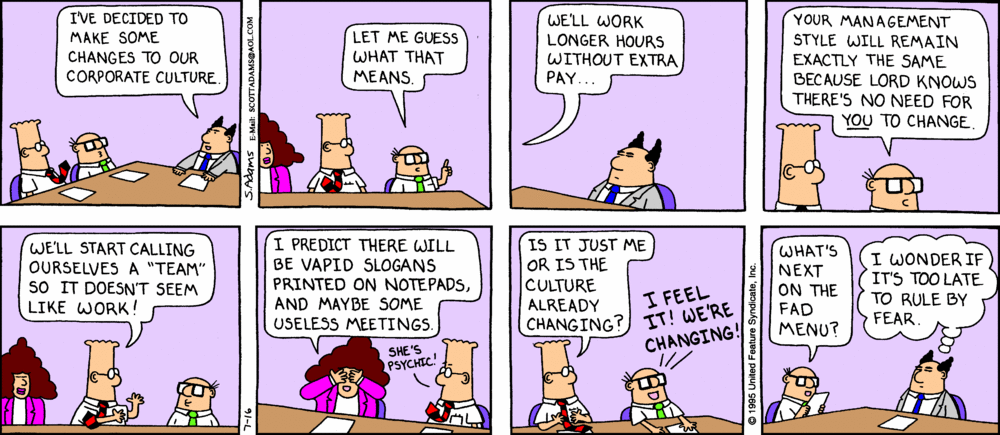
How to sit through these workshops gracefully and attentively while trying my hardest not to roll my eyes is probably my biggest accomplishment over the years.
Please Make Us Better
How about those anonymous employee surveys? I completely respect my human resources colleagues and their profession in designing and collating the results and meanings of these surveys. There is indeed a scientific backbone to all this. Though after all these surveys done every quarter or so, I find that I can’t feel anything anymore. I don’t want to be perceived as a whinny weasel who complains about anything. When I sign in to a job, I know what I am getting into and I seldom ask for more other than proportional recognition of my work performance. If I find my job or my company starting to fade away from my aspirations, in whatever means, I will make it clear to my superiors and consider my options if the gap can’t be bridged. I really don’t believe any anonymous venting can bring about substantial changes. No matter how comprehensive the privacy measures are carried out and announced, most survey participants are still apprehensive of the consequences. To flip the coin to the other side, you may also find it frustrating to see your work being criticized by anonymous comments of other colleagues that are borderline hateful. Why do we now have to resort to using surveys to replace face-to-face discussions in a civilized, dignified manner? We all better “man-up” for our opinions as well as mistakes. It’s gutless to hide behind a survey.

Want Fun?
The team building activities have changed color progressively. It started with gut-wrenching physical stunts like those you would see in “Fear Factor”. We are supposed to learn how to face our fear, unleash hidden talents, build inner-strength, and develop trust amongst team members during the exercises. Then slowly because of cost constraints and the increasing trend of virtual teams across countries and continents, such activities become less viable. In some cases a few teammates of the same office are given a certain budget to conduct their own team building activities. Nothing stereotypical here, but in Asia it often means eating it away. Okay, perhaps we will put on same colored shirts while we are at the dining table, take a few snapshots, and e-mail them across the global team, as proof that food brings everyone together.

Freebies Anyone?
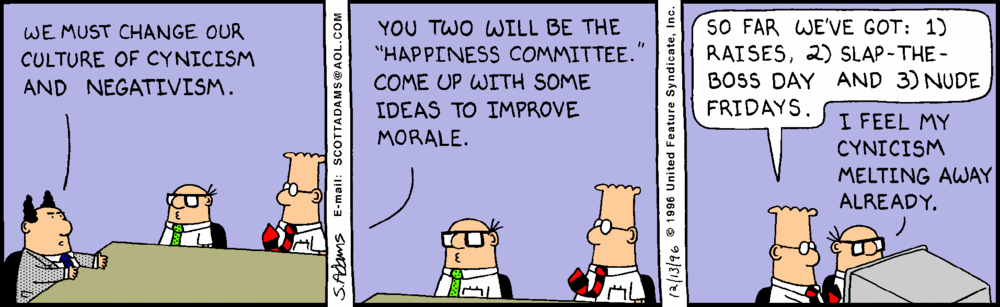
Since the dawn of very high-profile survey of “best companies to work for” in America, all major companies have put employee welfare as one of their high prioritized goals. Staffs are sometimes “encouraged” by their management to “vote” for their company in the annual survey. The better companies also make it an effort to establish company-wide social clubs, or nicely labeled employee engagement committees. I have the privilege to be invited to join or even chair a few of these committees across several of my employers in my career. It is no easy work. It takes us literally weeks to plan every activity, from the most popular annual balls, spring dinners to bowling or mahjong tournaments, open days for kids, charity visits and auctions, to distributing free t-shirts, windbreakers, umbrellas, breakfasts, lunches, so that there is always some kind of giveaway or activity for the staffs every month. To be honest, this sounds more like bribery to me. I enjoy my time working with my fellow committee members, but at the end of the day, all of us care most about getting satisfaction from the jobs we do and paid for. Getting a pat on the back for a job well done by my boss beats getting a free mug from the office safety club, hands down.
Posted in Grin, Hope, tagged employee, leadership, recruitment on February 22, 2011| Leave a Comment »

I read from the vault guide that there are now actual internship applications with candidates listing “excellent Facebooker” and “highly skilled Tweeter” on their resumes. Apparently the ability to connect with thousands of Facebook friends is an accomplishment, and I take my hat off to them.
But seriously? What are they thinking?
Hold that thought. Continuing on from my thoughts yesterday, when today’s post-80s, or Generation Y, are ready for more senior roles in the corporate world, the scene may be totally different. While social networking skills may not be something worth bragging about now, a few years later the absence of such will be considered fatal disqualifiers for Generation Y hiring managers.
Social media usage will only grow further with younger generations as they mature, contrary to some beliefs that they will grow out of such sites. With the increasing leverage of social media sites for corporate advertising, loyalty programs, public awareness and even hiring, the next time we try to shrug our shoulders reading those social networking attributes, let’s get real for a second and think again.


 Confessions of a Corporate Shopaholic